
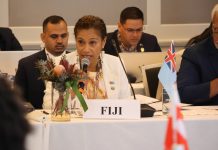

Pacific countries at the forefront of the climate crisis, described as a “ticking time bomb”, have vowed that their One Pacific Voice on keeping 1.5 alive, is heard loud and clear at the Thirtieth Conference of the Parties to the UN Framework Convention on Climate Change (UNFCCC COP30) in Belem, Brazil.
On the Road to Belem, the Pacific Small Island Developing States (PSIDS) pre-COP30 meeting, held at SPREP headquarters in Vailima, is the latest of a series of strategic meetings to prepare Pacific negotiators and officials for a “challenging COP” in Belem, from 10 to 21 November 2025.
“Our work over the next three days will be an excellent opportunity to land our approach to the COP30 negotiations and give ourselves every chance to ensure our voice will be heard and our priorities will be met in Belem,” said the Director of Tuvalu’s Climate Change Department, Jamie Ovia, speaking as the Chair of PSIDS.
Facilitated by the Secretariat of the Pacific Regional Environment Programme (SPREP) with support from Climate Analytics and OneCROP, the meeting is an opportunity to share knowledge, lessons and reflect on how issues have advanced since COP29.
“As PSIDS we worked tirelessly to try to advance our unique Pacific voice and priorities in Bonn. However, the session was marked by stalling and politicisation in almost every agenda item, leading to concerns about the need to reform the UNFCCC process or at least to rebuild trust within it,” Ovia said.
“Important areas of work – notably mitigation and finance – featured little progress. As a result, questions persist about the level of mitigation ambition and the financing necessary to achieve it. Working out how we can leverage what will likely be a woeful Nationally Determined Contribution (NDC) synthesis report outcome in Belem to drive stronger ambitious momentum will be an important consideration here.”
Facilitated by the Secretariat of the Pacific Regional Environment Programme (SPREP) with support from OneCROP and Climate Analytics, the meeting is an opportunity to share knowledge, lessons and reflect on how issues have advanced since COP29.
“As PSIDS we worked tirelessly to try to advance our unique Pacific voice and priorities in Bonn. However, the session was marked by stalling and politicisation in almost every agenda item, leading to concerns about the need to reform the UNFCCC process or at least to rebuild trust within it,” Ovia said.
“Important areas of work – notably mitigation and finance – featured little progress. As a result, questions persist about the level of mitigation ambition and the financing necessary to achieve it. Working out how we can leverage what will likely be a disappointing NDC synthesis report outcome in Belem to drive stronger momentum will be an important consideration here.”
The PSIDS pre-COP30 Chair also encouraged negotiators to push negotiating partners to deliver a clear pathway for implementing the New Collective Quantified Goal (NCQG) outcome and the 1.3 trillion road map. Also known as the Baku-to-Belem Climate Finance Roadmap, the road map is a plan to mobilise US$1.3 trillion annually in climate finance for developing countries by 2035.
“By no means will this be an easy task, as we will continue to encounter the same challenges we faced in the lead up to and during COP29 and will likely have to navigate our way through a whole new host of challenges,” Ovia added.
SPREP Director General, Sefanaia Nawadra said Pacific negotiators are aware of the challenges they face, especially in their efforts to strengthen global ambition as they prepare for Belem.
“We need to consider how to maximise the opportunities available to the region, in terms of pushing for greater global ambition, following the groundbreaking ICJ Advisory Opinion earlier this year,” he said.
“The ICJ opinion is something we can be proud of but now we need to work out how we use it within the negotiation space. We need to strategise and exercise wisdom in how we apply the ICJ opinion.”
The Director General also emphasised the critical nature of the work, and the importance of the One Pacific Voice, being heard in Belem.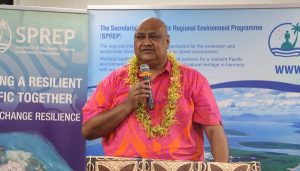
“I was at the Pacific Leaders Forum meeting recently, and I want to convey to you the importance they have placed on your work. You are entrusted with a lot and we must collectively do our best to ensure we honour the trust, and the responsibility we have been given,” said Nawadra.
For COP30, he urged the negotiators to focus on the Pacific’s core objectives, such as 1.5 to stay alive, raising adaptation as a core need to bring it up to par with mitigation, climate financing and ensuring obligations and promises already made are met and delivered.
“Being here in this gathering feels like being in a hive, you can hear the buzz in the room,” said Nawadra.
“I trust that the buzz will be channelled to address all the issues we need to consider, and provide guidance to our delegations and political champions with the collective wisdom we need to take this work forward, and that at the end of the week, we still feel that we are ready to make honey in Belem.”
The pre-COP30 meeting is attended by officials from the Cook Islands, Fiji, FSM, Kiribati, Niue, Palau, Papua New Guinea, Republic of Marshall Islands, Samoa, Solomon Islands, Tonga, Tuvalu and Vanuatu.
Pastor Junior Gaia, of the Seventh Day Adventist (SDA) Church Lalovaea, opened the meeting reminding that we are “stewards of God’s creation.”
“When a canoe sets out on a long voyage, every person has a role, one steers, another reads the stars, others bail with water and keep balance. We are bound together in one canoe of creation, that means we must sail together – with unity, cooperation, and shared responsibility,” said Pastor Gaia.
“The stronger must help the weaker, the resourced must help the vulnerable. Our collective survival depends not on competition but on partnership, on listening, learning and moving forward as one crew,” he said.