

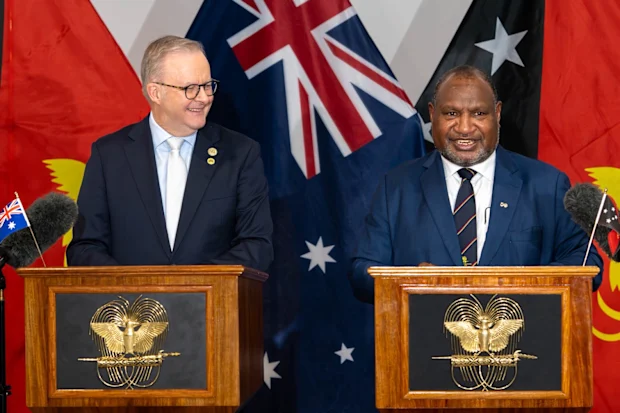
Australia’s Defence Minister Richard Marles has hosed down concerns that Papua New Guinea would sit out a potential conflict between Australia and China despite inking a landmark defence treaty.
The Pukpuk defence pact, which includes mutual defence provisions obliging both Australia and PNG to defend each other “in the event of an armed attack”, was signed less than three weeks after a failed attempt in Port Moresby.
However, just hours after inking the deal, the Pacific nation’s Prime Minister James Marape poured cold water on the pact, saying it was highly likely his country would sit out any conflict involving China.
PNG’s leader said the final call on whether to engage in such a conflict would rest with the country’s military commanders, suggesting the treaty was “not a construct to make war”.
“In a conflict, we don’t expect Australia to drop everything and run to us,” he said.
“What does PNG have to offer right now … At the moment our military capacity is not at a space where we are active participant.
“I don’t necessarily see China as an enemy.”
Marape’s comments follow a warning from Beijing that while it respected PNG’s right to engage in bilateral treaties, it should not jeopardise its relations with China.
“Such a treaty should not be exclusive in nature, nor should it restrict or prevent a sovereign country from co-operating with a third party for any reason,” an embassy spokesman said in a statement on Facebook.
The spokesman added that any treaties “should also refrain from targeting any third party or undermining its legitimate rights and interests”.
“We hope that the PNG side will continue to uphold independence and self-reliance, properly handle issues bearing on its sovereignty and long-term interests, and work with China to maintain the sound development of China-PNG relations and mutually beneficial co-operation.”
Marles played down concerns over Marape’s comments, suggesting he had very clearly named Australia as its “partner of choice”.
“Prime Minister Marape could not have been more clear about yesterday, and that our nearest neighbour is making that statement about Australia is profoundly important for our national security,” he said.
Marles also confirmed that any PNG military personnel serving in the Australian Defence Force would be subject to the instructions of the government of the day.
Marape flagged that up to 10,000 PNG citizens could eventually serve in the ADF as part of pathways written into the defence pact.
PNG Defence Minister Dr Billy Joseph said the treaty marks a new chapter in security cooperation between the two nations.
“This Treaty comes at the right time — it is about safeguarding the future of our two countries and ensuring the peace and security of our region,” Dr Joseph said.
“We are proud to make this historic step happen for the security and stability of both Papua New Guinea and Australia.”
The Pukpuk Treaty reinforces both nations’ shared commitment to protect sovereignty, uphold democracy, and maintain peace across the Pacific.
The treaty will now be presented to both nations’ respective parliaments for ratification.