



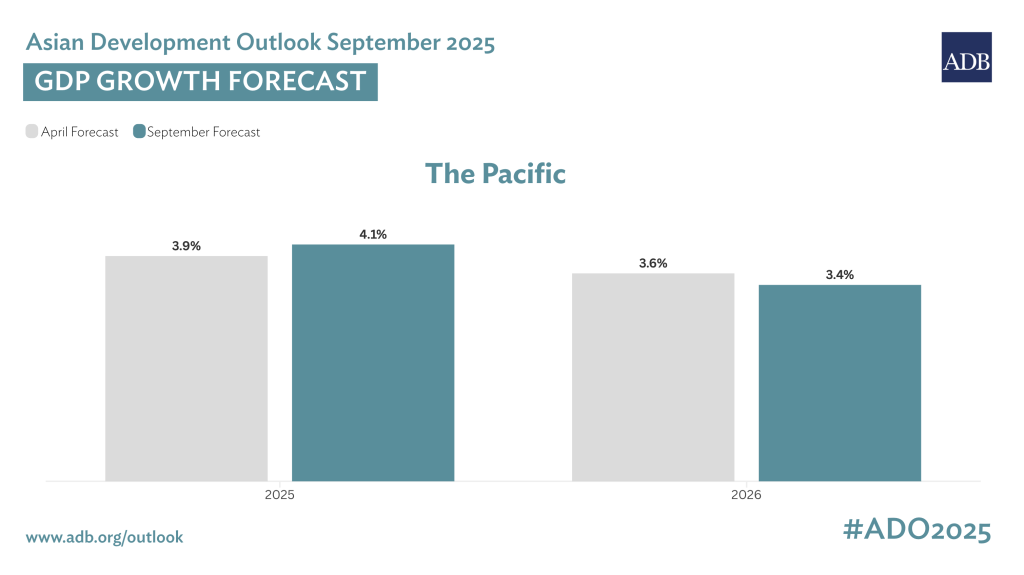
Economic growth in the Pacific is projected to accelerate to 4.1 percent in 2025 and moderate to 3.4 percent in 2026, according to the Asian Development Outlook (ADO) September 2025, the Asian Development Bank’s (ADB) flagship economic publication, released today.
The 2025 outlook, an upward revision from forecasts in April, is largely driven by resource-related activity in the subregion’s largest economy, Papua New Guinea (PNG).
“While it is good news that growth will accelerate in the Pacific subregion this year and inflation forecasts are adjusted down, geopolitical and trade tensions still pose risks to growth,” said ADB Director General for the Pacific Emma Veve.
“ADB remains committed to helping build resilience to potential shocks such as extreme climate events and disruptions to global supply chains.”
Resource output in PNG is at record levels this year and is largely driving the higher subregional growth forecast. PNG’s economy is forecast to grow by 4.6 percent in 2025 and then moderate to 3.6 percent in 2026 as resource output eases, along with the anticipated impact of global trade and policy uncertainty. Inflation projections remain unchanged. Investment decisions on various resource projects could substantially boost economic activity.
In Fiji, the subregion’s second-largest economy, the growth forecast for 2025 remains unchanged at 3.0 percent, while the indirect impact of U.S tariffs on Fiji’s major trading partners has led to a downward revision of the country’s 2026 growth forecast.
Inflation forecasts for 2025 and 2026 are revised down as fiscal measures help reduce consumer prices along with continued moderation in international commodity prices. Fiji remains exposed to large shocks due to limited fiscal buffers and climate risk, but ongoing reforms and new investments in water security and coastal protection should bolster long-term resilience.
Growth forecasts in Solomon Islands remain unchanged at 2.9 percent in 2025 and 3.2 percent in 2026. The inflation forecast is revised up for 2025 but will likely ease slightly in 2026, alongside international commodity prices trends. Earlier this month, the government announced a shift to an expansionary monetary policy over the coming six months. The shift is expected to support growth while containing inflation.
Economic growth in Vanuatu for the remainder of 2025 has been revised down to 1.5 percent due to delays in recovery and reconstruction from the 2024 earthquake. The growth forecast of 2.5 percent for 2026 remains unchanged.
In the Central Pacific, growth projections are adjusted slightly downward in Kiribati and Nauru—at 3.9 percent and 2.3 percent in 2025 and 3.3 percent and 2.5 percent in 2026, respectively—while the projections for Tuvalu remain unchanged at 2.7 percent for 2025 and 2.5 percent in 2026.
Stimulus from public infrastructure projects will continue to drive growth across all three economies. International commodity price volatility and supply chain disruptions are among the key risks to Central Pacific growth and inflation.
In the North Pacific, growth forecasts for 2025–2026 are raised in the Marshall Islands and adjusted downward for the Federated States of Micronesia (FSM) and Palau.
In the Marshall Islands, growth is projected to pick up to 3.0 percent in 2025 and 3.5 percent in 2026; in the FSM, it is forecast to be 0.8 percent in 2025 and 1.1 percent in 2026; and in Palau, growth is now expected to reach 8.2 percent in 2025 and 3.9 percent in 2026.
Inflation projections for these economies reflect international commodity price trends, but higher domestic demand can exert price pressures.
Fisheries and construction sectors have contributed to a pick-up in growth in the Marshall Islands, while in Palau, tourism is recovering slowly.
Utilisation of financial assistance under the renewed Compact of Free Association in FSM’s larger states has been slow due to capacity constraints.
Growth prospects vary across the South Pacific.
Tourism trends continue to dominate the growth outlook for Cook Islands, while lower agriculture and fisheries output dampen growth prospects in Samoa alongside moderating visitor arrivals.
Tourism and construction remain key growth drivers in Niue and Tonga.
The report estimates growth of 10.4 percent in 2025 in the Cook Islands, moderating to 2.5 percent in 2026; in Niue, 3.4 percent in 2025 and 3.0 percent in 2026; and in Samoa, 4.0 percent in 2025 and 2.7 percent in 2026.
Growth in Tonga is estimated at 2.5 percent in 2025, easing to 2.3 percent in 2026. Inflation continues to moderate in the South Pacific, but upward price pressures are likely.