The United States has rolled out a sweeping package of economic, security, and health commitments to Pacific Island nations, signalling what it calls a “reinvigorated” partnership with the region.
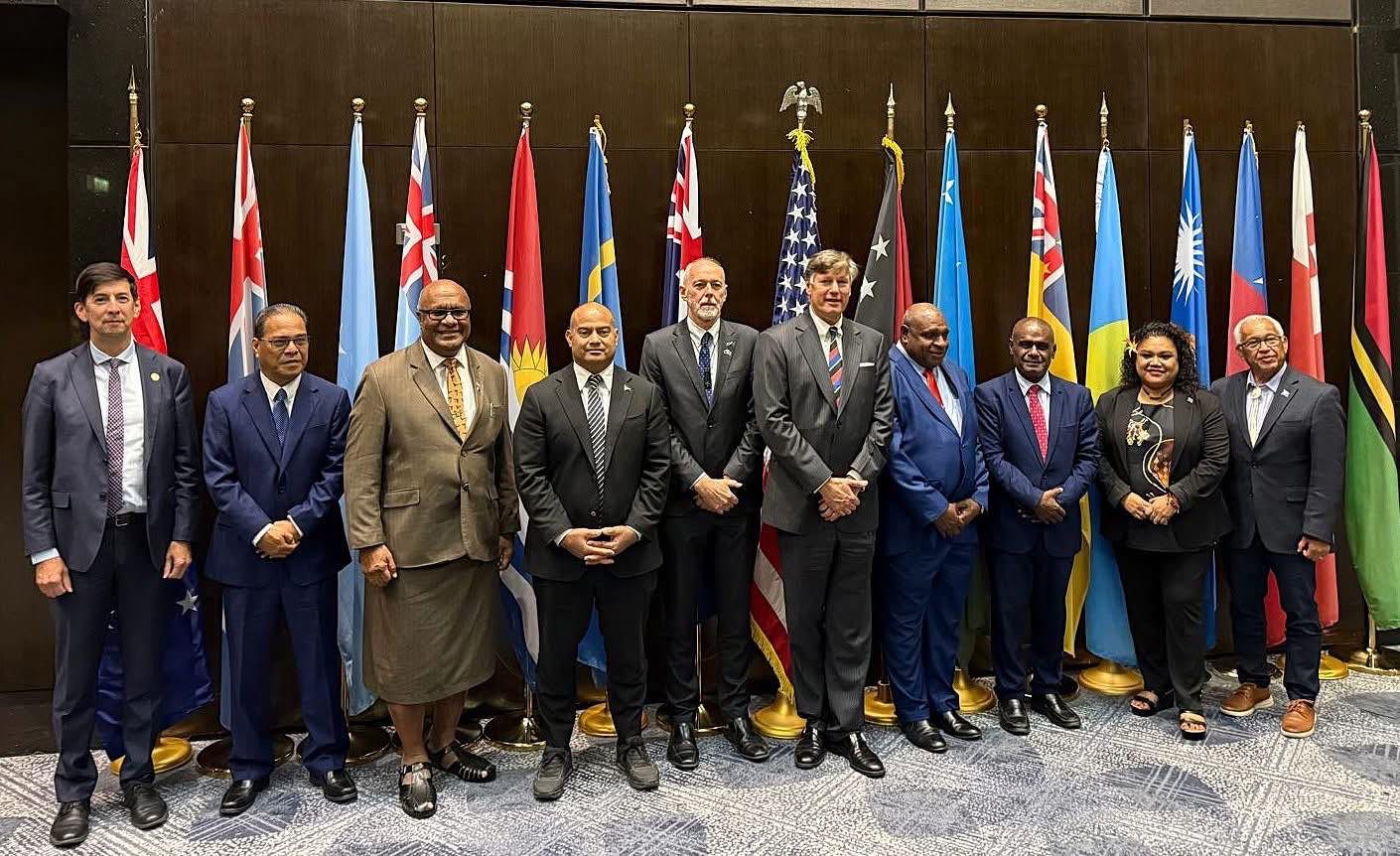
At a U.S-Pacific Islands Forum (PIF) roundtable in Port Moresby Tuesday, deputy Secretary of State Christopher Landau said Washington was “re-aligning our mutual priorities to deliver on concrete benefits for Americans and Pacific Islanders.”
The commitments span infrastructure, digital connectivity, fisheries, critical minerals, disaster resilience, and people- to-people ties — areas the U.S says are central to its Indo-Pacific strategy under the Trump administration’s second term.
The U.S emphasised trade over aid, with new programmes through the Millennium Challenge Corporation (MCC), including a full compact with Fiji and a threshold programme for Tonga.
A major focus is digital infrastructure. The East Micronesia Cable (EMC), jointly funded with over US$95 million from the U.S, Australia, and Japan, is on track for completion in November 2025 and will connect more than 100,000 people in FSM, Kiribati, and Nauru.
Additional U.S contributions include:
*US$7.5 million for branching units linking FSM, RMI, and Kiribati to the Central Pacific Connect cable.
*US$5 million to support Tuvalu’s spur connection alongside Taiwan.
*US$4.5 million for terrestrial infrastructure to expand access from existing undersea cables.
*Washington also pledged regional workshops on trusted ICT and satellite connectivity.
On fisheries, the U.S said it has provided US$60 million in foreign assistance linked to the South Pacific Tuna Treaty, which generates hundreds of millions in revenue annually.
The U.S is moving to strengthen cooperation on seabed resources. NOAA will provide US$3.3 million in deep sea research, including a 21-day expedition by the E/V Nautilus in October to explore priority habitats in the Cook Islands.
The Bureau of Ocean Energy Management will contribute US$250,000 in technical assistance to the Cook Islands, while the State Department is partnering with PNG’s Mineral Resources Authority on joint geoscience surveys.
The U.S announced new US$5 million in funding for the U.S Trade and Development Agency to accelerate project preparation across the region. Projects include U.S-backed development at Palau’s Koror International Airport and cybersecurity modernisation in Fiji.
Dual-use infrastructure is also on the table. The U.S Department of War is programming military construction projects in PNG, including upgrades to Lae Port, Jackson International Airport in Port Moresby, a fuel storage facility, and new training facilities at Lombrum Naval Base on Manus Island.
The U.S highlighted its Framework for Strategic Cooperation with PNG, covering defence, maritime security, law enforcement, and minerals.
It pledged to expand programmes to clear World War II-era unexploded ordnance in PNG, Palau, Solomon Islands, FSM, and the Marshall Islands. In May, a new UXO program launched in PNG, with U.S support now totalling US$4.25 million.
The U.S Coast Guard (USCG) has stepped up patrols under shiprider agreements, conducting 14 boardings in PNG waters in 2024. Six Fast Response Cutters and a 270-foot Medium Endurance Cutter are now homeported in Oceania to expand operations.
Washington is also providing US$11 million in foreign military financing to PNG to boost disaster relief, maritime security, and professionalisation of its defence force. PNG participated in the Talisman Sabre exercise for the first time outside Australia in 2025.
Law enforcement support will include a resident U.S advisor from Homeland Security’s Federal Law Enforcement Training Centres to strengthen police recruitment and training in PNG.
The U.S pledged continued support for regional disease prevention, with the CDC working on dengue prevention and outbreak response, including direct support to Nauru during its current dengue outbreak.
The State Department is backing a Pacific Vector Network to coordinate responses to mosquito-borne diseases and is supporting Fiji and PNG as Global Health Security Partners.
On HIV/AIDS, PEPFAR investments from 2018–2025 totalled US$26.95 million in PNG, with continued support pledged for treatment and prevention.
The U.S said its partnership must also be rooted in communities. The Young Pacific Leaders Programme will host a workshop in October focused on maritime security, cybersecurity, and health security.
Peace Corps volunteers will continue working across Pacific communities in education, health, and local development, described as a “vital part of efforts to empower local growth.”
The Port Moresby roundtable underlined Washington’s intent to embed itself more deeply in Pacific affairs after years of criticism that U.S engagement lagged behind other powers.
“Under this second Trump Administration, the United States has renewed its commitment to a free and open Pacific
Islands region,” the U.S said, framing the commitments as a strategic reset and a show of long-term intent.