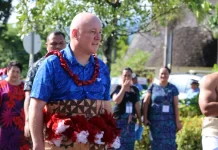

New Zealand Foreign Affairs Minister says NZ “had a duty to act” if the Cook Islands Government passed laws or took actions that “were offensive to New Zealand’s governing norms” or “injurious to Cook Islanders”.
At an event celebrating 60 years of New Zealand’s unique “free association” relationship with the Cook Islands, Winston Peters appeared to deliver a warning to its Government.
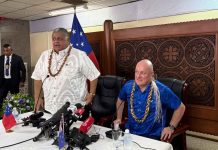
“If the Cook Islands Government passed laws or took actions that were offensive to New Zealand’s governing norms, or were injurious to Cook Islanders, then New Zealand had a duty to act on behalf of its citizens in the Cook Islands,” the Foreign Affairs Minister told the crowd at an event in Auckland’s Glen Innes on Monday.
Peters also said if the Cook Islands wanted full independence, New Zealand wouldn’t stand in the way.
His speech comes as New Zealand’s relationship with the Pacific nation is tested by the latter tightening ties with China.
Cook Islands Prime Minister Mark Brown signed a range of strategic, mining, transport, trade and fishing deals with China in February, without consulting with New Zealand.
This was despite a clause in the “Free Association” agreement with New Zealand to “consult regularly on defence and security issues”.
The snub prompted Peters to hit pause on millions of dollars in funding for the Cook Islands – and it’s a snub that appears to be fresh in his memory given some other comments he made on Monday.
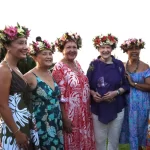
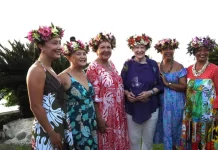
At the Constitution Day Celebrations at Upokina Taoro/East Cook Island Community Group, Peters delivered a few historical reminders to Prime Minister Brown of how the current relationship came to be in 1965.
“There were some Cook Islanders who preferred integration with New Zealand, a small number who sought independence, but there is no doubt the overwhelming majority of the Cook Islands people wanted to preserve their link with New Zealand, but with self-government,” Peters said.
“Thus the ‘Free Association’ model was born. Driven, developed and shaped by the Cook Islands Legislative Assembly, it then came into force, after the passage of the Cook Islands Constitution Act (1964), on 4 August 1965.”
Cook Islanders retained their New Zealand citizenship and passports – and they do to this day.
Peters also dug through the archive of diplomatic wires to (seemingly) remind Brown of the relationship. He quoted former Prime Minister Norman Kirk, who wrote to his Cooks counterpart Albert Henry in 1973:
“It is therefore unusual for a state to extend its citizenship to people living in areas beyond the reach of its own laws,” Kirk wrote. “That New Zealand has taken this step in relation to the Cook Islands is the strongest proof of its regard for, and confidence in, the people of your country.”
Peters’ other reminders included sharing a head of state, how “like any close family member, we’re there when you need us most”, how “our bond of citizenship” entails a “degree of New Zealand involvement in Cook Islands affairs”, and how nothing is preventing them from gaining full independence.
“That was the case in 1965. It remains the case today,” Peters said.
“If independence is ever sought by the Cook Islands people under Article 41 of the Constitution, as is their right, we will support it.
“That is, fundamentally, what the word ‘free’ means in the concept of ‘free association’, noting that any move to full independence can only ever be the sovereign choice of the Cook Islands people.”
Despite his numerous pointed comments – and always the diplomat – Peters finished with this: “In our troubled world, we sometimes need to stop, take pause from time to time, to reflect on our successes. Today marks one of them, because there is much to celebrate in our 60 years joined together in free association as part of the New Zealand realm.”