


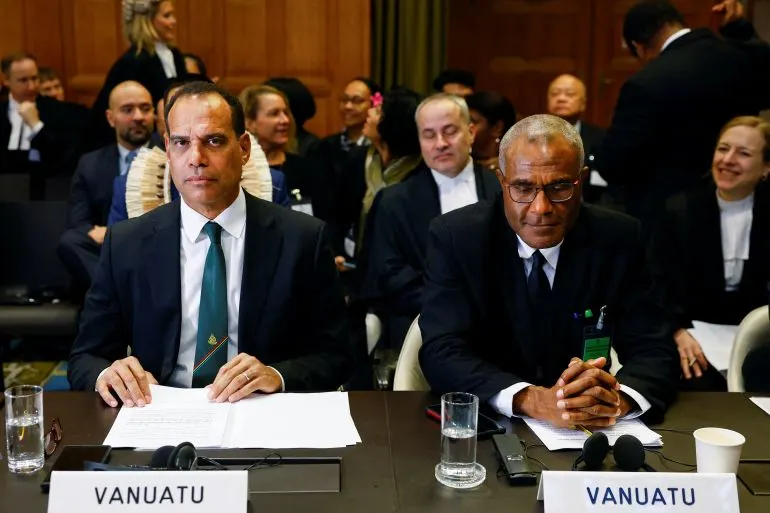
Vanuatu’s Minister for Climate Change, Ralph Regenvanu, has welcomed the International Court of Justice’s (ICJ) historic advisory opinion on climate change, calling it a “milestone in the fight for climate justice.”
“The Government of the Republic of Vanuatu commends the International Court of Justice (ICJ) on its landmark advisory opinion on climate change, issued today in response to a UN General Assembly Resolution requesting the opinion following the initiative of the Government of Vanuatu and our fellow Small Island Developing States,” Regenvanu said in a statement.
He said the ruling breaks through political barriers that have long stalled meaningful action.
“The ICJ ruling marks an important milestone in the fight for climate justice. We now have a common foundation based on the rule of law, releasing us from the limitations of individual nations’ political interests that have dominated climate action. This moment will drive stronger action and accountability to protect our planet and peoples.”
Regenvanu confirmed that Vanuatu would now return to the UN General Assembly to push for a resolution supporting implementation of the decision.
“The implementation of this decision will set a new status-quo and the structural change required to give our current and future generations hope for a healthy planet and sustainable future.”
He did not shy away from criticising powerful nations.
“Even as fossil fuel expansion continues under the U.S’s influence, along with the loss of climate finance and technology transfer, and the lack of climate ambition following the US’s withdrawal from the Paris Agreement, major polluters—past and present—cannot continue to act with impunity and treat developing countries as sacrifice zones to further feed corporate greed.”
Vanuatu has led the global push for the ICJ opinion, which has become a rallying point for developing nations and youth-led climate activism.
“Vanuatu is proud and honoured to have spearheaded this initiative, and the number of States and civil society that have joined to fight the same fight is a powerful testament to the leadership, courage, and determination of Small Island Developing States (SIDS) and youth activists. Their persistence has transformed a grassroots movement into the biggest case in the history of international law, placing climate justice at the heart of international discourse.”
He said countries in the Global South, like Vanuatu, continue to suffer the worst consequences of climate inaction.
“The Global South is bearing the brunt of a crisis it did not create. Families are losing their homes, entire cultures are at risk of disappearing, and lives are being shattered by man-made climate disasters. The nations most responsible for emissions should be held accountable for any violations of legal obligations and they must also step up and lead in providing resources and support to aid those most affected.”
Regenvanu said the ICJ ruling now provides a powerful legal tool to support global accountability.
“This ruling provides a critical foundation for lawyers and activists to further strengthen and affirm that climate destruction is ‘against the law.’ It also confirms that environmental harm violates fundamental legal principles.”
But he warned that this was only the beginning.
“A victory in the world’s highest court is just the beginning. Success will depend on what happens next through coordinated efforts across diplomacy, politics, litigation, and advocacy to turn this moment into a true turning point.”
He said Vanuatu stands ready to work with others to enforce the Court’s findings.
“Vanuatu looks forward to collaborating with other States on implementing the Court’s decision, and ensuring that the structural changes needed to increase accountability, demand real financial commitments, and reframe climate justice become the heart of every negotiation, every policy, and every court where our peoples’ futures are at stake.”
Vanuatu and the large majority of the 96 States and 11 International Organisations that presented evidence that States obligations were not limited to voluntary contributions and pledges found in the UNFCCC and Paris Agreement during the hearings in December 2024.
The ICJ agreed with the majority and confirmed that international legal obligations – including the duty to cooperate, human rights, duties to prevent transboundary and environmental harm, including marine harm, and to act with due diligence — were also applicable to States’ conduct in the context of climate change.
Additionally, all States, whether they are parties to the UNFCCC, Kyoto and Paris Agreements or not, were bound by these legal obligations under customary international law.
Breaches of any of these primary obligations confirmed as ‘most directly relevant’ to climate change would result in legal consequences. The Court also confirmed that harm from climate impacts could be established and scientifically attributed to specific polluter States whose acts or omissions resulted in significant harm.
Legal consequences include cessation, including requirements to regulate private polluters and end fossil fuel subsidies; assurances of non-repetition; and a duty to make full reparations to injured States and individuals.
This ruling is expected to take centre stage when the United Nations General Assembly meets in September and at the next conference of parties to the UN Convention on Climate Change (COP30), in November in Brazil.
These legal proceedings were requested by the UN General Assembly in a Resolution passed by consensus on 29 March 2023. The campaign for the resolution was initiated by the Pacific Island Students Fighting Climate Change and spearheaded by the Government of Vanuatu seeking climate justice.