

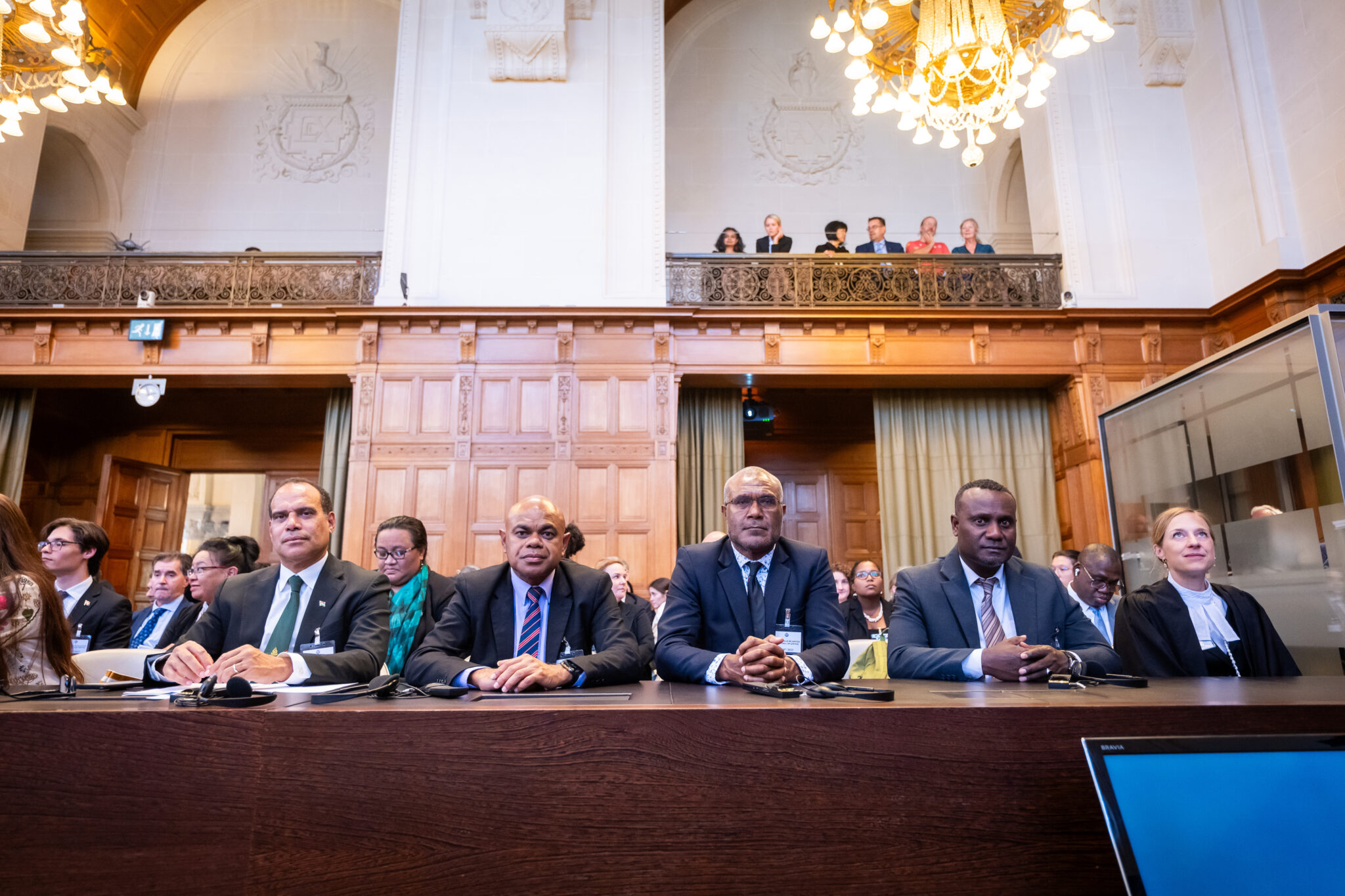
The Pacific youth who initiated the historic push to take climate change to the world’s highest court have hailed the International Court of Justice’s (ICJ) advisory opinion as a victory for justice and survival.
“Six years ago, young people from the Pacific decided to take climate change to the world’s highest court, and today the ICJ has responded,” said Vishal Prasad, Campaign Director of the Pacific Islands Students Fighting Climate Change (PISFCC).
“In no uncertain terms, it has told the world that climate impunity is no longer allowed and that those who have caused the greatest harm are required to provide remedy to people most affected by climate change.”
For Prasad, the ruling represents more than a legal pronouncement, it is a turning point.
“By affirming the science, the ICJ has mandated countries to urgently phase out fossil fuels because they are no longer tenable. For small island states, communities in the Pacific, and for young people and future generations, this opinion is a lifeline and an opportunity to protect all that we hold dear and all that we love.”
He called the decision “a tool for climate justice,” adding: “This advisory opinion sets the foundation for a transformational shift … and provides us with a reason to keep fighting.”
The ruling stems from a campaign launched by PISFCC in 2019, when a small group of law students from Vanuatu and across the Pacific began lobbying their governments to take climate change to the ICJ.
Their call was amplified by the region’s leaders and gained momentum internationally, culminating in a landmark 2023 United Nations General Assembly (UNGA) resolution, adopted by consensus, requesting the Court’s opinion on states’ obligations to address climate change.
On Wednesday, the Court answered.
In the advisory opinion, the ICJ declared that “failure to take all necessary measures to prevent further harm from climate change constitutes an internationally wrongful act,” underscoring that states cannot disregard their legal obligations to protect the planet and its people.
Vanuatu, which spearheaded the case alongside Pacific youth, called the opinion a “landmark milestone” for international climate law.
“For the first time in history, the ICJ has spoken directly about the biggest threat facing humanity, which is climate change,” said Ralph Regenvanu, Vanuatu’s Minister of Climate Change.
“The court has just confirmed that states do have legal obligations to act on climate change … These aren’t aspirational ideas, as some would have it. They are binding duties.”
Regenvanu said the opinion exceeded expectations, especially for its strong statements on fossil fuels and the rights of states threatened by sea level rise.
“It talked about the rights of states to exist regardless of sea level rise … It directly addressed fossil fuels and stated that giving licences for exploration or subsidising production can amount to an internationally wrongful act.”
He linked the decision to the global climate process, saying it underscores the need for stronger action ahead of the next UN climate talks.
“We’re a decade on now from the Paris Agreement, and it’s very important as the world goes forward that we make sure our actions align with what came out today from the Court.
“You can’t just make these commitments and then walk away from them. You are legally accountable.
“This is a call for all states to follow the science and take the rapid emissions reductions needed to keep within 1.5 degrees,” he said.
The Court also emphasised the principle of intergenerational equity, stating that obligations on climate change must be interpreted “in light of the rights of present and future generations.”
The Melanesian Spearhead Group (MSG), representing Fiji, Papua New Guinea, Solomon Islands, Vanuatu, and New Caledonia, described the decision as a powerful validation of Pacific peoples’ lived realities.
“Our people have suffered forced relocations from our traditional territories. Our political systems are breaking down as our economy is ground to ashes. We have already lost much of what defines us as Pacific Islanders and climate change has only gotten started,” said Ilan Kiloe, Acting Director General of the MSG.
“Having the ICJ, the highest court in the world, address the climate crisis is an idea that began from a spark of hope from our Pacific youth.
“The advisory opinion will be a central tool that we in the Global South will use at the next meeting of the United Nations General Assembly, the UN’s Climate Change and Biodiversity Conferences, and everywhere to advocate for climate justice so that our generations can enjoy the future we want,” Kiloe said.
Margaretha Wewerinke-Singh, legal counsel for Vanuatu’s case, said the ruling provides “the full framework for holding states to account for pollution that is internationally wrongful, unlawful, and that causes injury to other states.”
“When a state commits a wrongful act, it is under a legal obligation to make full reparations for the damages caused,” she said.
“The era where polluters can freely pollute and argue that their climate policies are a matter of discretion … that era is really over. We have entered an era of accountability.”
Regenvanu confirmed that Vanuatu would take the ruling back to the United Nations General Assembly to push for a resolution supporting its implementation.
“This decision sets a new status quo,” he said. “Let this be the moment when the world turns its face towards climate justice.”
For Pacific communities and their youth, the ICJ’s words have revived hope.
“Today is historic for climate justice,” Prasad said. “We are one step closer to realising this,” he said.