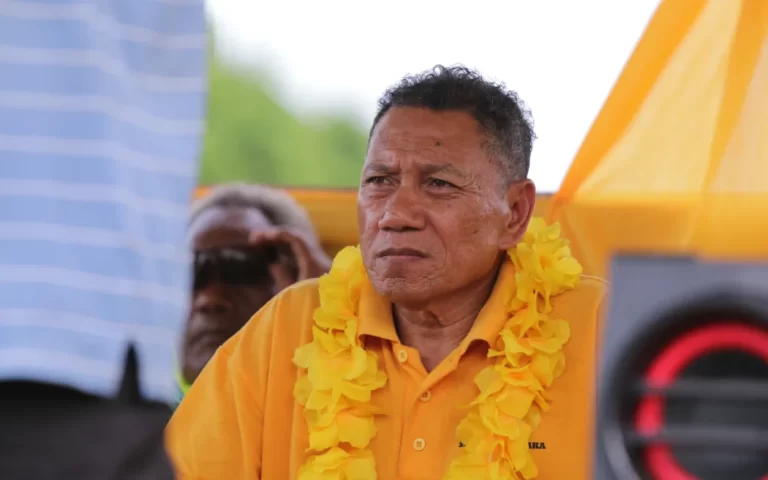
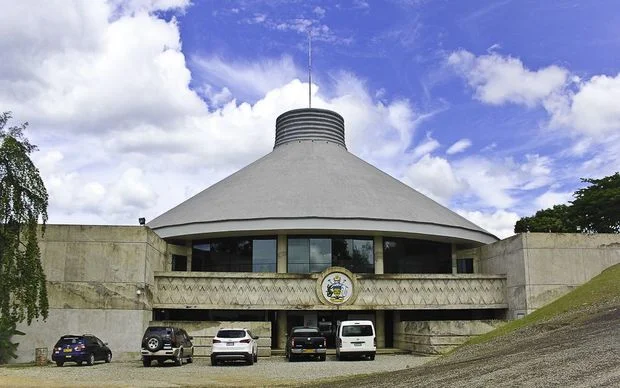
Solomon Islands Foreign Minister Peter Shanel Agovaka says he has been asked to lead a government takeover less than two years since Prime Minister Jeremiah Manele came to power.
Agovaka broke party lines and resigned from Cabinet on Monday night, joining a breakaway of ministers and backbenchers that kicked off on Sunday.
He told RNZ Pacific that the People’s First Party (PFP) have offered him the leadership, meaning a change of government would see him become Prime Minister.
“I feel it’s time, for me representing central Guadacanal, to take up that challenge to lead our country,” he said.
The PFP, joined by the official Opposition, have petitioned for an extraordinary sitting of parliament.
Government House said that petition was submitted Tuesday, with the Governor-General now to decide on whether to call a sitting.
Agovaka said they intend to file a motion of no confidence in Prime Minister Jeremiah Manele, and his Ownership, Unity and Responsibility (OUR) Party.
He believed the 12-member PFP had the numbers to form a new government with the opposition and independents, but said the situation was “fluid”.
“There is a critical motion that should be dealt with immediately … we’ll just hope that our number, which is 27, holds,” he said.
Current PFP leader Fredrick Kologeto told RNZ Pacific on Monday that he expected their support to rise beyond a simple majority in the Solomons’ 50-seat Parliament.
Kologeto said there was a breakdown in trust between ministers and that he ultimately saw no resolution while Manele’s OUR Party remained in power.
Several ministers have defected from OUR to PFP over the last year, including Finance Minister Harry Kuma and Justice Minister Clezy Rore.
Agovaka, who is now in the process of leaving OUR, called out Manele for sacking two PFP Ministers in February and replacing them with OUR members.
“I can’t work with some of the ministers … undermining the integrity of Cabinet and trying to push their own agendas,” Shanel said.
He said the PFP have yet to offer portfolios to other Ministers, but said that opposition leader Matthew Wale, who leads the Democratic Party, would be invited into a new Cabinet.
“There [will be] a coalition between the opposition, independents, and People First … if we come through that, then we can start sitting down and looking at the portfolios,” Agovaka said.
“We look forward to this change of regime.”
The Prime Minister’s Office declined RNZ Pacific’s request for comment.
The Office of the Speaker of Parliament has received a notice of a motion of no confidence against Solomon Islands Prime Minister Jeremiah Manele.
The notice, signed by the former Deputy Prime Minister and Member of Parliament for South Vella La Vella, was received Monday and is now before Parliament for consideration.
It is currently undergoing the required seven-day notice period, which will lapse on Monday, 23 March 2026.
Clerk to Parliament Jefferson Hallu said the motion can be moved and debated once the notice period ends, and when the Prime Minister convenes Parliament.
“The motion can be moved anytime from 24 March 2026 onwards, whenever Parliament sits again,” he said.
This is the third motion of no confidence to be filed against Prime Minister Manele.
Earlier this week, 12 Cabinet ministers resigned from the Manele-led Government for National Unity and Transformation.
Most of them are members of the People’s First Party(PFP), who cited frustration and mistrust among coalition partners as reasons for their resignation.
The mass resignation leaves 12 of the 24 government ministries without ministers.
Deputy Wing Leader of the People’s First Party and former Health Minister Dr Paul Bosawai confirmed that a new coalition is being formed between the People’s First Party, opposition members, and independent MPs.
“There is a coalition being formed between the People’s First Party, opposition and independent members, and the number is 28 at the moment. In politics, we cannot pre-count numbers, but we respect the choices of politicians.
If we share the same common ground to redefine Solomon Islands and bring economic benefits to the country, then we are seeing support from our colleagues on the independent and opposition sides,” he said.
On Tuesday, Prime Minister Manele welcomed Mary Daniella Zae Garu and Freda Tuki Soriocomua, who were officially sworn in at Government House.
The two MPs replaced ministers who had resigned from Cabinet.
Garu was sworn in as Minister for Traditional Governance, Peace and Ecclesiastical Affairs, succeeding Stephen Kumi, while Ms Soriocomua was sworn in as Minister for Justice and Legal Affairs, succeeding Clezy Rore.
Prime Minister Manele congratulated both ministers, saying their appointments will help ensure the Cabinet remains functional and focused on its objectives.
Meanwhile, the defection of 19 government ministers and backbenchers to the Opposition and independent ranks has now left the Prime Minister running a minority government.
The defected government members have joined with the Opposition and Independent groupings bringing their total number to 28 MPs.
Twenty Seven (27) MPs took a photo shoot Monday without Hon Franklyn Wasi who had also resigned but was still overseas.
The group has also signed a new coalition agreement and filed a motion of no confidence against the Prime Minister.
Sponsored
“When such a significant number of sitting members, including ministers, abandon their own coalition, it signals a government in serious crisis,” a statement from the group said.
The statement said these decisions are not made lightly.
They reflect deep frustrations over internal divisions, lack of trust, and growing concerns that the government has lost its sense of direction and purpose.
This mass exodus raises urgent constitutional and governance questions.
“Can a government that has lost the confidence of 19 of its own members continue to claim legitimacy? Can it effectively govern while grappling with internal collapse?”
The statement said that what is unfolding is not just a reshuffling of numbers; it is a rejection of leadership that has failed to unite, failed to listen, and failed to deliver.
Political commentator and director of the Citizens Rights Advocacy Network Solomon Islands, Redley Raramo, said there was still time for the PM to stabilise the coalition.
“Negotiations are still ongoing and progressing. The Prime Minister is yet to announce a formal date for the parliament meeting”.
“”I wouldn’t be concluding here because anything to do with the numbers can only be manifested on the floor of Parliament,” said Raramo.
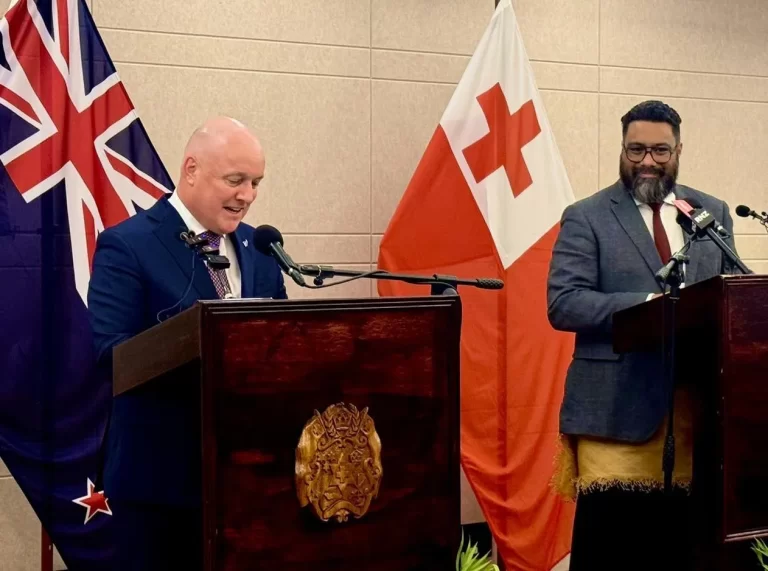
New Zealand’s Prime Minister, Christopher Luxon, has announced a NZ$30 million (US$17.58 million)expanded package of support for Tonga during an official visit aimed at strengthening bilateral ties and boosting resilience.
Luxon arrived in Nuku’alofa Tuesday with a delegation of ministers and business representatives, and was welcomed by the Deputy Prime Minister.
Talks with Prime Minister Lord Fakafanua, focused on economic cooperation, climate resilience and development priorities.
At a joint press conference, Luxon confirmed NZ$20 million(US$11.72 million) in general budget support over two years.
Additional commitments include NZ$5.25 million(US$3.07 million) over five years to strengthen health systems and services, NZ$5 million(US$2.92 million) in climate-flexible funding. And a NZ$2 million(US$1.17 million) to expand Pacific Resilient Food Systems support for Tongan farmers was also announced.
The funding comes as Pacific nations face mounting pressure from climate change and rising costs, with both leaders emphasising the importance of long-term resilience and sustainable growth.
Lord Fakafanua said the government welcomed deeper private sector engagement, highlighting a recent agreement between Sudima Hotels and King Tupou VI to develop a hotel at the new Parliament Precinct.
The project is expected to generate around 100 jobs and contribute an estimated T$18 million(US$10.54 million) annually to the economy.
Discussions also covered easing export barriers for Tongan pineapples into New Zealand, alongside plans for improved agricultural infrastructure in Vava’u.
The visit includes an audience with the King, site visits, and engagements with police and education sectors before the delegation departs today. Both governments say the outcomes reflect a shared commitment to long-term economic resilience and regional stability.
Australia and New Zealand will strengthen military co-operation as both nations navigate increasingly challenging global circumstances, with the war in Iran dragging on and the Pacific becoming more precarious.
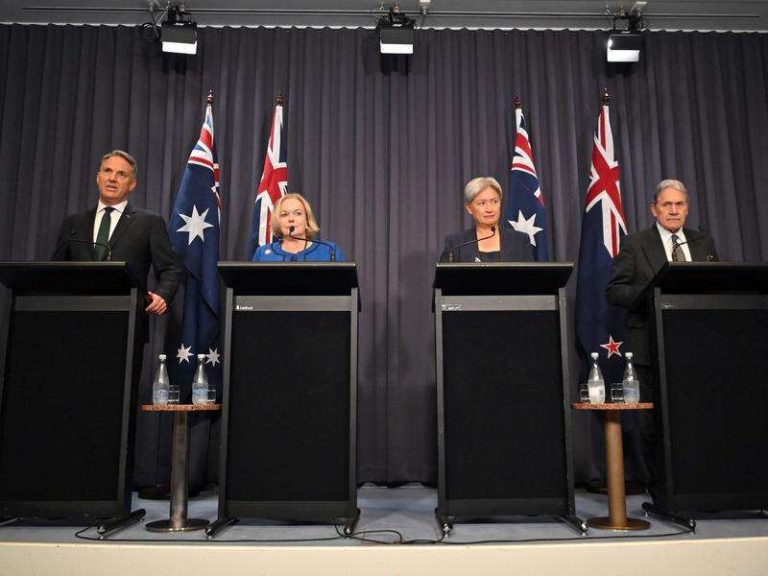
Defence Minister Richard Marles and Foreign Minister Penny Wong met their counterparts, Winston Peters and Judith Collins respectively, in Canberra on Tuesday as part of annual talks.
The Australian Defence Force and New Zealand Defence Force will boost co-operation, with members of each being increasingly embedded in the other over the next decade as part of an “ANZAC 2035 vision”.
This will include increasing support for security operations in the Pacific, including tackling transnational organised crime, drug trafficking and natural disasters.
An Australia-NZ working group will identify where both forces can better integrate and train together, and there will be combined investment in defence industry production and procurement, the ministers announced.
“This is important not just because of the world today, but because both of our defence forces are growing,” Marles told reporters at a joint press conference following the ministerial meeting.
Growing the militaries in tandem allows both nations to better leverage their capabilities, Marles said.
Judith Collins
“It’s not lost on any of us that in the context of that world, it is profoundly important that in the community of nations, family as we are, stick closely together,” he said.
The joint statement described it as being “force multipliers for each other” with defence forces able to combine to tackle security threats.
Both nations would work closely with Pacific Island nations to lift capability and streamline co-operation across the region, Collins added.
“We are both Pacific, and our security is inextricably linked to the security of the Pacific region and its peoples,” she said.
The trans-Tasman partnership has never been more important, Senator Wong said.
“This is amplified middle power diplomacy in action,” she said.
Senator Wong said discussions with her counterpart also included oil supply coming out of the Gulf as Iran halts tankers traversing the Strait of Hormuz, through which 20 percent of the world’s oil transits.
Australia was engaging with countries it imported fuel from amid concerns about supply, including China, she added, as Beijing moves to restrict exports to shore up domestic supply.
Cronulla centre KL Iro has outlined plans to use the upcoming World Cup to establish development pathways for more Cook Islands youngsters to chase their NRL debut.
There has been a long tradition of players of Cook Islands heritage, but Iro is among a small group of NRL players to have grown up in the tiny Pacific Island nation.
It’s a situation he’s desperate to change and this year’s World Cup looms as a unique opportunity to inspire the next generation of emerging players.
“Everyone loves rugby league, but it’s about the opportunities,” Iro told NRL.com. “Kids get stuck there. The kids I grew up with, all the talented ones, they just never left the country and never got their chance.
‘We’ve got to start building pathways and let the parents know they need to move the kids away at younger ages and make that sacrifice for them to fulfil their dreams.
“It’s slowly changing, but I’m hoping we can get more junior pathways. When they watch us Cook Islands boys playing in the World Cup, that gives them hope, and they have a dream to be there as well.”
Iro will represent his Cook Islands heritage when he takes to the field for Multicultural Round in Cronulla’s clash with the Dolphins.
The centre played a key role in the country’s successful bid to qualify for the World Cup and is set to line up alongside the likes of Valentine Holmes and Davvy Moale for the tournament.
Qualification has already had a positive effect, with the team attracting new sponsors and hoping to reinvest that money into the grassroots.
Talent and passion for the game are not in short supply in the Cook Islands, with NRL Immortal Andrew Johns attending the local competition’s grand final in 2024.
The Knights legend was stunned by the quality and the fervent support for the game and expressed his desire for a Witzer Pre-Season Challenge game to be played there in the future.
The biggest issue, however, is the lack of opportunities for talented youngsters to receive the elite training required to develop into an NRL player.
While he grew up in the Arorangi, Iro moved to New Zealand as a teenager for family reasons and was provided with the chance to chase his rugby league dream.
It’s a dream, he recognises, he likely would not have made reality if not for the decision to move away from his homeland.
“There was no way I would be here if I didn’t move,” Iro said. “I wanted to move earlier. I wanted to move when I was 12 and it would have been better if I came straight to Australia.
“New Zealand didn’t have the junior development back then, they didn’t have Harold Matthews, they just had under 20s and [NSW] Cup, so even I struggled with my development.
“I had a later start and I’m still developing my game now. That sweet age is around 10-12 when you need to move to develop and get better because there’s not much competition at home. There’s freakish players but they don’t get the chance to progress.”
Iro has worked hard to provide more opportunities back home since breaking into the Sharks NRL side and regularly returns to the Cook Islands to visit his friends and family.
A trip home over Christmas carried additional meaning, when the 26-year-old proposed to his partner.
While he enjoys returning home, Iro is also desperate to help youngsters travel to Australia to receive a taste of the NRL. The centre and his mother helped facilitate a visit by his junior club, the Arorangi Bears, to Cronulla last year, with the under 13 boys side playing Kurnell in a match before attending a Sharks game.
Plans are already advanced for two more tours this year, with a women’s team set to travel to Australia before a men’s team flies to Christchurch for the Cook Island’s World Cup clash with the Kiwis at the city’s state of the art new stadium.
‘My mum was huge with that, she ran all the fundraising to make it happen,” Iro said. “Instead of a kids team, they want to bring a women’s team over to play a local women’s team here.
“Then at the World Cup, we have a game in Christchurch, so they’re fundraising to get a men’s team there so they can play a men’s A-grade team in Christchurch.
“They’re trying to give everyone different opportunities and get them out of their local lifestyles. My mum’s been huge helping with that stuff, fundraising and getting it moving,” he said.
The disruption of global energy supplies is being felt worldwide, the UN’s top climate change official warned on Monday, as conflict in the Middle East drives oil and gas prices sharply higher – echoing the market turmoil triggered by the war in Ukraine.
Speaking at the 2026 Green Growth Summit in Brussels, Simon Stiell, Executive Secretary of the UN Framework Convention on Climate Change (UNFCCC), said the volatility underscored the strategic value of renewable energy.
“Renewables turn the tables,” he said during a keynote address to the event, which brings together European climate and environment ministers alongside businesses, investors and other key stakeholders.
“Sunlight doesn’t depend on narrow and vulnerable shipping straits, wind blows without massive taxpayer-funded naval escorts [and] renewable energy allows countries to insulate themselves from global turmoil and to side-step might-is-right politics.”
Indeed, renewable energy also delivers on people’s top priorities across the continent: security, well-paid jobs, better health and relief from rising living costs, he added.
“Fossil fuel dependency is ripping away national security and sovereignty and replacing it with subservience and rising costs,” he said, adding that the reality is what most voters are demanding, climate action delivers at scale.
“Renewables and resilience keep bills down and create far more jobs,” he said.
“Cutting out fossil fuel pollution cleans our air, improving health and quality of life.”
“Some responses to the fossil fuel crisis, incredibly, argue for doubling down on the cause of the problem and slowing the shift to renewable energy even though it is clearly cheaper, safer, and faster to market,”
“This is completely delusional because history tells us, this fossil fuel crisis will happen again and again,” Steill said, adding that fossil fuel dependency means economies, household budgets and business bottom lines are “at the mercy of geopolitical shocks and price volatility in a chaotic world”.
His message to ministers meeting in Brussels was simple: Meek dependence on fossil fuel imports will leave Europe forever lurching from crisis to crisis, with households and industries literally paying the price.
The UNFCC chief noted the bloc is more reliant on fossil fuel imports than almost any other major economy, which cost the continent over €420 billion (US$276 billion) in 2024 alone.
Pointing out that in 2025, renewables overtook coal as the world’s top electricity source, and over US$2 trillion was invested in clean energy – double that of fossil fuels – he said, “the opportunities are immense.”
As a leader in climate action and ambition, Europe’s efforts, including its Emissions Trading Scheme, is driving investment and innovation, with the continent’s companies at the forefront of clean industries and growth.
That includes SSAB, Maersk and Holcim, which are leaders on green steel, shipping and cement, and Siemens, Schneider and IPS, which are pioneers in wind power, energy storage and electro-tech services.
“Europe can permanently seize the multi-trillion-euro goldmine of investment that’s just getting started by embracing green growth, drawing on your many strengths, [including] education, strong institutions, smart regulation, social justice and innovation and intellectual property, and by backing it up with plans and policies.”
Last century, when a continent reeling from war came together to build the foundations of integration, energy was top of the list because countries understood that secure and affordable supplies, achieved through cooperation, were the basis of peace and prosperity, he said.
“Today, these truths are more important than ever,” he said.
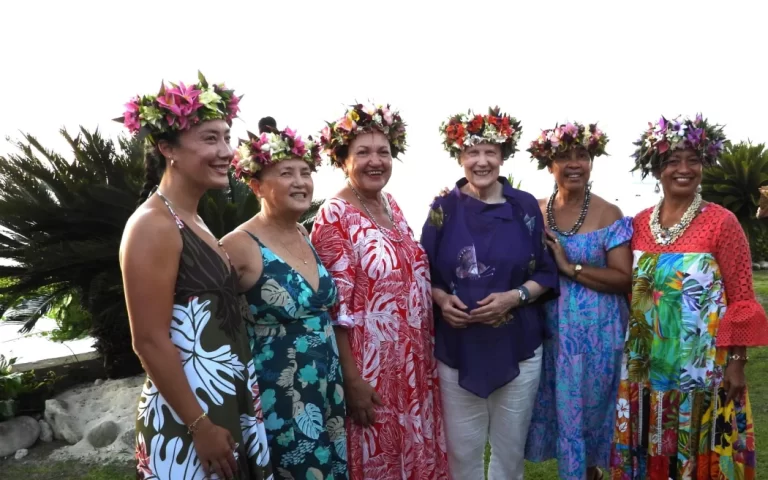
The current diplomatic tension between the Cook Islands and Aotearoa is “concerning” but “not beyond repair”, former New Zealand Prime Minister Helen Clark says.
Clark made this remark in response to a question raised at a recent fundraising dinner, which featured a moderated discussion hosted by the Cook Islands Breast Cancer Foundation in Rarotonga.
Diplomatic tensions between the Cook Islands and New Zealand began brewing in late 2024 and became public after the Cook Islands signed a comprehensive strategic partnership and other agreements with China in February last year.
New Zealand cited a lack of consultation regarding the deals with China and subsequently suspended NZ$29.8 million (US$17.44 million) in funding.
Cook Islands lawyer Brian Mason raised the issue of the Cook Islands’ agreement with China during the moderated discussion.
“In a podcast not that long ago, which covered a variety of matters, when you were asked about the agreements or memorandum of understanding that the Cook Islands government entered into with the People’s Republic of China, you indicated it was definitely out of line.
“As a former Prime Minister, what would you do to try and improve the relationship following that event, or was the die cast and the damage done?” Mason asked.
Clark responded that the situation was concerning but not beyond repair.
“The point I would make, firstly, I’m very sad to see this difference of opinion, because the Cooks are part of the New Zealand family,” she said.
“But the point I would make is that New Zealand would not sign the kind of agreement that the Cook Islands signed with China.
“And so, if it’s not the sort of agreement we would sign, then clearly it’s an agreement that is going to be of great concern to New Zealand.”
Clark pointed to one clause that particularly raised alarm in Wellington.
“There’s a clause that says the two countries, Cook Islands and China, undertake to support each other’s candidates in international organisational elections where they’re both members. We would never agree to that.
“But there’s a lot of other aspects to it too. So, it’s happened, and it needs to be sorted out through discussion.”
She suggested the dispute could eventually be resolved through dialogue, possibly by agreeing not to implement certain parts of the agreement.
However, she warned the disagreement is already having economic consequences.
“At the moment this is costing the Cook Islands big time, right, with something like $20 to $30 million (US$11.70 million – US$17.55 million) a year being held back,” she said. “That’s a lot of money.”
Meanwhile, Prime Minister Mark Brown is expected to travel to New Zealand next week – a major visit since the diplomatic fallout between the two nations.
The Office of the Prime Minister has neither confirmed nor denied whether a ministerial-level discussion with the New Zealand government is on the agenda.
Opposition leader Tina Browne, who is also the leader of the Democratic Party, has urged Brown to use the upcoming trip to “engage directly with New Zealand leaders” and resolve the diplomatic standoff between the two nations and resolve the suspension of about NZ$30 million (US$17.55 million) in funding.
Scientists are warning that chemicals used in plastic food packaging may pose significant risks to human health, with thousands of substances linked to plastics potentially migrating into food and contributing to chronic diseases.
The concerns were raised during a recent seminar by researchers from the Food Packaging Forum, where Managing Director and Chief Scientific Officer Dr Jane Muncke and Senior Scientific Manager Dr Birgit Geueke presented research on chemicals in food packaging and their implications for human health and the environment.
Dr Muncke said the organisation conducts independent research and science communication on chemicals in food contact materials, with a focus on preventing chronic diseases linked to hazardous chemical exposure.
“Our goal really is to prevent chronic diseases, non-communicable diseases that are attributed to avoidable hazardous chemical exposures,” she said.
“These chemicals transfer out of food contact materials, out of food packaging into food, and there’s quite a lot of hazardous chemicals there.”
Plastics contain complex mixtures of chemicals derived largely from fossil carbon, including both intentionally added substances and “non-intentionally added substances” such as impurities and reaction byproducts formed during manufacturing.
“Chemically speaking, plastics are very complex mixtures of many different chemicals,” Dr Muncke said.
“Some of them are intentionally used, some of them are non-intentionally added substances, and a lot of the chemicals in plastic are actually unknown.”
Research by the Food Packaging Forum and other scientists has identified more than 16,000 chemicals associated with plastics, with around 4,200 known to have hazardous properties, including the ability to damage DNA, disrupt hormones or persist in the environment.
Dr Muncke said plastics production is expected to increase significantly in the coming decades as fossil fuel industries shift toward plastics manufacturing.
“Making plastic has become kind of the plan B for the use of fossil carbon,” she said.
Packaging remains the largest sector for plastic use globally, particularly in food products. Dr Muncke noted that plastics are often hidden within packaging materials such as beverage cartons or metal cans, where plastic layers come into direct contact with food.
She also highlighted environmental and health risks across the lifecycle of plastics, from production to disposal.
“Once the plastic is produced, there’s no great management option for how to deal with it,” she said. “Reducing production and consumption is obviously important.”
One major concern is the open burning of plastic waste, which releases highly toxic chemicals such as dioxins.
“If there’s one takeaway today, open burning is a severe problem, and it needs to be addressed. These chemicals are very toxic at very low levels and can remain in the environment for decades.”
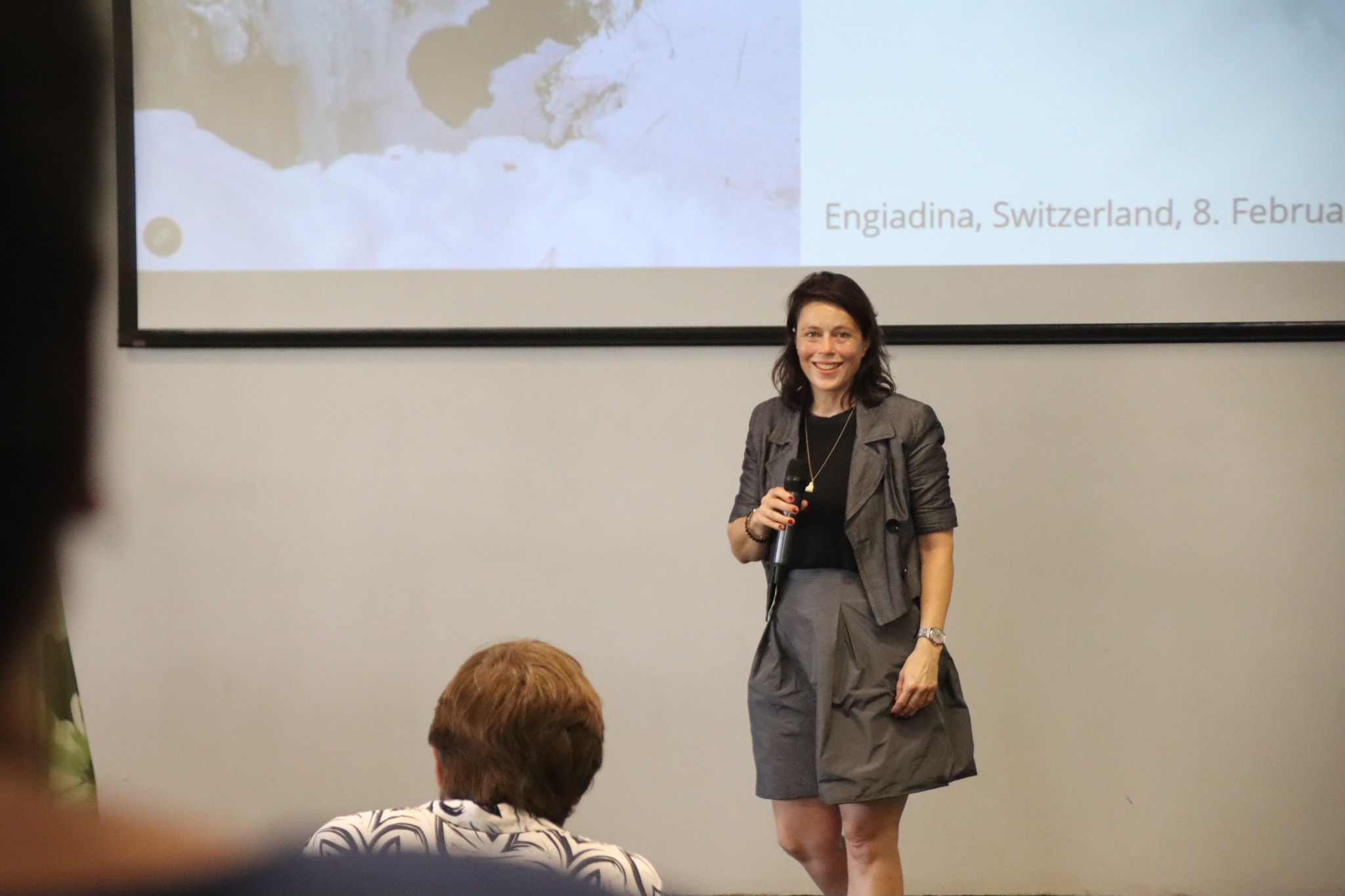
The Food Packaging Forum, Managing Director and Chief Scientific Officer Dr Jane Muncke. Photo: CSF Seminars
She noted that open burning remains a challenge in many regions where waste management infrastructure is limited, including in some small island developing states.
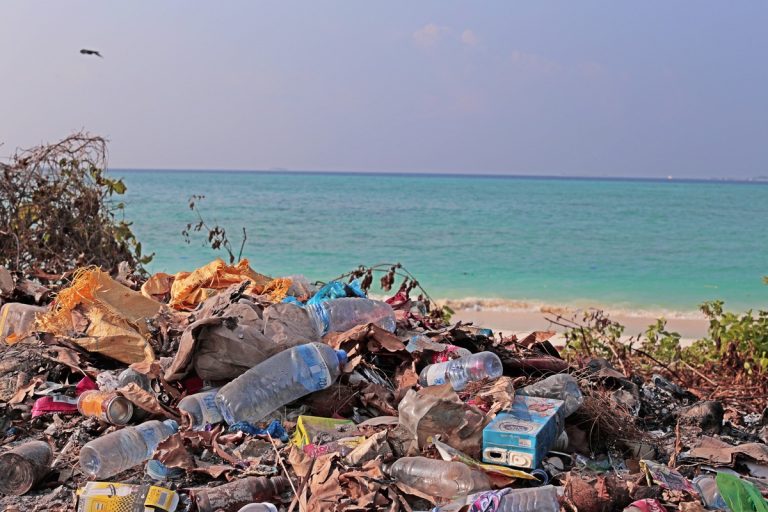
Dr Muncke also stressed that food packaging is a major contributor to global plastic pollution, with most items collected during beach clean-ups linked to food packaging.
“There’s this convenience culture and fast-food culture, which really is a huge problem in terms of environmental pollution,” she said.
According to research cited during the seminar, 56 global companies are responsible for more than half of branded plastic pollution identified during international clean-up audits.
The scientists also highlighted the importance of international policy efforts such as the Global Plastics Treaty, currently being negotiated under the United Nations.
The treaty aims to establish a legally binding global agreement addressing plastic pollution across the entire lifecycle of plastics, from production and design to consumption, recycling and disposal.
Dr Muncke said the treaty is particularly important because plastic chemicals are not regulated consistently across countries and plastic pollution crosses national borders.
“Member countries of the United Nations said they want to negotiate a legally binding treaty to end plastic pollution in the marine environment.
“That also means looking at all the life stages of plastic and reducing the harm to human health.”
She also commended Fiji’s role in the negotiations, noting that the country has been advised by scientists through the Scientist Coalition for an Effective Plastics Treaty.
“I really want to thank the Government of Fiji for playing a leading role in this process and for demanding high ambition and basing their policy proposals on science,” she said.
Dr Geueke then presented findings from the Forum’s Food Contact Chemicals and Human Health Project, which compiles global evidence on chemicals used in food packaging.
She said scientists created the project because evidence on chemical use, migration into food, human exposure and health effects had previously been scattered across many studies.
“We knew there are many plastic chemicals, and that they migrate from packaging into food and are present in humans,” Dr Geueke said.
“We measure them in urine, in blood, in breast milk, in hair, in the placenta; everywhere.”
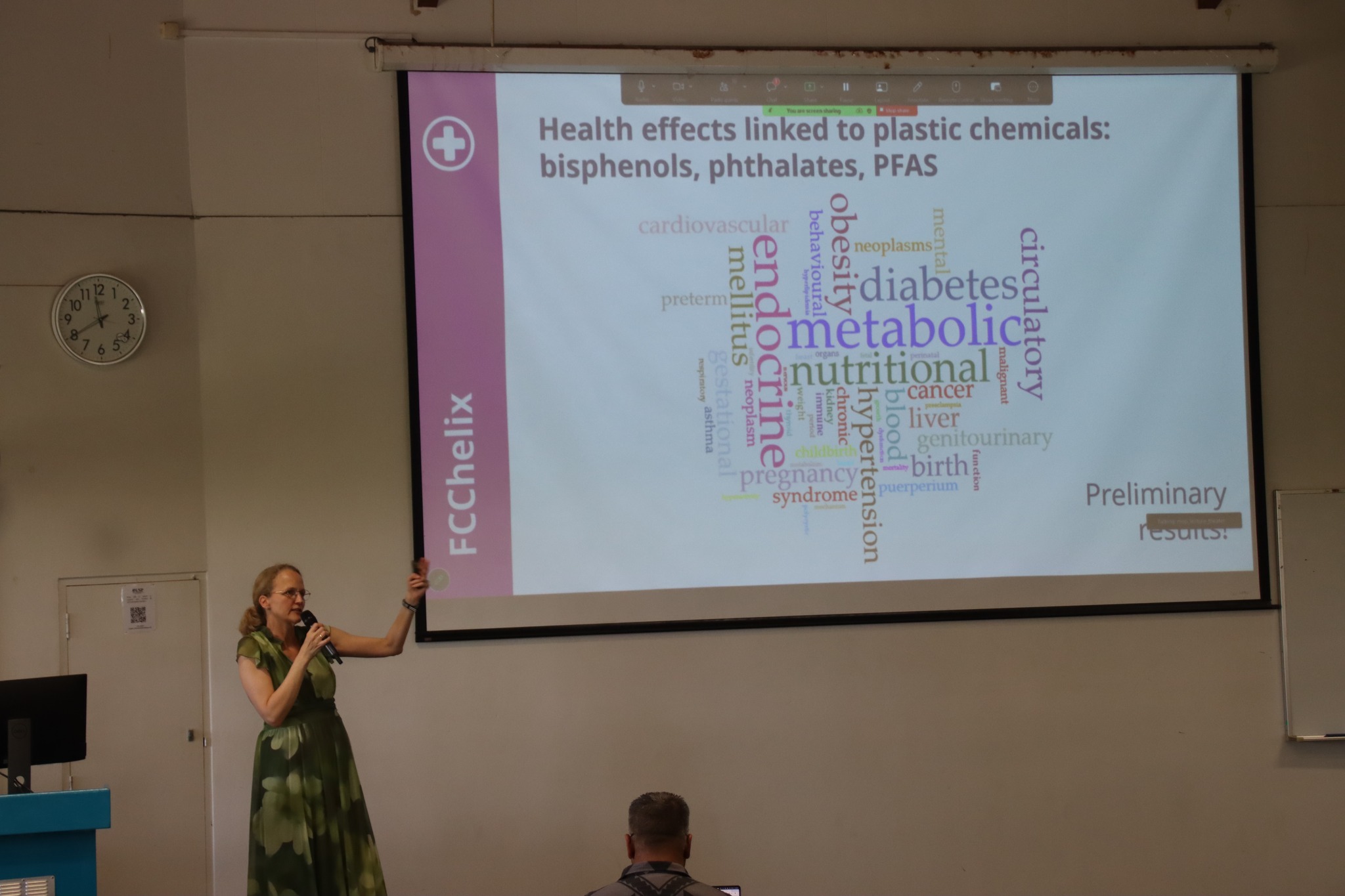
The Food Packaging Forum, Senior Scientific Manager Dr Birgit Geueke. Photo: CSF Seminars
By analysing regulatory lists and scientific studies, researchers identified about 4,500 chemicals allowed for use in plastic food packaging. However, when they compared these lists with chemicals detected migrating into food, the overlap was far smaller than expected.
“We saw the overlap is pretty small,” she said.
“That really surprised us because we thought, where are all these chemicals coming from that are not regulated?”
Many of these substances are believed to be non-intentionally added chemicals formed during manufacturing or degradation processes.
The research also found that thousands of plastic chemicals have been detected in human samples, with studies linking exposure to metabolic diseases, endocrine disruption, reproductive effects and cancer.
“Cancer-causing chemicals are present in our packaging and in our bodies,” Dr Geueke said.
Scientists are also studying microplastics released from food packaging, with evidence suggesting that heat, ultraviolet light and mechanical stress, such as opening and closing bottle caps, can generate microscopic plastic particles.
Despite growing scientific evidence, Dr Muncke said current regulatory testing remains limited.
“The chemicals that are intentionally used to make plastic need to be tested toxicologically, but only if they are present at certain levels,” she said.
“And the testing focuses mainly on whether they damage DNA.”
She said this approach does not fully account for other ways chemicals may affect human health.
“Chemicals contribute to diabetes, cardiovascular disease, reproductive health problems, immune system impacts and brain health. Those are not being tested at all right now.”
The researchers stressed that addressing plastic pollution will require systemic change, including reducing plastic production, improving waste management and promoting safer materials.
Dr Muncke said solutions could include greater reliance on local food production and packaging systems using reusable or inert materials.
“Local food production and local food consumption can be part of the solution,” she said.
“Import foods in bulk and do the filling locally in Fiji, and you can create jobs while reducing single-use packaging.”
She added that tackling plastic pollution will require collaboration between scientists, policymakers and communities.
“We need system thinking to end plastic pollution. If we work together, we can find responses to tackle this big problem,” she said.
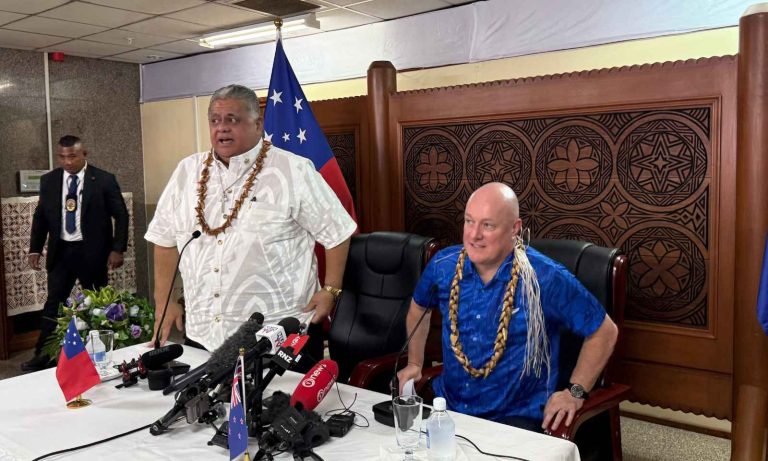
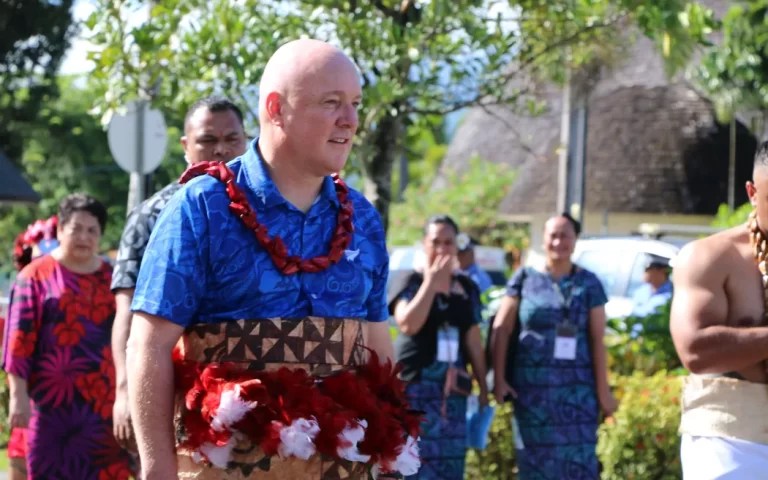
New Zealand Prime Minister Christopher Luxon has defended visa requirements for Pacific travellers, even as he described Sāmoa and New Zealand as “family” during his first official visit to Apia.
Luxon made the comments on Monday shortly after he was bestowed the chiefly matai title Tuisinavemaulumotoʻotua by the villages of Apia, a traditional honour that reflects leadership, service, and belonging within the wider Pacific family.
But the moment also raised a political question. Sāmoan media asked whether the relationship “family” should mean visa-free travel between Pacific countries and Aotearoa.
Pacific leaders, community groups, and advocacy organisations have repeatedly called for visa-free travel, arguing that deep historical ties, labour links, and family connections across the region should allow easier movement.
Asked directly about the issue, Luxon pointed to changes his government says have already made travel easier.
“As a new government in New Zealand over the last two years, we’ve done several things to try and make it easier to facilitate visas and travel to New Zealand,” Luxon says.
“The challenge that we have is you know as any leader does is to make sure that you’ve got legal migration and that you’ve actually got good risk management around your immigration system because otherwise what happens is you get an anti-immigrant feeling that builds up inside a country.”
Last year, the New Zealand Government introduced a number of changes affecting Pacific travellers.
Visitor visas for Pacific Islands Forum nationals were extended from the standard one-year visa to a 24-month multi-entry visa, allowing travellers to visit New Zealand multiple times within that period while still observing normal visitor stay limits.
New Zealand also started recognising valid Australian visitor visas for entry, making travel easier for Pacific visitors already transiting through Australia.
Visa application fees for Pacific travellers were also temporarily reduced for a 12-month period.
Luxon says a petition calling for visa-free travel for Pacific countries will go through New Zealand’s parliamentary select committee process before any decision is made.
The issue comes as New Zealand seeks to strengthen ties across the Pacific, where closer cooperation and the movement of people are increasingly tied to broader political and economic partnerships.
Sāmoa’s Prime Minister Laʻauli Leuatea Polataivao Fosi Schmidt said regional cooperation remains vital as global pressures grow.
“New Zealand and Australia we look up to as big brothers and sisters,” Laʻauli told journalists.
“You see the changing nowadays in the world. Big countries bully, start to change things dynamically, tariff, pushing things, petroleum and all that taking over.
“Sāmoa’s focus is to make sure we look after ourselves… So that’s why it’s very, very important for Sāmoa, New Zealand and Australia and all Pacific regions to come back together again.”
Luxon is visiting Sāmoa with a large delegation of ministers, officials, business and community leaders.
He says the trip is focused on strengthening cooperation between the two countries.
He leaves for Tonga today, where discussions are expected to cover fuel security, economic pressures, and regional stability.
Luxon also warned that drug trafficking is becoming a growing threat in the Pacific, with criminal networks increasingly using the region as a transit route.
“We’re up against crime families in South America that are doing extraordinary things now to send drugs into our region and actually the border and the security is the Pacific,” he said.
“It’s not just the New Zealand border alone as well. So, it’s very important that we work together,” he said.
New Zealand and Samoa have vowed to do more to combat the flow of drugs through the Pacific, which prime minister Christopher Luxon says has become a “super highway”.
Luxon and his Samoan counterpart La’aulialemalietoa Polataivao Leuatea Fosi Schmidt have signed memorandums of understanding for Police and Customs to work together and share more information.
The agreement would see dedicated New Zealand Police officers embedded in Samoa.
Both Luxon and La’auli were under no illusions as to the challenges the Pacific faced.
“We have recognised that border risk … the fast-paced problem of illegal drugs crossing our borders is on the rise,” La’aulialemalietoa said.
“We’re up against it. We’re up against crime families in South America that are doing extraordinary things now to send drugs into our region,” Luxon said.
“And actually, the border and the security is the Pacific. It’s not just the New Zealand border alone as well. So, it’s very important that we work together.”
Later, Luxon watched a demonstration of a drug seizure by two detector dogs donated by New Zealand, as part of the Pacific Drug Detector Dog Programme.
A combined effort to combat transnational crime is something Luxon would be bringing with him to Tonga on Tuesday afternoon, as he flew in for a meeting with prime minister Lord Fatefehi Fakafanua.
But Luxon said he was also keen to talk energy security and was preparing to discuss how officials could work together in that space as well.
It was likely the calls for visa waivers will follow Luxon to Nuku’alofa.
La’aulialemalietoa, community leaders, and Samoan media had all lobbied for Pacific visitors to be treated the same as those from 60 other countries and be given visas on arrival.
But Luxon appeared unlikely to budge, for now.
“You see what happens around the world when immigration gets out of control, and it’s not legal and it’s not managed. We have, very much, a risk-based approach to it all. We’re trying to liberalise what we can do in the Pacific, and we’ll continue to look at it.”
Luxon would also be keen to put the matter of his matai title behind him as he left Samoa, after the Samoan government admitted neither Luxon nor any of his representatives had requested it.
Luxon said it was a” miscommunication”, and he had moved on, but would not say if Samoa’s government had apologised.
At a gala dinner on Monday evening, La’aulialemalietoa said the controversy was “
nonsense” and advised Luxon to ignore it.
“Do not worry about the nonsense on Facebook. Let the village of Apia sort it out, and handle it with respect,” he said.