Home Blog Page 507

2050 Strategy, PALM10 to top Japan-Pacific Islands Forum Foreign Ministerial

Partnerships and implementation of the 2050 Strategy for the Blue Pacific Continent (2050 Strategy), as well as the preparations for the 10th Pacific Islands Leaders Meeting (PALM10) in Tokyo this July, are on the agenda for the 5th Japan-Pacific Foreign Ministerial meeting in Suva on 12 February.

The Ministerial Interim Meeting is to follow-up on previous PALM commitments and to allow preparatory discussions for the PALM later in the year, which will be the first face to face session since the COVID-19 pandemic.

The 5th PALM Ministerial Interim Meeting (MIM) will be an historic event as it comes to the Pacific for the first time, ahead of the high-level PALM10 in Tokyo from 16-18 July 2024.

Senior Officials Meetings in hybrid mode have prepared a formal programme for events on 11-12 February.

“The Japan – Pacific Island Forum Leaders Meeting has come to symbolise a level of mutual respect and dialogue as the way to deepen progress towards common ground, as a collective, between our sea of islands and global development partners such as Japan,” said Forum Secretary General SG Puna.

“With the recent Pacific Partnerships for Prosperity launch from the Forum Leaders meeting in Rarotonga, to the next steps for the 2050 Implementation Plan, I look forward to the 5th PALM Ministerial Interim Ministerial in Suva playing an integral part in framing the first face to face PALM since 2018,” he said.

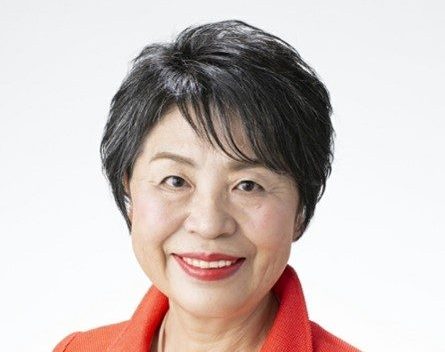
The Minister for Foreign Affairs of Japan Yoko Kamikawa will head the Japan delegation, with plans to visit Samoa enroute to Fiji this week.

Delegations from Australia, Cook Islands, Federated States of Micronesia, French Polynesia, Kiribati, Nauru, New Caledonia, New Zealand, Niue, Palau, Papua New Guinea, Republic of Marshall Islands, Samoa, Solomon Islands, Tonga, Tuvalu, and Vanuatu will begin arriving in Suva this weekend.

SOURCE: PIFS/PACNEWS

Amata welcomes next step for Pacific Partnership Act

0

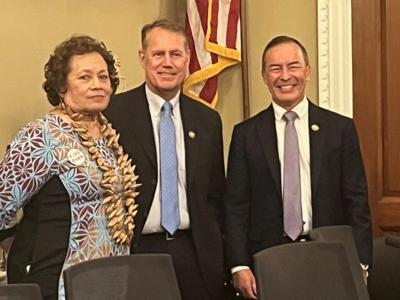
U.S Congresswoman Uifa’atali Amata is an original cosponsor of the bipartisan Pacific Partnership Act, H.R. 7159, and is welcoming passage Tuesday in the House Foreign Affairs Committee.

The bill, sponsored by Rep. Ed Case, D-Hawaii, would bolster U.S engagement with the Pacific Islands region, an issue which Congresswoman Amata highlights often.

Speaking in support of the bill in committee, Congresswoman Amata emphasiAed that the U.S is a Pacific Island nation by giving her statement first in Samoan before repeating it in English.

“My home is a Pacific Island, and we are increasingly under threat — especially from China. China is increasingly investing in the Pacific Islands — building infrastructure projects just 70 miles from my home, in Independent Samoa.

“Now is the time to act! We have to show an American commitment to the Pacific — it codifies an American strategy for the Pacific Islands and codifies the Partners in the Blue Pacific Initiative to deconflict aid to the region and encourage cooperation.

“I want to thank Rep. Case for his leadership on this bill and for all the members who have showed their support for the Pacific Islands.

“Thank you and God bless,” she said.

SOURCE: MARIANAS VARIETY/PACNEWS

PNG wants to stand on its ‘own two feet’: PM Marape

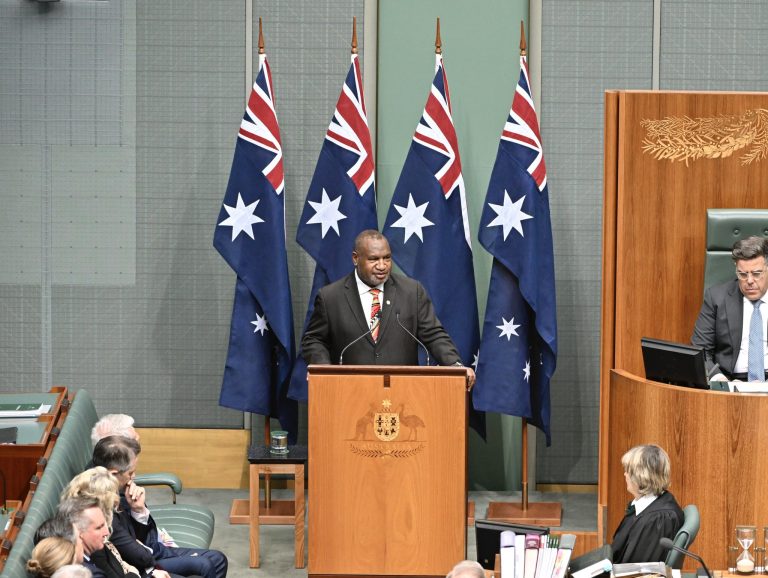
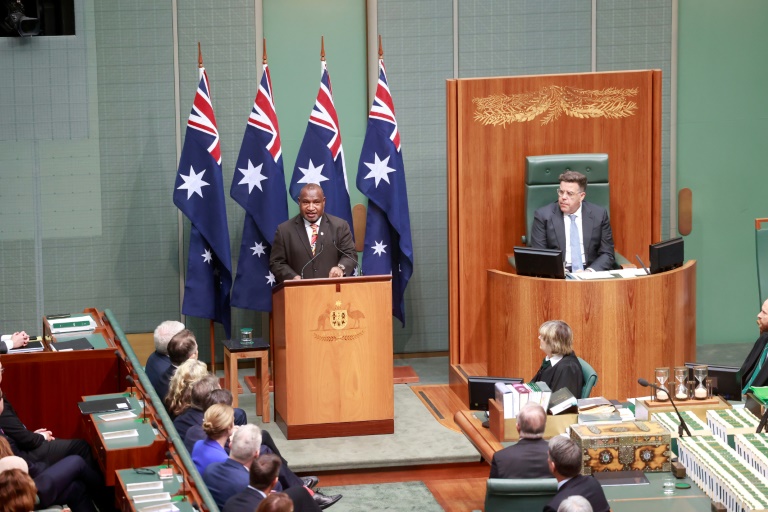
Papua New Guinea must become a strong nation and stand on its own two feet, its prime minister said in a historic address to federal parliament.

James Marape on Thursday became the first Pacific leader to address a joint sitting, lauding the close bonds between the near neighbours and thanking Australian governments and investors for their economic support.

“Papua New Guinea must not continue to be an aid grant-receiving nation, a nation that depends on borrowing every year to survive, we must become a strong country standing on our two feet,” he said.

“We’re looking forward to not letting down the aspirations of those who came before us.”

A recently signed bilateral agreement provided a “blueprint” for PNG to become an economically resilient nation.

“A strong economically and powered Papua New Guinea means a stronger and more secure Australia in the Pacific,” Marape said.

“Contribute where you can and leave the rest to us, we will do our best.”

Marape also used his speech to reflect on the nearly 50 years since PNG was granted independence from Australia in 1975.

“I want to say thank you to the memory of prime minister (Gough) Whitlam for hearing the cries of the founding fathers of Papa New Guinea for our own self-determination,” he said.

Marape met with Prime Minister Anthony Albanese following his address, where the pair discussed PNG’s economic sustainability and budget repair plans, including its reform program that’s supported by the International Monetary Fund.

The leader-to-leader discussions also spanned policing and regional security.

Marape singled out poverty as one of his nation’s biggest challenges as he tried to boost investment in PNG to make it more economically independent.

“Building a strong economy ensures our domestic security as well as regional security,” he said later in a speech at the Australian National University.

“And in the process, we hope to support Australia in the upkeep of our region.”

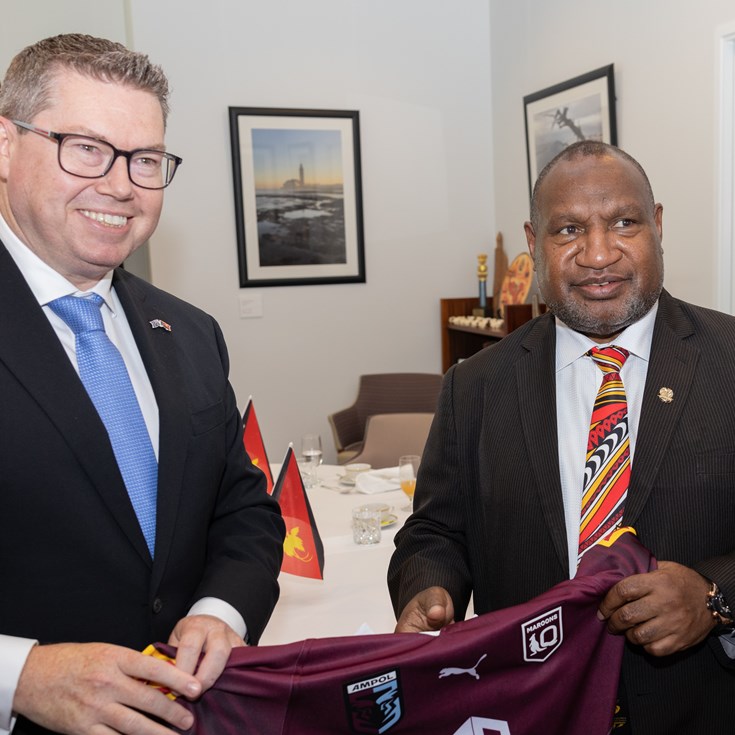
Football diplomacy was also thrown into the mix, with Australia extending its programme helping create a pathway for high-performance athletes and keeping the PNG Hunters team in the Queensland Cup.

Australia will also fund a women’s rugby league competition in PNG and support a talent scouting program for them.

“Rugby league is really a vehicle for gender equality in Papua New Guinea,” Pacific Minister Pat Conroy said.

Australia and PNG were close in every sense of the word, Albanese said.

“We are the nearest of neighbours, the most steadfast and trusted partners, and the very oldest of friends,” he told parliament.

“Our connection stretches back thousands of years to Torres Strait Islanders and Indigenous traders, weaving together their cultures and communities.”

PNG’s independence from Australia in 1975 was not a gift but a right asserted by its people, Albanese said.

“It speaks for a universal truth,” he said.

“Every Pacific nation, big and small, has the right to shape its own future and secure its own destiny.”

Opposition Leader Peter Dutton reflected on the appreciation Australians felt towards their Pacific neighbour after their soldiers fought side by side at Kokoda during World War II.

“To this day, Australians commemorate the tenacity of your soldiers – the bravery of your coast watchers and the compassion of your Fuzzy Wuzzy Angels who all helped to turn the tide of the war,” he said.

Marape received a ceremonial welcome and signed the official visitors book at Parliament House before he addressed the joint sitting.

SOURCE: AAP/PACNEWS

Cooks add to spike in Pacific security talk

0

By Sam Sachdeva

With a common citizenship and currency, closely related native languages, and formal relations dating back over 120 years, there is much that binds the Cook Islands and New Zealand closely together.

Yet in recent years, the small Pacific nation has increasingly sought to move out from the shadow of the Realm of New Zealand.

Sporadic talk about securing fully sovereign status may not have come to fruition, but the United States’ decision to initiate direct diplomatic relations with the Cook Islands (as well as Niue) last year has served as a boon to those in the country hoping to benefit from bilateral ties with partners other than New Zealand.
read more

While Aotearoa maintains a specific obligation to assist with the Cook Islands’ defence and security if asked, the country is looking to branch out in that area too.
Marking 30 years of diplomatic relations between his nation and Australia last month, Cook Islands prime minister Mark Brown announced his desire to pursue a new defence and security agreement involving not just New Zealand, but our trans-Tasman neighbours as well.

Speaking at a press conference this week after his meeting with Peters, Brown indicated the proposal was primarily about updating existing Australian support to the Cook Islands in areas like transnational crime and cybersecurity threats.

“Linking that with New Zealand’s traditional support for our security and defence arrangements is something that I think would be worth our three countries sitting down and having a chat about what that would look like.”

If the prime minister’s plan does come to fruition, it would be just the latest in a series of pacts signed across the Pacific in recent years – raising fears in some quarters about the potential militarisation of the region.

In early 2022, news broke of a security deal between China and the Solomon Islands that would allow the superpower’s vessels to carry out “logistical replenishment” in the Solomons – a potential precursor to a permanent base with military applications, according to some experts.

Since then, Western nations have been rushing to head off the threat of further Chinese security pacts. The United States has inked deals with Papua New Guinea and the Marshall Islands – the former giving the American military “unimpeded access” to the island nation’s bases – while Australia has signed defence-minded agreements with Papua New Guinea, Tuvalu and Vanuatu (although the lattermost is in doubt after the country’s new prime minister indicated last September he wished to rewrite the deal).

New Zealand is no exception, having signed a new deal with Fiji in mid-2023 to strengthen military training and maritime security.

Peters seemed reluctant to make too much of the trilateral concept for the time being, his remarks to media indicating the Government may have received little advance warning of the Cook Islands’ aspirations.

“We’re talking about something new that has been floated with Richard Marles, the deputy prime minister of Australia, and [Australian foreign minister] Penny Wong well before we got to hear it right here, right now, and so both Shane Reti and myself and our Cabinet will have to consider that going forward, on the best advice of our foreign affairs team.”

The foreign minister was also cagey when it came to the topic of the proliferation of security pacts throughout the Pacific – yet it was just about possible to discern a veiled critique of China’s diplomatic endeavours in the region, albeit without ever directly naming the country.

“The approach that we would like to follow is, let’s find out what is actually being said, what has been promised to the rest of the world, and hold those people to the promises they made…

“If you say, ‘I’m here for a peaceful purpose, but I’ve got a whole lot of things I want to do militarily’, you’ve kind of got to be called out, I would expect, wouldn’t you?”

Then there is Aukus, the polarising trilateral security pact with a bill many magnitudes greater than anything that could possibly be agreed between the Cook Islands, New Zealand and Australia.

While New Zealand contemplates whether to sign up to the second pillar of the deal, focused on emerging technologies, it is the plans to provide Australia with nuclear-powered submarines that have caused the most unease in the Pacific – at least in part due to the destructive legacy of nuclear testing in the region.

Although some Pacific activists, scholars and politicians have criticised the plan to spend hundreds of billions of dollars on military hardware rather than tackling climate change, reaction to the prospect of New Zealand taking up a role in the less contentious aspects of Aukus has been muted so far on Peters’ trip.

Tonga’s acting prime minister Samiuela Vaipulu dodged a question about his country’s views, saying simply that “we don’t interfere with what other countries do”, while Brown’s initial concern about the deal in 2023 subsided after he received “assurances” from American officials regarding the nuclear dimension.

But on Thursday, Brown reiterated his belief that the time was right for a review of the Treaty of Rarotonga – the 1985 pact that established a ban on the use, testing and possession of nuclear weapons within the South Pacific – taking into account issues like the Aukus pact, as well as the discharge of contaminated wastewater from Japan’s Fukushima nuclear plant into the Pacific.

Marco de Jong, a Pacific historian at the Auckland University of Technology, told Newsroom the potential revitalisation of the Treaty was “timely as the region faces a new nuclearism and works to distance itself from superpower rivalry”.

“To strengthen and update Rarotonga for today, Pacific nations might review its language, work to have it universally adopted amongst Pacific nations, or have its existing provisions better enforced,” de Jong said, noting that some nations had “downplayed” its application in relation to Aukus and Fukushima despite going against the spirit of the treaty.

Peters has bridled whenever the issue of Aukus has been brought up by New Zealand journalists on his current trip – but just as new security deals show no signs of diminishing, the topic is unlikely to go away any time soon.

SOURCE: NEWSROOM/PACNEWS
NRL’s Pacific revolution rolls on with launch of advisory body for Māori and Pasifika players

0

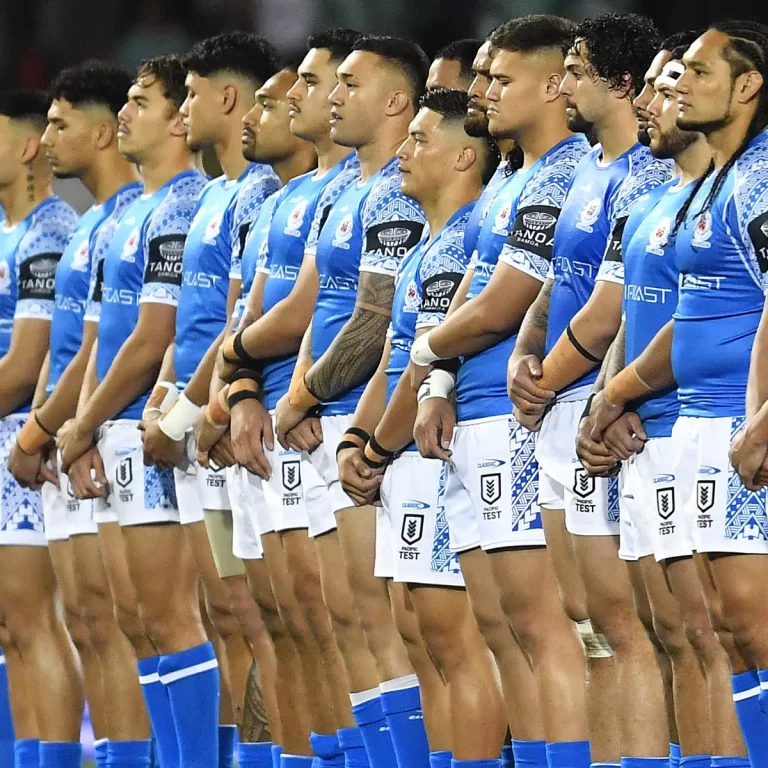
A new NRL player forum has been established in response to the growing influence of Māori and Pasifika athletes, who the NRL says make up over 45 percent of players in the elite men’s competition and over 48 per cent of women competing in the NRLW.

The Rugby League Players Association (RLPA) launched Māori and Pasifika player advisory body, the Mana Group, this week to ensure the cohort is adequately represented, and has already hired former players from Māori and Pasifika backgrounds to work in player operations.

The advisory group will promote Māori and Pasifika players into leadership roles and create an environment where players and stakeholders – especially those from non-Pasifika backgrounds – will have the opportunity to discuss matters involving the increasingly diverse NRL and NRLW playing group.

The move follows the Manly pride jersey boycott in 2022, which highlighted the need for greater cultural awareness of Pacific Islands athletes in the sport. The Sea Eagles’ then-coach Des Hasler said mistakes were made by management, with “little consultation or collaboration” within the club’s Māori and Pasifika players on the proposed rainbow jersey, seven of whom refused to take part in the match for religious and cultural reasons.

The launch of the Mana Group is a shift in approach around consultation with Māori and Pasifika players. A previous advisory panel was jointly managed by the NRL and RLPA, but the new group is being managed solely by the players.

Cowboys NRLW and PNG Orchids player, Shellie Long, said she was proud to be part of the Mana Group, and its establishment reflected the growth in the number of professional players from Māori and Pasifika communities and the need to better understand them.

“Building those relationships and building that trust with those players is essential to keeping the game alive,” she said.

“We know Māori and Pasifika people can be quite shy, quite scared to have certain conversations. But this group will allow us to promote Māori and Pasifika players but also help them eventually go into those leadership roles off the field.”

RLPA chief executive, Clint Newton, said the Mana Group has the support of the NRL.

“We have a good history of Pasifika and Māori players in our leadership group, including Sia Soliola on our board, but we acknowledge we are forever on a journey of growth and understanding,” he said.

The group also includes current and former NRL and NRLW players Zahara Temara, Simaima Taufa, Junior Paulo, James Fisher-Harris, Siliva Havili, Feleti Mateo and David Mead.

Newton said the new group “will enhance our service to that demographic and their specific cultural needs, and also enable them to fill more leadership roles on and off the field.”

Former NRL and Cook Islands player, Tinirau Arona, was appointed to the role of RLPA player operations manager last year, with former Pasifika and Māori players Nita Maynard, Joe Galuvao and Soliola also brought into the fold.

Arona said it was important for people from Maori and Pasifika communities to see there are non-playing opportunities in rugby league, and cited the efforts of Galuvao, Mateo, fellow NRL employee David Solomona and Frank Puletua, now the General Manager of Oceania Rugby.

“Those guys are leading the way for our Pacific communities, and it just gives that sense of hope and belief for our community that it’s possible, and there is a pathway.”

Arona said he hoped to be able to inspire others.

“It’s cool to see a young Pacific Islander boy from Western Sydney, one of our own, in these positions outside of the playing arena.”.

SOURCE: THE GUARDIAN/PACNEWS

Albanese govt boosts support for rugby league in PNG

0

The Albanese Government is bolstering rugby league player development in Papua New Guinea with further assistance for high-performance pathways and the participation of the PNG Hunters team in the Hostplus Cup.

The assistance, under the PacificAus Sports program, continues the Government’s partnership with the Queensland Rugby League (QRL) as well as its support for the development of elite PNG rugby league players and PNG’s aspirations for an NRL franchise.

The assistance will be used to establish a national women’s competition in PNG and support a women’s talent identification program as well as build capabilities and credentials of PNG rugby league coaches, support staff and administrators.

Since 2020, the QRL – in close collaboration with the Papua New Guinea Rugby Football League (PNGRFL) – has taken high performance rugby league to the next level.

This culminated in the Orchids’ and Kumuls’ impressive performance at the 2023 Pacific
Championships.

Minister for International Development and the Pacific, the Hon Pat Conroy MP, said the program would continue to make a significant impact.

“Australia and Papua New Guinea have a shared love of sport and the linkages forged between our people through rugby league brings the two countries and their communities closer together,” Minister Conroy said.

“The Albanese Government is proud to support the establishment of a national women’s rugby league competition in PNG, which will provide talented female athletes with enhanced high-performance pathways to support their development.

“This commitment to establishing elite pathways for PNG rugby league players also marks a crucial step towards PNG achieving its aspiration of securing a franchise in both the NRL and NRLW.”

Minister for Sport Anika Wells echoed those sentiments.

“Investing in a national women’s competition will be a game changer for Papua New Guinea talent aspiring to play for the Orchids,” Minister Wells said.

“This assistance is further demonstration of our commitment to Pacific athletes and the development of women in sport, not just in Australia but abroad.”

Having already visited PNG twice since his appointment as QRL CEO, Ben Ikin is excited about the opportunity to continue to grow the game in the country.

“It’s a privilege to partner with the Australian Government, PNGRFL and the PNG Hunters to help support the growth of rugby league in PNG,” Ikin said.

“The QRL prides itself on being an experienced and responsible steward of the game in Queensland and we’re happy to share our knowledge and expertise with trusted partners.”

Papua New Guinea Rugby Football League (PNGRFL) CEO Stanley Hondina acknowledged the importance of the program.

“The PNGRFL and the PNG Hunters are grateful for this partnership with the Australian Government and the QRL. The last two years have started the phase for long term improvement in the game in PNG,” Hondina said.

“Our female game is in its initial professional competition stage, and we are looking forward to getting it off the ground for the for first time’’.

‘’We appreciate the people-to-people connection piece that links our two countries and the support from the Australian Government and the QRL’’.

PNG Orchids player Jessikah Reeves said the support for rugby league from the people in PNG was unmatched.

“Playing at the Santos National Football Stadium in PNG in front of our local fans is an unreal experience,” Reeves said.

“As an Orchid, it means a lot to me to inspire young girls in PNG to put on the Orchids jersey and represent our country proudly.

“I believe there are many girls with the potential to earn that badge. My message to them is simple. ‘train hard and compete fiercely in everything you do’.

“Having a women’s national competition in PNG is a huge opportunity for our girls. It gives them a chance to showcase their talents and gain experience at a higher level.

“We (Santos PNG Orchids) have built our way up through determination. This competition will help level the pathway for women in PNG (similar to the men) and support the future success of the Orchids. Together, as one big family, we’ll keep striving.”.

SOURCE: POST COURIER/PACNEWS

PNG PM James Marape urges Australia to not ‘give up’ on his country in historic parliament address

The Prime Minister of Papua New Guinea James Marape has urged Australia to not “give up” on his country during an historic address to the federal parliament.

On Thursday morning, Marape became the first Pacific leader to address the joint sitting of both houses, with MPs and Senators packing into the lower house to listen.

The prime minister dwelt heavily on the shared history between Australia and Papua New Guinea, paying tribute to prime minister Gough Whitlam who helped shepherd his country to independence almost 50 years ago.

“It was from this parliament that many decisions were made that have helped and shaped what Papua New Guinea was before 1975, and what Papua New Guinea is after 1975,” Marape said.

“This is why Papua New Guinea has a very special and very unique relationship with Australia. We are the only country Australia has birthed.”

He acknowledged that Papua New Guinea continues to grapple with profound social and economic difficulties in the wake of riots that gripped the capital Port Moresby just last month, but declared that his government was intent on overhauling the public sector, police force and judiciary in order to improve stability.

“It is true our people need greater empowerment in many aspects of their life. But not all is bad. Not all is bad,” he told the joint sitting.

“Nearly 50 years on, our democracy remains strong as ever …. we have not fallen to the barrel of the gun as many emerging nations.”

Australia has extended multiple loans and grants to Papua New Guinea worth billions of dollars to help support its budget bottom line and develop its infrastructure, and last year the two nations struck a security pact which will see Canberra plough a further $200 million (US$130 million into developing PNG’s police force and judiciary.

Marape said PNG’s leaders had to deal with a vast and inaccessible landscape, widespread illiteracy and a large and hugely diverse population.

“As I visit you today, I ask you — do not give up on Papua New Guinea,” the prime minister said.

“We have always bounced back from our low moments and we will continue to grow, learning from every low moments and every high moments.”

Marape has repeatedly spoken about the critical need to expand PNG’s economic base and cut its dependency on development assistance, and he struck a similar theme this morning.

“Papua New Guinea must not continue to be an aid grant receiving nation, a nation that is borrowing every year to survive,” he told the joint sitting.

“We must become a strong country standing on our own two feet economically independent and strong so we too can help Australia maintain democracy, preserve peace and ensure stability in our part of planet Earth, in our Pacific.”

The prime minister also drew a laugh when describing Australia and PNG as siblings which were joined at the hip.

“One is stuck with family forever… our two countries are stuck with each other. We have no choice but to get along,” he said.

SOURCE: ABC PACIFIC/PACNEWS

Winston Peters and Shane Reti make Cook Islands climate change announcement

0

Tackling the impacts of climate change is a key focus for New Zealand, with a total of $16.5 million (US$10 million) to go to the Cook Islands to help fight the crisis.

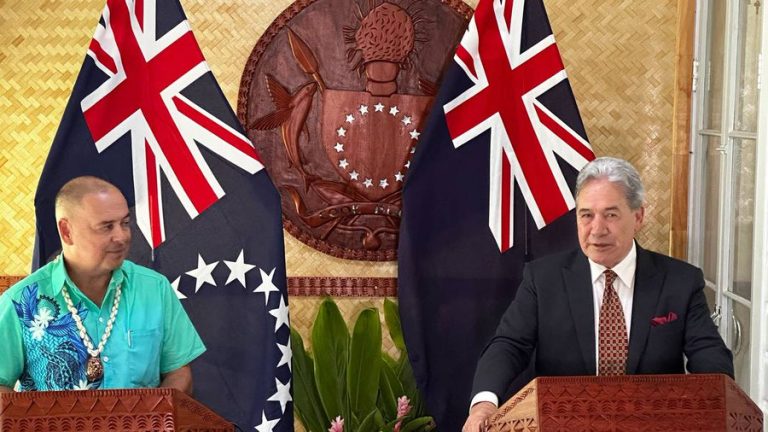
Deputy Prime Minister and Foreign Affairs Minister Winston Peters made the announcement in the Cook Islands this morning, where he and Pacific People’s Minister Dr Shane Reti are on the second day of a Pacific mission.

The funds will go to projects including cycle shelter upgrades, battery replacements, water security, and renewable energy systems in the island nation.

Some of the climate change impacts already being seen in the Cooks include coastal erosion to sea level rise – another very serious issue for a number of other Pacific nations including Tuvalu and Tokelau.

“We are committed to continuing to respond together to the complex and varied challenges facing the region, as well as finding areas and opportunities for bilateral co-operation,” Peters said after meeting Cook Islands Prime Minister Mark Brown.

Today’s announcement comes as the mission’s delegation settles into day two of the trip – which officially started in Tonga and will end in Samoa.

The group touched down in Rarotonga last night; effectively going back in time – with the Cook Islands being behind one day.

Earlier this morning, Peters and Reti took part in a ground-breaking ceremony for the new Punanga Nui farmers market in Avarua.

The market – which New Zealand helped with the development of costing about $8m (US$4.8 million) – is a popular hub with locals and tourists alike and will be a welcome boost to the local economy.

Acknowledging the somewhat stormy reception Peters got at Waitangi this week, a Cook Islands official told him they were welcome here.

He said that throughout the week, up to 50 vendors set up shop at the market. On Saturdays, that number is around 100.

Those vendors will now move from being in a carpark, to an actual sheltered building, he said.

The market was described as an opportunity not only for locals to earn a living, but also providing a grassroots approach to boosting the local economy.

As in Tonga, Peters and Reti received a warm reception complete with a traditional Rarotongan welcome.

Addressing the official’s comments about Waitangi, Peters said: “I wasn’t worried – at all. I don’t want people thinking they can come along … they woke up yesterday and know more than we do.”

He said he liked the idea of being called the “action man” and said he wanted to see the Cook Islands’ economy continuing to grow.

As he neared the end of his speech, a huge gust of wind ripped through the guests’ marquee – lifting it slightly.

Peters quipped: “I’m sorry we couldn’t bring a calmer day for us.

SOURCE: NZ HERALD/PACNEWS

Media policy in vetting process: PNG Information Minister

Papua New Guinea’s National Media Development Policy is going through the Social, Law and Order Sector Heads vetting and clearance process before it is presented to Papua New Guinea Cabinet for endorsement.

Information and Communications Technology Minister Timothy Masiu said this when refuting claims by Ialibu-Pangia MP Peter O’Neill that journalists would be jailed if found to be misreporting.

Masiu said: “I have not seen anything in the policy that states a person or journalists will be jailed if there is misreporting.

“We are now continuing the consultation process through the relevant state agencies to ensure we don’t stray away from government policy and the spirit of the constitution of the country. Therefore, we don’t intend to jail people.

“Please see the department website https: http://www.ict.gov.pg to read the policy .”

Masiu said O’Neill must not mislead the people as this was clearly politicking at a time when the Prime Minister is visiting Australia and when there was talk of a vote of no confidence.

He said on the contrary, the policy aimed to support the media industry to become more professional, ensure that journalists were trained well, establish a clearly defined self-regulatory process for the media, become more accountable and responsible to their code of ethics and conduct.

“I repeat what I stated recently that we do not want to tighten up on media but we want to make sure reporters are responsible for what they report and will emphasise on media quality accessibility and responsibility to information dissemination based on facts,” Masiu said.

“The policy will put in place the self-regulatory process and this process will determine the accountability of the media to be discussed further by stakeholders including the media fraternity.

He said the Department of ICT had conducted extensive consultation and the general response was for a clear policy direction to address media quality, journalist welfare and profession and strengthen self- regulation as the key focus of the policy.

“The policy is on the Department’s website and I welcome the member for Ialibu-Pangia to see for himself the policy and for others to also peruse.

“There is no attempt to curb media and the freedom of speech,” he said.

SOURCE: THE NATIONAL/PACNEWS

Fiji Cabinet approves medicinal cannabis industry establishment after nationwide consultations

0

Following extensive consultations and careful deliberation, the Fiji Cabinet has given the green light to establish the medicinal cannabis industry in the country.

A Taskforce was established in August 2023 to carry out national and community consultations on the proposal.

It was also mandated to oversee the feasibility of this industry and assess the laws required for this emerging market.

The Taskforce has also carried out media engagements, public and community consultations and private sector engagements.

A total of 17 nationwide and community consultations from 09 October 2023 to 28 November 2023 were carried out providing the Taskforce with insights into the socio-economic impacts of this proposal.

The Taskforce registered a total of 513 participants, where 287 members of the public engaged during the community consultations, and 226 participants engaged during the public consultations.

The policy framework guiding the establishment of the medicinal cannabis industry outlines the Taskforce’s work to include (but not limited to), the following:

(i) develop a comprehensive feasibility study that includes conducting nationwide consultation;
(ii) establish a mechanism to allow foreign investors to establish the medicinal cannabis industry in Fiji;
(iii) review and amend relevant laws to facilitate the medicinal cannabis industry in Fiji; and
(iv) devise and create the right and appropriate policies and laws for the medicinal cannabis industry in Fiji.

Cabinet noted that the Market Development Facility (MDF) will fund the feasibility study.

In addition, the Ministry of Trade will enter into a three-year MOU with Aether Pacific Pharmaceuticals Ltd trading as Medical Kiwi, to establish a framework for cooperation and collaboration between Medical Kiwi and the Government for the development of medicinal cannabis in Fiji.

Medical Kiwi is a registered company in New Zealand. It is a market leader in New Zealand, in the cultivation and export of medicinal cannabis and cannabidiol to export markets using innovative science and technology.

Medical Kiwi intends to build an extraction and manufacturing facility in Fiji. The facility is aimed to eventually obtain the Good Manufacturing Practices certification for the nutraceutical and pharmaceutical markets.

When the medical cannabis industry is established by law and policy in Fiji for cultivation and export, Medical Kiwi would still be required to apply for the appropriate licence and adhere to the rules and regulations stipulated.

Medical Kiwi endeavours to invest a minimum of FJD$65 million (US$32.5 million) within 3 to 5 years, subject to the extent permissible by law.

SOURCE: FIJI GOVT/PACNEWS

Stay connected

529FansLike
172FollowersFollow
156SubscribersSubscribe
- Advertisement -