Home Blog Page 37

Palau pushes blue economy at Melanesia Ocean Summit

0

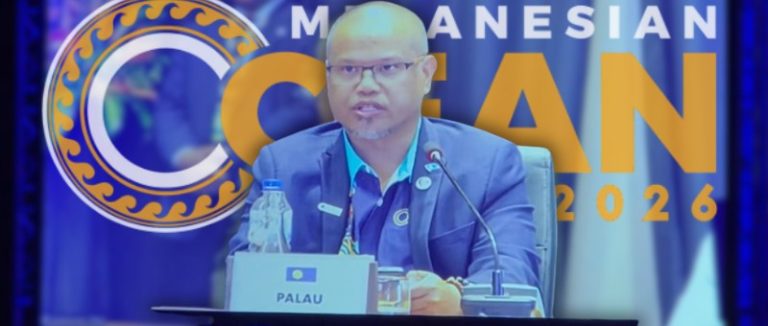
Palau’s Special Envoy of the President, Steven Victor, told the Melanesia Ocean Summit underway in Port Moresby that Pacific nations must harness ocean resources to drive prosperity, stressing that conservation must go hand‑in‑hand with economic growth.

“It is about financing our transition to a sustainable blue economy and ensuring that the wealth of our resources stays within our islands,” he said.

Victor highlighted Palau’s 20‑year migration channels programme as proof that local action can deliver regional success, while urging nations to adopt the Unclogging Pacific Prosperity Plan.

The plan calls for managing 100 percent of Pacific waters sustainably, with 30 percent under high protection, while building scientific and financial capacity to control their own resources.

He pointed to East New Britain’s initiative as an example of a transition to a blue economy to retain benefits in the Pacific and reaffirmed Palau’s leadership as the first nation to ratify the High Seas Treaty.

“The health of our waters depends on the health of the islands,” he said, urging others to join.

The envoy concluded that economic resilience and ocean stewardship must advance together, so Pacific nations can secure livelihoods and long‑term prosperity for their people.

Marshall Islands stresses community role in ocean protection

0

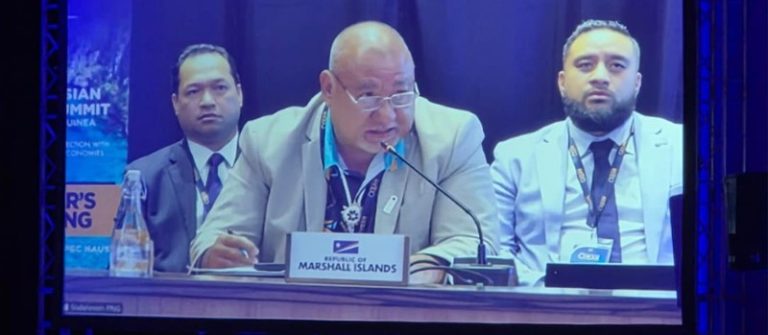
The Republic of the Marshall Islands (RMI) has told the Melanesian Oceans Summit that conservation must be rooted in communities and guided by traditional knowledge.

Speaking on behalf of President Dr Hilda Heine, the Special Envoy said lessons from the Micronesian challenge show that protected areas are strongest when local people lead.

“Conservation succeeds when communities own it. Traditional knowledge and science are not competing systems, but complementary ways of caring for the same ocean,” he said.

He said the National Conservation Area Framework brings together governments, traditional leaders, women, youth, fishers, and scientists to decide how best to manage resources, linking community stewardship with national systems and global commitments.

He added that Melanesia’s vision for reserves, research hubs, and sustainable fisheries reflects the same principle.

“Ocean protection must be community‑rooted, legally grounded, scientifically informed, culturally respectful, and practically financed,” he said.

FSM special envoy urges regional unity at Melanesian Ocean Summit

0

Special Envoy for the President of the Federated States of Micronesia (FSM), Kandhi Elieisar, addressed regional leaders at the Melanesian Ocean Summit Tuesday, calling for urgent, science-based action to protect the Pacific’s most vital resource.

Representing President Wesley W. Simina, Elieisar opened his remarks by thanking Papua New Guinea’s Prime Minister James Marape for hosting this gathering.

The Envoy emphasised that for island communities, the ocean is more than just a resource; it is a source of food, income, and cultural identity.

“It is indeed the lifeblood of our island communities,” he stated, “and is fundamental to our sovereignty.”

However, he issued a stark warning regarding the deteriorating health of the Pacific.

He highlights several “unprecedented challenges,” including: The region’s primary security threat. Over 150 million metric tons of plastic currently contaminate the seas.

Elieisar added that nearly 90 percent of global fish stocks are fished at or beyond sustainable limits.

“There is simply no healthy planet without a healthy ocean,” Elieisar remarked, noting that human activity remains the chief cause of this decline.

Representing a “big ocean state,” the FSM Envoy urged Pacific nations to leverage their collective strength.

He highlighted the Micronesia Challenge 2030 as a flagship framework for translating global biodiversity goals such as the “30×30” initiative—into concrete local results.

Elieisar also called for the swift ratification of the BBNJ Treaty (Biodiversity Beyond National Jurisdiction), stressing that developing states must have fair access to green technology and benefit-sharing.

The Envoy concluded by reminding the summit that ocean governance is a generational responsibility.

“It is not so much that we inherit the ocean from our ancestors,” he concluded, “but that we borrow it from our children.”

The summit continues this week, with leaders expected to further discuss regional cooperation and shared solutions for a resilient Pacific continent.

Pacific nations secure more funding for climate and aid

0

Australia will provide more support to Pacific nations including funding for upcoming climate change summits and tax exemptions for some rugby league players.

Tuesday’s federal budget contained more than $335 million (US$242 million) of assistance across the Pacific.

The bulk of the funding will go towards development assistance measures for Nauru, with $167.3 million (US$121 million) over the next four years and about $50 million (US$36 million) per year after that.

The funding will kick in from 2027, when an existing aid program expires.

The Pacific will also get $147 million (US$106 million) to help host events as part of the UN’s annual climate summit.

Pacific nations will help host conferences in the lead-up to the summit, including a leaders’ event.

After Australia and the Pacific made a joint bid to host the UN summit, a diplomatic compromise saw hosting rights fall to Turkey, but Pacific countries are hosting events ahead of the main gathering.

Security across the region will also be bolstered, with $5.5 million (US$3.97 million) to guard against money laundering, crime and the financing of terrorism.

An extra $550 million (US$397 million) over the next decade will be set aside for infrastructure resilient to climate change throughout the Pacific and East Timor.

Rugby league diplomacy is also central to the Pacific budget, with players signing on to the PNG Chiefs team in the NRL, as well as club staff, given an exemption from paying tax.

The sweetener will deliver a $5.4 million (US$3.90 million) hit to tax revenue over the next four years.

The ABC will also receive funding to build media distribution and engagement in the Pacific, with $14.1 million (US$10.19 million) set aside.

Aid outside of the Pacific has also been included in the budget, with continued support for Ukraine.

A duty exemption for Ukraine will also be extended by two years to 2028.

All goods from Ukraine will be duty-free entering Australia, except for products such as alcohol, fuel and tobacco.

Tuvalu Prime Minister defines Ocean Health as frontline of National Security

0

Tuvalu Prime Minister Feleti Teo delivered an address at the 2026 Melanesian Ocean Summit Tuesday, declaring that the ocean is no longer merely an environmental concern for Tuvalu, but the very front line of its national security.

Speaking at APEC Haus, Teo announced that Tuvalu is currently developing its first-ever National Security Policy, which will place maritime conservation and management at the absolute centre of the country’s strategic architecture.

The government expects to officially launch the policy by the second half of this year.

Teo underscored that for a low-lying atoll nation, the distinction between land and sea is a matter of survival.

” For Tuvalu, the ocean is our sovereignty,” the Prime Minister stated.

“It is our economic development, our food system, and the integrity of our borders. Our cultural identity is deeply tied to the health and stability of the sea.”

The Prime Minister highlighted a shift in how the Pacific nation categorizes external pressures.

He noted that traditional environmental issues must now be treated as strategic national security challenges, specifically citing: Illegal, Unreported, and Unregulated (IUU) fishing

Transnational crime and marine pollution, Biodiversity loss and accelerating sea-level rise.

“Safeguarding ocean health is fundamental to safeguarding national resilience, peace, and the future security of our people,” Teo said.

In a regional unity, Prime Minister Teo expressed Tuvalu’s strong support for the Melanesian Ocean Corridor of Reserves (MAPA framework).

He commended the initiative for its shared stewardship, noting that its reliance on both science-based management and customary knowledge is essential for protecting sovereign rights across the Pacific.

Fiji PM Rabuka calls for united Melanesian action to protect and sustain the Pacific Ocean

0

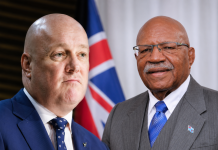
Fiji Prime Minister Sitiveni Rabuka has reaffirmed Fiji’s commitment to regional ocean leadership, sustainable blue economies, and collective Pacific stewardship during his address at the inaugural Melanesian Ocean Summit in Port Moresby.

While delivering his remarks Tuesday, Prime Minister Rabuka emphasised that the Pacific Ocean remains central to the identity, livelihoods, security, and future of Pacific Island nations.

“Fiji comes to this Summit as a Large Ocean State, with the ocean not only surrounding us, but shaping who we are as a people, as an economy, and as a nation. For Fiji, the ocean is not simply a resource. It is our food security, our climate shield, our transport corridor, our culture, our identity, and our inheritance,” Rabuka stated.

“Today, we are not merely discussing oceans, we are shaping the future of our region. As custodians of one of the largest and most significant oceanic regions on Earth, the responsibility rests with us to ensure that our ocean remains a source of life, resilience, prosperity, and peace for generations to come.

“The ocean is not simply a resource. It is our food security, our climate shield, our transport corridor, our culture, our identity, and our inheritance.”

The Prime Minister reaffirmed Fiji’s strong support for the regional vision of an “Ocean of Peace”, describing the Pacific as a region that must continue to be defined by cooperation, solidarity, sustainability, and shared prosperity amid growing global geopolitical competition.

He highlighted Fiji’s national ocean governance efforts, including the implementation of Fiji’s National Ocean Policy and the Climate Change Act 2021, which commits Fiji to sustainably managing 100 per cent of its ocean spaces and protecting 30 per cent as Marine Protected Areas by 2030.

As part of this commitment, Fiji intends to designate up to 15 percent of its waters as Marine Protected Areas by the end of 2026.

The Prime Minister also outlined progress on Fiji’s Marine Spatial Planning process and Blue Economy Framework, aimed at balancing sustainable economic growth with ocean conservation, climate resilience, and community wellbeing.

In supporting the proposed Melanesian Ocean Corridor of Reserves (MOCOR), Prime Minister Rabuka described the initiative as a practical expression of regional solidarity and collective stewardship.

“MOCOR represents a bold and timely step forward, recognising that our oceans do not end at national boundaries, and that our stewardship responsibilities must therefore extend across them,” he said.

Prime Minister Rabuka further called for strengthened regional cooperation in ocean science, maritime security, sustainable fisheries, climate adaptation, and blue economic development.

As part of Fiji’s proposals to the Summit, the Prime Minister announced support for advancing a Melanesia Blue Shipping Initiative focused on developing climate-resilient and low-emission maritime transport systems to improve regional connectivity and reduce transport costs across the Pacific.

He also reaffirmed Fiji’s continued leadership on global ocean and climate issues through its roles in international ocean governance processes, including the United Nations Ocean Conference, the Paris Agreement, and preparations towards pre-COP31 and COP31.

Prime Minister Rabuka concluded by urging Melanesian nations to work together to ensure the Pacific Ocean remains a source of peace, resilience, prosperity, and security for future generations.

“Our responsibility is clear: to protect the ocean that has protected us, to manage it wisely, and to ensure that future generations inherit a healthy, secure, resilient, and thriving Blue Pacific,” he added.

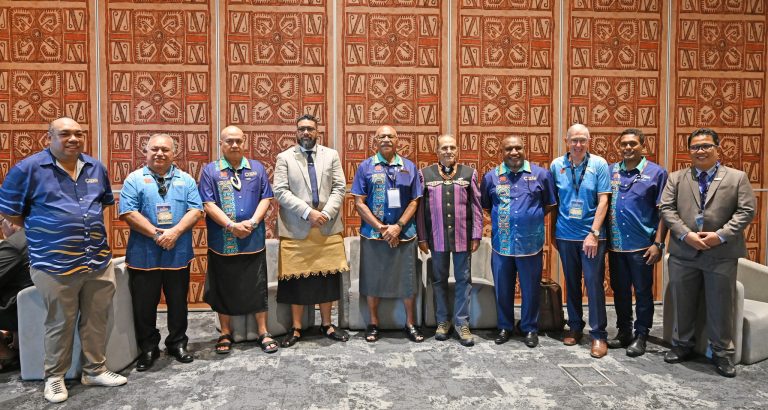
At the end of the first plenary session, the Melanesian leaders present signed the MOCOR Declaration.

Fiji’s endorsement further represents our sub-regional commitment to strengthen the protection, sustainable management, and stewardship of the Pacific Ocean and its marine resources.
Vanuatu PM calls for courage in ocean protection

0

Vanuatu Prime Minister Jotham Napat has called on Pacific nations to act with courage and unity to protect the ocean, warning that climate change and overfishing are already threatening livelihoods across the region.

Speaking at the the Melanesian Ocean Summit in Port Moresby, Napat said marine biodiversity is declining and tuna stocks, vital for national budgets will be disrupted by 2050 if action is delayed.

“Our traditional custodians hold knowledge that no satellite can replace. Our scientists hold tools that no canoe can carry. We need both,” he told leaders.

The Prime Minister announced that Vanuatu has protected more than 17,000 square kilometres of northern waters, about ten (10) percent of its exclusive economic zone, and plans to expand protection once maritime boundaries are settled.

He said regional cooperation is essential, noting that no single nation can manage its exclusive economic zone alone.

Napat also urged Melanesian countries to overcome colonial divisions by working together through a “Melanesian corridor” linking Solomon Islands, Vanuatu, New Caledonia, and Fiji.

He said solidarity, not colonial borders, should shape the future of the Pacific.

Closing his address, Napat declared: “We are not sacrificing our ocean to save it. We are choosing protection over extraction, and the long memory of our ancestors over the short interest of others.”

He offered Vanuatu as host of the next Melanesian Ocean Summit in two years’ time.

Solomon Islands will not endorse a moral declaration at the Ocean summit

0

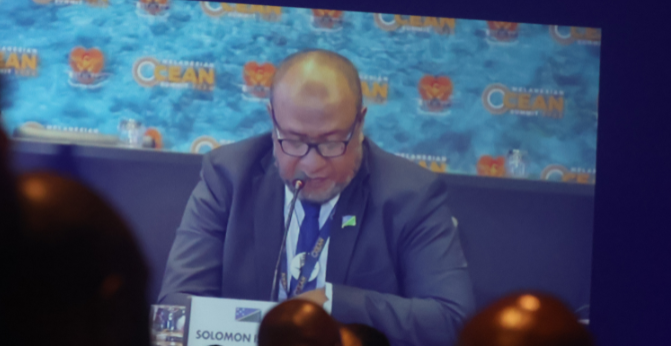
The Solomon Islands has formally declined to endorse a new regional ocean declaration, with High Commissioner William Soaki delivering a pointed defense of indigenous governance and constitutional due process.

Speaking at the Melanesian Ocean Summit in Port Moresby Tuesday, Soaki framed the Solomon Islands’ position not as an act of obstruction, but as a commitment to a vision of cosmic harmony that rejects modern, secular pragmatism.

In an address, High Commissioner Soaki challenged the conventional view of environmental management.

” The ocean is not a resource to be managed from above,” Soaki stated.

“It is a living system of which we are part. The human person is not the absolute master of the universe, but an interdependent component.”

He said that the Solomon Islands’ approach to the ocean is rooted in a totality that predates colonial influence.

He emphasised that the nation never ceded sovereignty over its customary governance systems through colonial treaties.

Central to the High Commissioner’s address was the concept of More, an operational framework the Solomon Islands cabinet endorsed in mid-2025.
He clarified that this framework is a recognition of existing traditions rather than a new initiative.

” There is no external secretariat directing what Solomon Islands does in its own waters,” Soaki said.

“There is no funding deploying resources in our Exclusive Economic Zone (EEZ) without our consent.”

He described the nation’s participation as a voluntary cooperation among willing states, emphasising that the Solomon Islands remains at the summit in a technical capacity only.

The High Commissioner was candid regarding the legal barriers preventing the signing of the summit’s declaration.

He noted that the proposed document: Has not undergone required domestic processes. Lacks clearance from the Attorney General.

Has not been endorsed by the Solomon Islands Cabinet.

“These are not procedural preferences,” he stressed.

“They are the constitutional mechanisms through which our sovereign commitments are authorised.”

Invoking the history of his hosts, Soaki drew a parallel to the 1975 constitutional deliberations of Papua New Guinea’s founding fathers. He quoted their refusal to rush independence for the sake of quantitative change, choosing instead to focus on “lqualitative change.”

” The quality of a foundation matters more than the speed of construction,” Soaki concluded.

“The question Solomon Islands brings today is not ‘Can we produce a document?’, but ‘What kind of governance will it actually create?’” he said.

Cook Islands lead with sacred ocean protection

0

Cook Islands Prime Minister Mark Brown told leaders at the inaugural Melanesian Ocean Summit that his country is committed to safeguarding the Pacific Ocean through one of the world’s largest marine parks and science‑based governance of seabed minerals.

Brown said the Marae moana Act of 2017 created a multi‑use marine park spanning nearly two (2) million square kilometres, with 324,000 square kilometres designated as protected areas where large‑scale fishing and seabed mining are banned.

“Marae moana means sacred ocean,” he explained, adding that its principles of protection, sustainable use, cultural significance and transparency are obligations, “we carry for our children and our children’s children.”

He highlighted that the Cook Islands has completed maritime boundary agreements with neighbours, secured recognition of its extended continental shelf, and is considering whale migration corridors as new transboundary protected areas with Tonga and Niue.

Turning to seabed minerals, Brown said the nation’s Exclusive Economic Zone (EEZ) contains an estimated seven million tonnes of polymetallic nodules but stressed that “any future decision on whether to allow minerals harvesting must be science‑based.”

Three exploration licences issued in 2022 have produced extensive mapping data, but he noted, “the science is not yet complete” and more research is required before decisions are made.

Brown linked ocean stewardship directly to climate resilience, warning of warming seas, bleaching reefs, and shifting fish stocks.

He argued that protection and prosperity can work together: “By leading with knowledge and foresight we can show that a thriving environment is the very foundation of a thriving economy.”

He invited Pacific nations to share environmental standards, marine spatial planning experience, and join Cook Islands’ Women in Science expeditions. “Together let us protect it as our ancestors would expect of us. Let us develop it only as our children can be proud of it,” Brown concluded.

Melanesian Ocean Summit: Message in a bottle

0

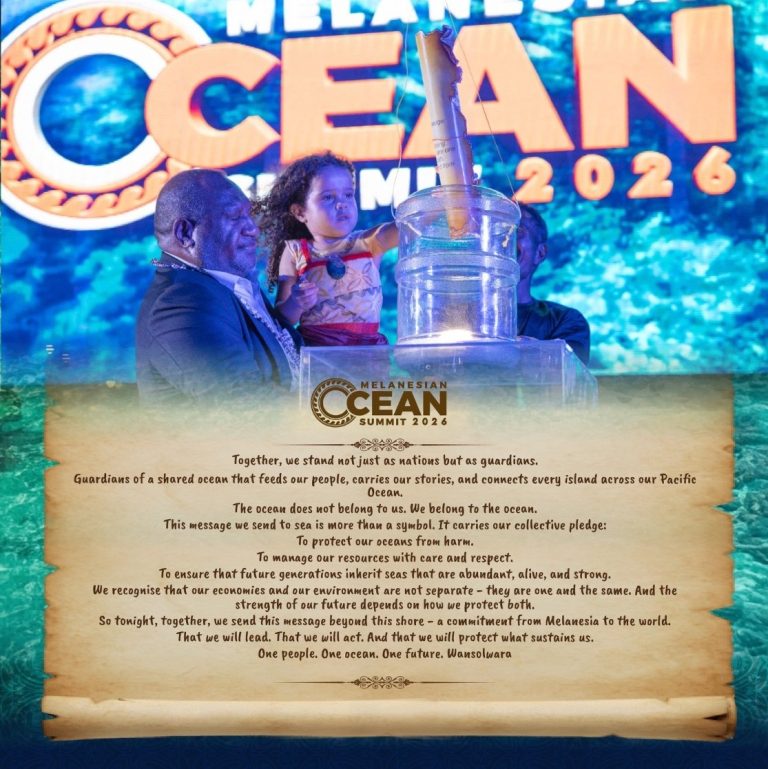
To commemorate the inaugural Melanesian Ocean Summit launch at the APEC Haus on Monday, May 11th, 2026, attending delegates and officials gathered outside to see the message in a bottle sent out to sea.

At the seafront, Prime Minister James Marape addressed all who attended while carrying a child in his arms to symbolize Moana, depicting the Ocean theme

He told the gathering that Pacific nations, as custodians of a vast ocean reservoir, are prepared to sacrifice their economy and influence to protect the life‑giving ocean.

“In the Pacific, we as a big reservoir of ocean can sacrifice our economy, our influence, in the quest to preserve the life‑giving ocean. Please join us, help save our oceans,” Marape said before releasing the message in a bottle.

The message in a bottle contained the following pledge:

To the technocrats out there, to those of you who in haste for profit of today’s generation, squandering the prospect of young Moana’s generation.

Together, we stand not just as nations but as guardians.

Guardians of a shared ocean that feeds our people, carries our stories, and connects every island across our Pacific Ocean.

The ocean does not belong to us. We belong to the ocean.

This message we send to sea is more than a symbol. It carries our collective pledge:

*To protect our oceans from harm.
*To manage our resources with care and respect.
*To ensure that future generations inherit seas that are abundant, alive, and strong.

We recognise that our economies and our environment are not separate – they are one and the same. And the strength of our future depends on how we protect both.

So tonight, together, we send this message beyond this shore – a commitment from Melanesia to the world.

That we will lead. That we will act. And that we will protect what sustains us.
One people. One ocean. One future. Wansolwara.

Stay connected

529FansLike
172FollowersFollow
156SubscribersSubscribe
- Advertisement -