Home Blog Page 197

Samoa Office of the Electoral Commission ready for for pre-polling

0

The Office of the Electoral Commission (OEC) has confirmed it is prepared for pre-polling on Wednesday, 27 August, with over 1,000 voters expected to cast ballots at 50 booths across Samoa.

Electoral Commissioner Tuiafelolo John Stanley said the OEC has taken extensive measures to ensure that all pre-polling stations are staffed, equipped, and ready to provide a smooth and secure voting experience.

“Our teams have worked diligently to prepare every booth, and we are confident that voters will be able to cast their ballots safely and efficiently,” he said.

Pre-polling provides an opportunity for voters who are unable to attend on the official Election Day to participate in the democratic process. Booths opened from 9 am to 4 pm, and votes cast during this period will be treated as special votes, to be counted after the general elections.

The OEC said that all necessary materials, including ballot papers, voter rolls, and security measures, have been distributed to the pre-polling locations. Staff have also been trained to manage voter registration checks, assist voters, and ensure compliance with electoral regulations.

Tuiafelolo emphasised that public confidence in the electoral process is a top priority for the Commission.

“We encourage voters to participate in pre-polling if they are unable to vote on Election Day. Our teams are ready to ensure every vote is recorded accurately and securely,” he said.

By providing multiple pre-polling sites across the country, the Commission aims to make voting accessible to all eligible voters while maintaining the integrity of the electoral process.

Voters are urged to check their nearest pre-polling booth locations and take advantage of this early voting opportunity.

With comprehensive planning, trained staff, and strict adherence to electoral procedures, the OEC is confident that pre-polling will run smoothly, reinforcing public trust in Samoa’s democratic system.

Fiji President calls for united and resolute Pacific voice on climate change

0

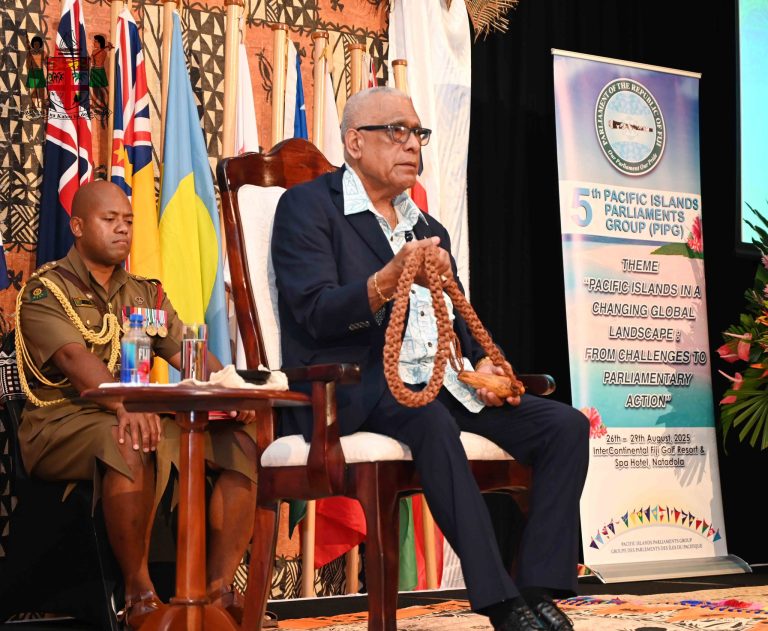
The President of Fiji, Ratu Naiqama Lalabalavu, officially opened the 2025 Pacific slands Parliamentary Group (PIPG) Conference in Sigatoka Tuesday.

Delivering his keynote address, President Lalabalavu welcomed delegates and expressed gratitude for their
presence, noting the conference theme, “Pacific Islands in a Changing Global Landscape: From Challenges to Parliamentary Action.”

He reminded participants that the gathering was not merely ceremonial but a reaffirmation of the Pacific’s commitment to parliamentary democracy, regional solidarity, and the resilience of small island nations.

“The world around us is shifting rapidly, with trade disruptions, economic uncertainties, and the existential threat of climate change reshaping the way we live, work and interact,” he said. “For Pacific peoples, these challenges are not distant headlines — they affect our islands, our families, and our livelihoods.”

The Head of State emphasised that small island states remain uniquely vulnerable to external shocks due to reliance on trade, tourism, and natural resources, with the COVID-19 pandemic exposing starkly the fragility of island economies. Despite this, he said, the Pacific continues to demonstrate resilience, innovation, and unity.

Over the next three days, parliamentarians from across the region will deliberate on key issues, including strengthening economic resilience, harnessing regional integration, and advancing the proposed establishment of a Pacific Inter-Parliamentary Assembly (PIPA).

The President described the initiative as a “historic step forward” that would institutionalise interparliamentary cooperation, strengthen regional governance, and amplify the Pacific voice in global assemblies such as the Inter-Parliamentary Union and the Commonwealth Parliamentary Association.

Turning to climate change, President Lalabalavu urged delegates to take a united stance, stressing that the impacts of rising seas and extreme weather were already being felt across the region.

“We need to have a united and resolute voice – you must deliberate in the next few days on what must become the priority for our region. The Pacific must fight above our weight and tell the rest of the world how urgent and present climate change is for us.”

He told parliamentarians that the Blue Pacific remains the unifying identity of island nations and urged them to strengthen resilience and solidarity in the face of shared challenges.

“Our Pacific neighbours are suffering. Our countries are already suffering,” he said. “If we are to endure, there is one place, there is one ocean that we share, which sustains and nurtures us collectively — the Blue
Pacific which unites us.”

“Together, we can turn challenges into opportunities, vulnerabilities into strengths, and aspirations into action, let us seize this moment to reaffirm regional solidarity and ensure that the Pacific voice is heard loud and clear on the global stage.”

The three-day conference will bring together Speakers, Members of Parliament from across the Pacific to chart the next phase of parliamentary cooperation under the PIPG.

The conference will provide a platform for Pacific Parliaments to collectively address emerging global challenges and strengthen their role in shaping sustainable development.

Over the coming days, delegates will discuss how global economic shifts—such as supply chain disruptions and protectionist policies—affect Pacific Island nations, while exploring strategies to build resilience through diversification, social safety nets, and climate-smart development.
The forum will also examine the power of regionalism, drawing lessons from blocs such as ASEAN, CARICOM, and the European Union, to consider how deeper Pacific cooperation can strengthen bargaining power and amplify the region’s voice internationally.

A major outcome of the conference is expected to be the establishment of the Pacific Inter-Parliamentary Assembly (PIPA). This new body will serve as a structured platform for Pacific legislatures to deliberate on regional issues, oversee commitments, and enhance democratic legitimacy and accountability across the Blue Pacific.

Tuilaepa warns of ‘greater mess’ if rivals win Sāmoa election

0

This week’s election in Sāmoa is being called one of the most consequential in decades.

At the heart of the contest is former Prime Minister Tuilaepa Sailele Malielegaoi, who, after four decades in Parliament and four years in opposition, is determined to prove that the Human Rights Protection Party (HRPP) is the only viable choice to restore stability and prosperity to Sāmoa.

PMN News sat down with the elder statesman of Sāmoan politics over the weekend in Apia to discuss his views on leadership, lessons learnt from previous elections, and his vision for the next five years.

He believes this ambitious plan will restore confidence in the government both at home and abroad. The party’s campaign, however, is not only about promises on paper but about who is fit to lead – a question Tuilaepa believes lies at the centre of this election.

When asked about the defining issue for voters, Tuilaepa did not hesitate. “To me, the major issue that the voters have to address … is the question of leadership. If the voters opt again to vote for Fiamē or Laauli, I can tell you this country would be in a greater mess than the three and a half years that they ran this country.”

Sāmoa’s elections on 29 August were announced in June following the FAST government’s internal leadership issues, which resulted in a split within the party, a failure to pass the 2025/2026 budget, and the subsequent dissolution of Parliament.

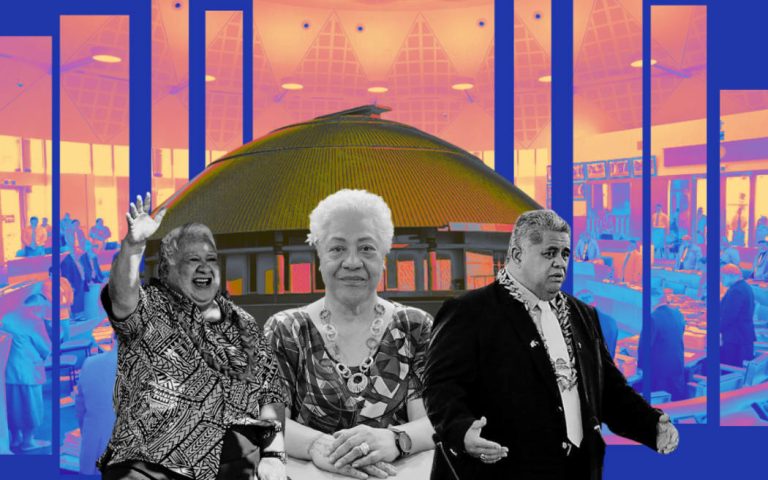
Fiamē Naomi Mata’afa has since formed the new Sāmoa Uniting Party (SUP), while Laaulialemalietoa Leuatea Polataivao Schmidt has taken over as Chairman and Leader of Faatuatua i le Atua Sāmoa ua Tasi (FAST).

Tuilaepa’s confidence in HRPP’s chances of returning to executive leadership is based on positive community responses to their campaign rallies. This election cycle, HRPP adopted the FAST-style roadshow format, visiting every electoral district across the main islands of Sāmoa and increasing its media presence.

The former prime minister contrasts his own leadership style with that of caretaker Prime Minister Fiamē Naomi Mataʻafa, who, after breaking away from HRPP, has led both FAST and now SUP.

Mata’afa described her approach as more hands-off, allowing ministers greater freedom in decision-making. In Tuilaepa’s view, this leads to poor governance.

“When I was Prime Minister, I followed the process,” he explains, describing how any cabinet submission required reports from the Treasury on economic viability, from the Attorney-General on legality, and from sector ministries on practical implications.

“Fiamē disliked this process. She preferred to let the minister responsible do whatever the minister wants without interference from the cabinet. That is a response from a leader that has never worked in government … She lacked the experience of transparency and accountability, principles of good governance.”

For Tuilaepa, the principle of collective responsibility is not just a formality but is a safeguard against chaos.

“Once that principle is not observed, then you will have a cabinet that will fight amongst themselves and the prime minister loses control.”

He recounts an early indication of Mata’afa’s individualism, which led to her departure from HRPP, when she voted against the party in parliament on a matter relating to the President of the Land and Titles Court.

Adopting the FAST style of political rallies in every district has been one of the strategic changes made by HRPP for the 2025 election season.

“That was the first breach of the principle of collective responsibility,” he says. “I stood up in parliament and told her, right, you should be sacked from the cabinet. In the meeting that followed, she apologised to me. That was the beginning of her end.”

The shadow of the 2021 election still looms large for Tuilaepa. Despite the historic failure to return to power, he insists it is not a simple rejection of his leadership.

“There were many issues which caused our fall. A major downfall … was the failure of members of parliament to accept the simple truth that if you have too many members standing for one seat, the vote will spread out so much that a candidate from another party with a small number of votes taken would win.”

Those lessons have shaped HRPP’s election strategy this time around.

He points out that HRPP had the popular vote with around 60 per cent of the tally, compared to around 30 per cent for FAST, but victory was given to Fiamē and Laauli’s new party because of the split vote.

“Winston Peters raised this when he was here. He could never understand why the HRPP lost when 60 per cent of the population voted for the HRPP candidates.”

Another major factor was the one-million-tala constituency promise made by FAST.

“For the first time, people were driven mad,” he says. “Each one thinking that a million dollars will cure all his or her problems … When the FAST government took over, it wasn’t the case. Instead of cash… wheelbarrows and spades were distributed.”

He believes disillusionment in communities has created an opportunity for the HRPP to present a grounded alternative that is both corrective and forward-looking. At the centre of their proposal are three signature poverty alleviation pledges: COLA, a $300 (US$112) annual payment to every citizen; PELEGA, which offers increased pensions for the elderly; and SUPA, which provides assistance for people with disabilities, along with new-born bonuses and vaccination incentives.

“People don’t want to be given things they didn’t ask for,” Tuilaepa says. “They want money to buy food for their children … So, we decided to help our people by putting up these three broad categories of help to ease the pressure of the high cost of living.”

The manifesto also promises hospital upgrades, renewed access to overseas treatment, and a better supply of medicine. It also offers teacher provisions for salaries at mission schools, tertiary grants, and expanded scholarships. Farmers will get tax breaks, financial aid, and export support. Infrastructure improvements include road works, renewable energy initiatives, and a proposed bridge between Savai’i and Upolu by 2035. Businesses will benefit from tax holidays and loans, schools will receive free Wi-Fi, and Savai‘i will see a redeveloped Salelologa with new offices, hospitals, schools, and a multipurpose stadium.

Such an ambitious programme has drawn scepticism, with critics doubting whether it can be delivered within the promised 100 days. For many voters, policy pledges are weighed against trust in leadership. Tuilaepa insists HRPP’s track record speaks for itself, pointing to Sāmoa’s graduation from “least developed country” status in 2014.

“Our donors have always favoured us because of transparency and accountability,” he says, recalling how development partners supported Sāmoa under HRPP’s stewardship. “They know that what they give us we use properly.”

FAST, meanwhile, has repeatedly accused HRPP of mismanagement and corruption. Tuilaepa dismisses the allegations as politically-motivated, citing the forensic audit commissioned by the current government.

The audit investigated major projects under Tuilaepa’s administration, including the Vaiaata Prison, Ti’avea Airport, Satitoa Wharf, and the National ID scheme. Caretaker Finance Minister, Lautimuia Uelese Vaai, confirmed last April that the original list of 20 projects set for review was reduced to 13 due to budget limits and the tight turnaround time for the auditor.

“This government stupidly thought that we did [something] wrong,” Tuilaepa says. “They wasted $1.5 million (US$560,000) to fund a forensic audit, which, up to now, there’s no report. What we gathered was that there was really nothing serious.”

In a recent interview with PMN, Mata’afa says the audit report was before Cabinet, and her first impression of it was that there were no major red flags.

For Tuilaepa, governance is not only about managing funds but also about protecting communities, with the meth epidemic being a major concern.

He says the solution lies in stronger policing, closer collaboration with village chiefs, and tougher sentencing.

“The legislation is there… we have a court that does not agree with recommendations from the police. They let people out, and they repeat what they did. “We need to fix the law so that sentencing is not less than the maximum.”

He also pointed to the return of deportees from overseas and customs delays as key contributors to the drug trade.

Tuilaepa’s relationship with Sāmoa’s diaspora has often been strained, and when asked if his opinion has softened, he suggests that misinformation has misled many people overseas.

“They don’t understand what is happening here. A lot of them base their accusations on false reports. “What we have done to help the diaspora understand is to have these live interviews. And those who listen to our interviews have come around.”

Sāmoa’s local media bodies have mirrored the country’s political divide, with some newsrooms and broadcasters aligning themselves with political parties.

The current Reporters Without Borders global index on press freedom lists Sāmoa at 44 out of 180, a major drop from 2024, when it ranked 22nd.

Sympathetic to the work of the media, Tuilaepa says his role as Spokesman for Cabinet in the 1980s taught him the importance of being open to journalists.

“Very early on, I knew it is very important to have an open-door policy for the media. It is their job, and the people also want to know what the government is trying to do.”

Still, he noted the commercial pressures faced by local media outlets, acknowledging that “a lot of the media are opinionated … They do want to sell the news. People want things that look very bad in order to sell…”

Beyond domestic affairs, Tuilaepa is attentive to regional issues in the Pacific. In contrast to Fiamē, Tuilaepa criticised the Solomon Islands Prime Minister’s move to restrict participation in the upcoming Pacific Islands Forum discussions.

“To me, that is a decision that should be made by the leaders of the Pacific Forum, and it should never be allowed to be decided by one country alone.”

Reflecting on his long career, the Former Prime Minister acknowledges both criticism and praise. At over 80 years old and with more than four decades in Sāmoa’s legislative assembly, Tuilaepa remains a polarising figure.

When asked what he is most proud of over the last four years in opposition, he pointed to HRPP’s record of challenging the government in court.

“The greatest thing is the way we have taken to sue the government for every breach they make.

“If we don’t do it, no one will … Only the HRPP can be the mouthpiece for the whole population who are unhappy.”

As the election approaches, Tuilaepa frames the choice for voters as one of truth and resilience.

“It is not the power that is stronger,” he said, quoting a Sāmoan proverb – “E lē moni le malosi, a e malosi le mea moni, it is the truth that is much stronger than power.
Marshall Islands president vows to rebuild the parliament building

0

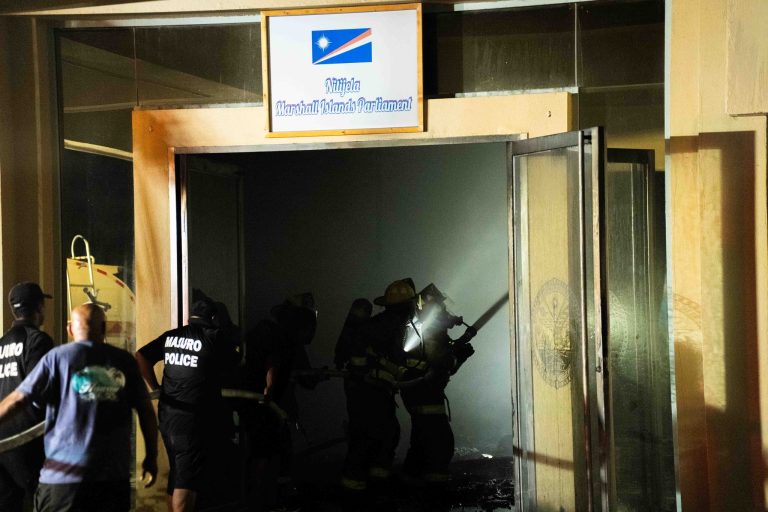
Marshall Islands President Hilda Heine promised to immediately rebuild the parliament building, known as Nitijela, which was burned to the ground early Tuesday morning.

In her video message in Marshallese, Heine said, “the authorities are doing their best to explain to us what happened.”

“Although there has been a great deal of destruction in the making of our law, let us remember that the foundation of our freedom and culture will never be shaken and our work of hard work and diligence will never be lost in any way,” the president added.

Chewy Lin, a freelance photographer and filmmaker who lives near the Capitol building, arrived on the scene with his camera when the fire broke out around 1:10 am.

He said the blaze started from a shipping container behind the parliament building.

“I could see it from outside the gate, but I wasn’t too worried. I thought the fire would be dead soon, but I was there for two hours, and it was still going,” Lin said in a phone interview with the Pacific Island Times.

By 2 a.m., he said, the wind changed direction toward the parliament building and started blowing huge smoke.

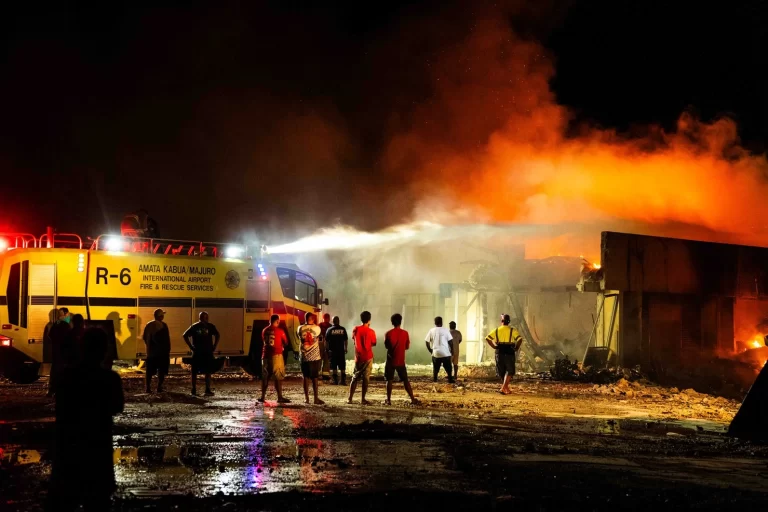
Lin said that since the town’s fire truck has been inoperational for several months, responders had to call a fire truck stationed at the airport, which is a 30-minute drive away from the capital.

“But for them, it’s probably slower, so it came one hour later,” he added.

In the succeeding hours, the blaze continued to engulf the parliament building before firefighters managed to put it under control between 6 am and 7 am.

Lin said it wasn’t known who owned the container and what caused it to go up in flames.

“It’s been there for a while. In the Marshall Islands, we use containers as storage. I’m not sure what was inside that container,” Lin said.

He posted the scene photos on Facebook while the fire was taking place, with a note that reads: “I was literally inside the Nitijela this afternoon to take a photo and now that will be the last photograph of the Nitijela.”

In her video message posted on Facebook, Heine said, “I promise that the work of building the Nitjela meeting house will begin within this year.”

More information will be released in the coming days, she added.

“The Nitjeḷa is a symbol of freedom, a place where our leaders come together, where the laws are made, and it is the highest house of the Marshallese people,” the president said.

“The vision of the Nitijeḷa is not only about its glory, but its vision lives in the hearts of the people, in the knowledge of the elders, the voices of the youth, in the hands of those who work for the betterment of our world,” she added.

In an interview with RNZ Pacific, journalist Giff Johnson said the building was completely engulfed by the time the fire truck arrived on site.

He said the parliament chamber and offices, the library and all the archives, “have been all destroyed” and “everything’s wiped out. All the records are gone.”

The Nitijela was the seat of the unicameral parliamentary system established by the 1979 RMI constitution.

Fiji and Samoa players get 3-match bans for Women’s Rugby World Cup red cards

0

Fiji prop Bulou Vasuturaga and Samoa centre Melina Grace Salale have received three-match bans for their red cards at the Women’s Rugby World Cup.

They will miss the rest of the pool matches for their teams.

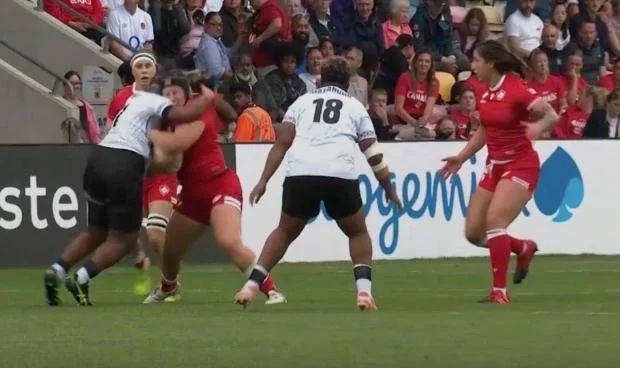
Both went on as second-half replacements, and both were sent off for dangerous high tackles late in their opening pool matches on Saturday.

Vasutaraga committed a shoulder-to-head tackle on Canada counterpart McKinley Hunt.

Fiji lost to Canada 65-7 in York and Vasuturaga will miss the remaining pool games against Scotland and Wales.

If Vasuturaga, at her second World Cup, completes World Rugby’s tackle school, she will be available if Fiji reaches the quarterfinals.

Salale made a head-on-head tackle on Australia’s Desiree Miller in Manchester as Samoa lost 73-0.

She had been on the field for only eight minutes in her World Cup debut and will likely not play again in the tournament.

Even if Salale undertakes tackle school, Samoa is not expected to win its last pool matches against England and the United States.

Aussie derbies locked in for Round 1 of Super Rugby Pacific 2026

0

Aussie fans will be treated to a spectacular opening weekend of Super Rugby Pacific 2026 with local derbies confirmed for successive February nights.

The New South Wales Waratahs will host the Queensland Reds at Allianz Stadium on Friday 13 February before the Western Force welcome ACT Brumbies to HBF Park on Saturday 14 February.

The news follows a string of social media teasers from Super Rugby Pacific clubs ahead of the official 2026 fixture release later this week on Thursday 28 August.

In a statement, Waratahs coach Dan McKellar welcomed the push for early season derbies.

“It’s good for the competition that we’re starting with a game of such significance,” McKellar said.

“Round 1 … New South Wales versus Queensland. I don’t think it gets any bigger than that.

“It’s a rivalry that goes back more than a hundred years [to 1882], and one that the fans will get excited about in 2026.”

Meanwhile the Force-Brumbies game holds particular significance with the West Australian club’s first ever competition clash in 2006 coming against their ACT rivals.

Other leaked Australian fixtures include the Reds hosting the Crusaders at Suncorp Stadium on 11 April- ending a three-year run of away games against the perennial powerhouses – and the Brumbies’ February 28 clash with the Blues in Canberra.

Another Round 1 blockbuster looms for 2025 wooden spooners Fijian Drua, who will host Moana Pasifika in Lautoka to open their 2026 campaign.

‘All destroyed’: Fire engulfs Marshall Islands parliament complex

0

Fire engulfed Marshall Islands Nitijela (parliament building) just after midnight on Monday, with firefighters risking their lives as they battled the blaze into early Tuesday morning to save the complex.

“Sometime around midnight or shortly after this morning, the parliament building in Majuro caught on fire, started burning,” RNZ Pacific’s correspondent in the Marshall Islands Giff Johnson said.

“The fire department here is pretty nonexistent, except for an airport fire fighting team, which was called in, but they weren’t able to get there for over an hour.”

Johnson said the building was completely engulfed by the time the fire truck arrived on site.

He said the parliament chamber and offices, the library and all the archives, “have been all destroyed”.

“Everything’s wiped out. All the records are gone,” he said.

“A lot of the structure, which is concrete, is still standing, but it’s now noontime (Tuesday, NZT), and it’s still smoking. Firefighters are still on site, trying to quell it.

“The building is no longer usable, and already, alternative plans are being talked about, about where they’re going to hold parliament, because parliament is actually in session right now.

“Fortunately, the fire started late overnight so no indication that anybody was harmed.”

Johnson said the Marshall Islands did not have much capacity in firefighting and fire inspection processes, making it difficult to determine the cause of the fire.

He said a lot of entities in the Marshall Islands did not have back-ups and it would take people weeks to figure out what they had lost and what they could access.

“From purely a records point of view, and just getting their system back up and running, it’s going to be a while because everything has been digitised at the parliament, and it’s a really complicated situation.”

The Marshall Islands Cabinet is having an emergency and expected to make a statement later today.

All Pacific Leaders Confirm Attendance at PIF Meeting in Honiara

0

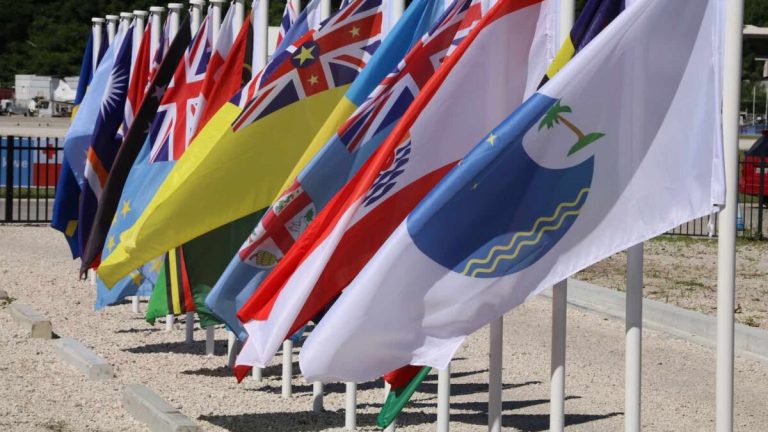
The Solomon Islands Government has confirmed that all 17 Pacific Island Forum (PIF) Leaders will attend the 54th PIF Leaders Meeting in Honiara next month.

Chairman of the Local Organising Committee, Sir Dr Jimmie Rodgers, told SBM Online Monday that all leaders have confirmed their attendance despite earlier reports suggesting otherwise.

Concerns were raised after the Solomon Islands Government announced it would not invite Post-Forum Dialogue (PFD) partners to this year’s meeting. The PFD involves 21 partner countries, and some had threatened not to attend the Forum in protest.

Prime Minister Jeremiah Manele explained in Parliament that his government’s decision to defer the PFD was taken “in the spirit of sovereignty and respect for the Pacific Way,” consistent with the decision made at the 53rd PIF Leaders Meeting in Tonga last year.

Sir Jimmie said the government has now received firm confirmation from all Forum members. “There will be 17 leaders in total, with Prime Minister Manele being the 18th,” he said.

The 54th Pacific Islands Forum Leaders Meeting will run from 8–12 September in Honiara, with the Leaders’ Retreat to be held in Noro, Western Province.

Meanwhile, preparations continue with Australia and China donating vehicles to assist the event. Australia provided 61 police-fitted vehicles to support security operations, while China donated 27 vehicles to be used by Pacific leaders during the Forum.

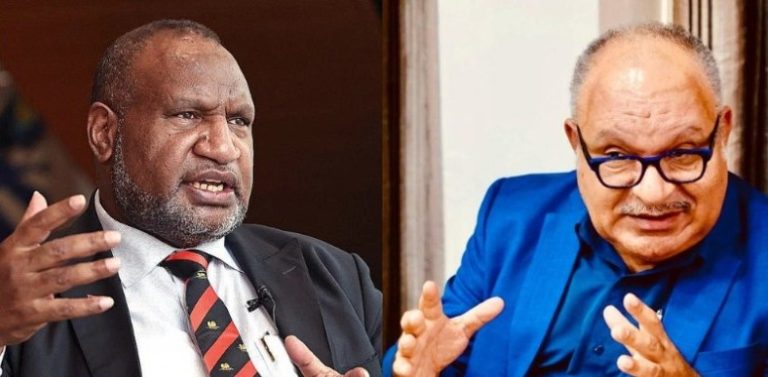
PNG Prime Minister Marape responds to O’Neill: UN visit affirms PNG’s global standing, not failure

0

Prime Minister James Marape has dismissed claims by Ialibu-Pangia MP Peter O’Neill that the forthcoming visit of United Nations Secretary-General António Guterres is a sign of Papua New Guinea’s democratic failure.

“The people of Papua New Guinea should not be misled,” Prime Minister Marape said.

“The UN Secretary-General is coming to our shores to acknowledge our country’s 50 years of nationhood, our peace-building achievements, and our leadership on global issues like climate change, oceans, and sustainable development.

This is an unprecedented four-day visit is the longest any UN Secretary-General has made to our region and it is recognition, not reprimand.”

The Prime Minister said it was ironic that Peter O’Neill, whose government left behind a trail of corruption cases, economic mismanagement, and questionable deals, now attempts to lecture the nation on democracy.

“It was under O’Neill’s watch that trust in government collapsed, the economy nosedived, and institutions were compromised. The people remember who bulldozed Parliament, who silenced dissent, and who created the very conditions that weakened our systems.”

Prime Minister Marape stressed that under his leadership, difficult but necessary reforms are underway to strengthen democracy and restore credibility to elections.

“Yes, our democracy has challenges, as do all democracies. But unlike in O’Neill’s time, my government is working transparently with the Electoral Commission, international partners, and civil society to reform our electoral processes.

Preparations for Local Level Government elections are progressing and will be delivered, not swept aside or ignored as in the past.”

He also reminded citizens that global democracy indexes are not final judgments but analytical tools, and that real democracy is measured by the resilience of institutions and the freedom of people to speak, assemble, and choose their leaders.

“Papua New Guinea remains a democracy; vibrant, noisy, sometimes messy, but alive. Our courts are independent, our press is free, and our people have never lost their right to choose their leaders.”

The Prime Minister concluded: “Peter O’Neill should not use the UN Secretary-General’s visit to score cheap political points. This visit is a milestone in our history; the first time ever a UN chief spends four days in Papua New Guinea. It is an acknowledgement of our journey since 1975, not a condemnation.

Instead of running down our country on the eve of our Golden Jubilee, O’Neill should join the rest of us in welcoming this honour with pride.

“This is not about O’Neill or Marape. This is about Papua New Guinea. And Papua New Guinea will stand tall,” he said.

Campaigning over – Samoa gets ready to vote in ‘unpredictable’ election

0

Samoan voters will head to the polls in a national election on Friday described as one of the country’s “most unpredictable”, with no clear favourite.

Election campaigning has wrapped up, and the countdown in on. Pre-polling begins tomorrow (Wednesday).

Fifty parliamentary seats will be contested, with the FAST (Fa’atuatua I le Atua Samoa ua Tasi) Party aiming to repeat its dramatic 2021 victory over the long-standing HRPP (Human Rights Protection Party), despite an internal split that ultimately triggered an early election.

Samoa’s election chief has confirmed that 187 candidates will contest this year’s general election, representing six political parties and 46 independents vying for seats.

The governing FAST Party leads the field with 58 candidates, following close behind is the HRPP with 50.

The caretaker Prime Minister Fiame Naomi Mata’afa’s Samoa United Party has 26 candidates, while the Samoa Labour Party has five.

Two smaller parties – the Tumua ma Pule Republican Reform Party and Constitutional Democratic Republic Party – will each contest one seat.

This brings the total number of parties contesting this election to six, alongside 46 independent candidates.

The election was originally scheduled for April next year but was brought forward after a split in the ruling FAST party led to months of political instability, that ended with Fiame’s minority government being unable to pass its 2025 Budget.

It is business as usual on the streets of the capital Apia with people going about their daily routines.

The official campaign period ended on Saturday, so there are no more billboards or pickets, but the energy and anticipation ahead of voting is still palpable.

Voters interviewed by RNZ Pacific expressed a mix of hopes for the political parties of their choice.

Some want to maintain the status quo, others are seeking change, and some say it’s up to God.

Stay connected

529FansLike
172FollowersFollow
156SubscribersSubscribe
- Advertisement -