Home Blog Page 134

PNG Parliament endorses PNG – FSM treaty on Maritime Boundaries and cooperation

0

Papua New Guinea Parliament on Wednesday ratified an important treaty between Papua New Guinea and the Federated States of Micronesia.

This Treaty permanently establishes the maritime boundary between the two countries. The treaty, needing ratification since amendments to it were signed in 2015, secures national jurisdiction over marine resources and includes provisions for cooperation regarding both living and non-living resources within the defined areas.

FSM is to the north of Papua New Guinea, above the New Guinea Islands, and shares a sea boundary with PNG. A maritime boundary agreement was first signed in 1991 and amended in 2015, defining the Exclusive Economic Zone (EEZ) boundary between the two countries.

The boundary is approximately 426 nautical miles long and is defined by nearly 40 geodesic points. It separates the EEZs, generated by the southernmost FSM atolls and several PNG islands.

It is important that Parliament approved this signing, and that Papua New Guinea becomes a State Party to it. This treaty permanently establishes the maritime boundary of PNG and FSM within which both countries will exercise sovereign rights within their respective maritime borders or territories with respect to exploration and the use of their sea and seabed resources.

The treaty will also enable cooperation between both countries in exploration, use and conservation of the sea resources in the EEZs and seabed resources which both have a jurisdiction over.

Work had to go into reviewing the agreement because of errors in the geographical coordinates in the details of the treaty, but was finally completed, agreed to, and signed by former prime minister Peter O’Neill and former president of FSM Peter Christian in 2015 on the margins of the Pacific Islands Forum Meeting in Port Moresby.

A legislation supporting the treaty was also enacted by Parliament in July 2015.

The Department of Foreign Affairs, Department of Justice and Attorney-General, Department of Lands and Physical Planning, National Mapping Bureau, National Fisheries Authority, National Maritime Safety Authority and other respective partners took the lead on behalf of the National Government ensuring the finalisation of the treaty.

PNG unveils new foreign policy

0

Papua New Guinea has launched its most significant foreign policy overhaul in more than 40 years, with Foreign Minister Justin Tkatchenko warning Parliament that the country must adapt to a “complex and dynamic international landscape” or risk being left behind.

Presenting the 2025 Papua New Guinea Foreign Policy White Paper on Thursday, Tkatchenko said the new blueprint  marks a decisive shift from the country’s outdated 1981 framework and places security, economic resilience and

global partnerships at the centre of PNG’s external engagement.

“This Foreign Policy White Paper is a roadmap in articulating Papua New Guinea’s evolving foreign policy direction in an increasingly complex and dynamic international landscape,” he told MPs.

“It reinforces the foundational doctrine of Friends to All, Enemies to None; while adapting to contemporary realities.”

Tkatchenko said the government initiated the review because “Foreign Policy should be seen as an extension of domestic policy, with a core aim to improve citizens lives through global engagement.”

“At its heart, this foreign policy aims to promote national security, economic prosperity, social well-being and a sense

of national unity, through dynamic partnerships and purposeful diplomacy.” he added.

The White Paper outlines eight strategic pillars that will guide the country’s foreign policy machinery:

*1. Bilateral relationships:

PNG will deepen ties with Australia, Indonesia, China, Japan, ASEAN members, Pacific neighbours, the U.S and

Europe. “Reciprocity and mutual benefit will be driving principles for us,” Tkatchenko said.

*2. Effective multilateralism:

He emphasised the importance of bodies such as the UN, WTO, APEC, PIF and MSG, noting PNG’s ambition to join

ASEAN and support UN Security Council reform.

*3. Robust institutions for sovereignty and security:

PNG will boost defence and policing capabilities, strengthen borders and improve resilience to cyberattacks and

climate threats, working closely with partners including Australia and the U.S.

*4. Economic and commercial diplomacy:

“Facilitating international trade and investment agreements… can help grow our economy, reduce reliance on foreign

aid, and create jobs,” Tkatchenko said.

*5. Development cooperation:

All aid partnerships must align with national priorities and support sustainable, inclusive growth.

*6. National branding and soft power:

“We will work to strengthen perceptions of our country,” he said, highlighting efforts to promote PNG as a competitive, reliable partner and build national pride.

*7. Departmental and diplomatic reform:

A new Foreign Service Act, diplomatic academy, stronger ICT systems and expanded staffing will modernise PNG’s overseas missions.

*8. Leadership and coordination:

Whole-of-government coherence, evidence-based decisions and closer engagement with non-government partners will underpin implementation.

Tkatchenko said PNG’s geography, population and resources position it as a “bridge and a partner of choice” between Asia and the Pacific — but warned that governance, law and order, and climate vulnerability continue to demand international cooperation.

“The White Paper outlines a foreign policy for a self-assured Papua New Guinea, grounded in our national values and principles, responsive to global changes, and dedicated to achieving peace, prosperity, and international respect,” he said.

He urged Parliament to endorse the policy fully.

“Through principled partnerships and strategic investments in our institutions, we are collectively positioning Papua New Guinea as a regional leader and a constructive player on the world stage.”

“Thank you, Speaker, I commend the 2025 Papua New Guinea Foreign Policy White Paper entitled Strategic Partnerships for Security and Economic Prosperity; to Parliament for its endorsement, said Tkatchenko.

WCPFC warns data gaps, weak monitoring and stalled harvest strategy threaten effective tuna management

0

By Pita Ligaiula in Manila, Philippines

The Western and Central Pacific Fisheries Commission (WCPFC) has issued a blunt assessment of its 2025 performance, warning that persistent data gaps, weak monitoring and slow progress on key reforms continue to undermine effective management of the world’s largest tuna fishery.

In its Twenty-Second Regular Session Annual Report on the Work of the Commission in 2025, the WCPFC says it is still grappling with “additional challenges related to the availability of data to support compliance monitoring, strengthening measures for mitigation of fishing impacts on Non-Target, Associated and Dependent Species (NTADS), and progressing a harvest strategy for South Pacific albacore tuna.”

The report says maximising compliance across the vast membership remains a major hurdle.

“The Compliance Monitoring Scheme (CMS), while in its 15th year, still deals with inconsistencies in data reporting, particularly in high seas and longline fisheries,” the Commission states.

It warns that “data and monitoring gaps from some members and for some fisheries, including observer coverage discrepancies between longline and purse seine fisheries, have hindered accurate assessments… and in some cases identification of potential violations.”

The report makes clear that strengthening monitoring and reporting “continues to be a top priority.”

On environmental impacts, the Commission says its ability to protect non-target, and vulnerable species is being held back by patchy information.

“WCPFC’s efforts to mitigate fishing impacts on non-target and associated or dependent species remain hampered by gaps in monitoring and data collection,” the report says, noting that global moves to expand marine protected areas under the new BBNJ Agreement could step in where RFMOs are seen as ineffective.

With tuna stocks currently healthy, the Commission says it has “a clear opportunity to address some of the long- standing data gaps that are hindering the full effectiveness of its mitigation measures.”

The report also flags slow progress on harvest strategies, saying modern fisheries management demands are rising sharply.

“The demands of modern fisheries management are rapidly evolving, driven by climate change, technological advancements, and international marine conservation agreements,” it says. WCPFC’s shift toward ecosystem-based management and climate resilience “will be partially realised through its application of a harvest strategy management framework.”

It warns that as markets raise sustainability expectations, “the WCPFC will be challenged to meet higher expectations around sustainably- and ethically- caught tuna.”

Looking ahead, the Commission says it has a strong base to build from, but members must move faster.

It notes that with healthy tuna stocks and decades of accumulated data, “WCPFC has clear opportunities to redefine its future work by enhancing the way it adapts and responds to the demands of modern fisheries management.”

The 2026 work programme prioritises improved data availability, stronger stock assessment and compliance review, better research on fishery impacts, and full operationalisation of Article 30 across all Commission work.

“Greater collaboration and swifter action are required by WCPFC members and stakeholders to ensure that the last two decades of investment… is maintained well into the future.”

The report highlights major advances in data systems, saying the WCPFC Information Management System now allows members to directly manage vessel authorisations and reporting, accelerating evidence-based decision-making across science, compliance, and ecosystem management.

Ultimately, the Commission argues that integrated, data-driven management is the path forward.

“Integrating key datasets into a coherent and comprehensive picture… will convert two decades of data collection into actionable insight,” it states, strengthening risk-based compliance and improving scientific advice.

The report says the Commission is well-positioned to meet rising expectations if members align around ecosystem- based management, data-driven decisions, and stronger regional cooperation.

“WCPFC will be well positioned to tackle present challenges and demonstrate measurable progress… in advancing the long-term sustainability of fisheries throughout the western and central Pacific Ocean,” it concludes.

WCPFC flags unpaid dues and rising reliance on voluntary funds as 2025 budget pressure grows

0

By Pita Ligaiula in Manila, Philippines

The Western and Central Pacific Fisheries Commission (WCPFC) enters 2025 with nearly a third of its agreed member contributions still unpaid, raising concerns about how the organisation will sustain critical fisheries monitoring, science and compliance work across the region.

According to the Commission’s 2025 annual report, members approved a US$9.78 million budget for the year — but US$3.29 million of those contributions had not been collected at the time of reporting, including arrears from previous years.

The Commission said the budget underpins essential work, from scientific stock assessments to vessel monitoring and support for Small Island Developing States (SIDS).

“The budget ensures that the Commission can effectively carry out its conservation and management responsibilities across the region,” the report notes.

Total expenditure for 2025 is estimated at US$8.99 million, and there have been no advances from the Working Capital Fund so far.

The report also highlights the growing role of voluntary contributions, which WCPFC describes as “an important role in supplementing the WCPFC’s annual budget.”

In 2025, members provided US$487,910 in voluntary support for scientific, compliance and capacity-building projects — not including Canada’s US$233,124, allocated in 2020 but applied this year.

These voluntary funds covered a wide mix of priorities:

*Japan contributed US$156,566 to the Japanese Trust Fund.

*Korea provided US$135,805 for the Pacific Tuna Tagging Project.

*Canada added US$60,539 for digital tools to help members track reporting gaps, plus its previously allocated annual-meeting support.

*The United States contributed US$30,000 to the Special Requirements Fund, US$20,000 for Vessel Monitoring

System (VMS) manual reporting, and US$50,000 for a bigeye tuna stock assessment workshop.

*China added US$30,000 to the Special Requirements Fund.

*FSM contributed US$5,000 to support 21st Regular Session of the Technical and Compliance Committee (TCC21).

The Commission says such contributions continue to be critical for SIDS, which rely heavily on targeted assistance to meet reporting requirements, strengthen compliance, and participate in WCPFC processes.

But the report makes clear that voluntary funding cannot replace core contributions and the Commission will struggle to meet its responsibilities if members continue to fall behind on payments.

Pacific nations head to Manila “united, focused” as FFA pushes for decisive tuna management at WCPFC22

0

By Pita Ligaiula in Manila, Philippines

 Pacific Islands Forum Fisheries Agency (FFA) members are heading into next week’s Western and Central Pacific Fisheries Commission (WCPFC22) in Manila with a single message — the Pacific wants firm action on tuna management, and it wants it now.

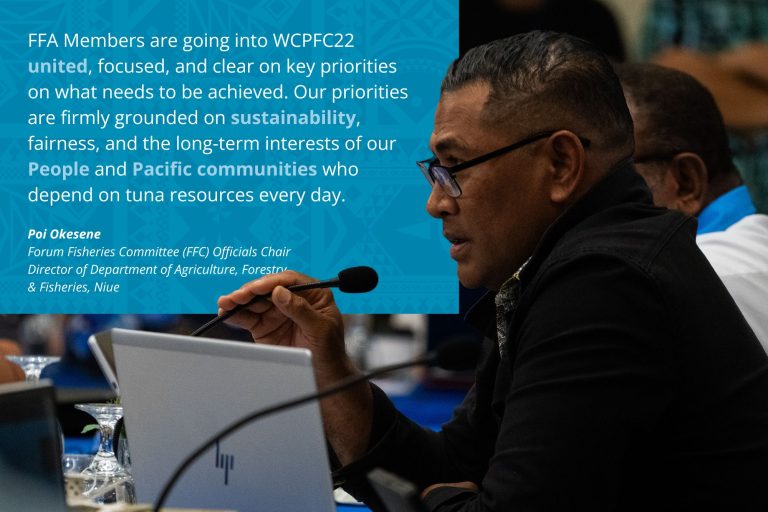
The Forum Fisheries Committee (FFC) Officials Chair, Poi Okesene, said Pacific countries will arrive at the Commission united behind clear priorities, led by the adoption of a Management Procedure for South Pacific Albacore.

“FFA Members are going into WCPFC22 united, focused, and clear on key priorities on what needs to be achieved,” said Okesene at the FFA Pre-WCPFC22 Meeting.

The South Pacific Albacore measure has been years in the making and is considered the FFA’s top agenda item for 2025, alongside proposals aimed at strengthening conservation rules, improving compliance, and building climate resilience across the fishery.

FFA members are meeting this week to coordinate their positions ahead of the Manila negotiations — a critical exercise given the weight the Pacific holds as custodians of the world’s largest tuna stocks.

The WCPFC is responsible for managing highly migratory tuna species across the Western and Central Pacific Ocean, which produces around 60 percent of the world’s tuna and remains the healthiest and most valuable tuna fishery globally.

Pacific officials say they want WCPFC22 to deliver decisions that safeguard that status not delay it.

Okesene said the Pacific’s stance is anchored in the interests of the people whose economies, food security and livelihoods rely on tuna.

“Our priorities are firmly grounded on sustainability, fairness, and the long-term interests of our People and Pacific communities who depend on tuna resources every day,” he said.

FFA members will enter the Manila talks presenting what they describe as a coherent, collective approach and a firm expectation that the Commission must deliver.

Minister Bainivalu warns IUU fishing costs Fiji $50m a year, vows tougher surveillance and new powers to stop offenders

0

Fiji’s Minister for Fisheries and Forestry, Alitia Bainivalu, has issued a blunt warning that illegal, unreported and unregulated (IUU) fishing is draining FJD$50 million (US$25 million) from the country’s blue economy every year and says the Government is now moving to tighten laws, expand surveillance and push technology-driven enforcement across its vast ocean territory.

Delivering her ministerial statement in Parliament Tuesday, Bainivalu said Fiji’s 1.3 million square kilometre EEZ remains highly vulnerable to organised illegal fishing.

“Fiji, being a large ocean state with an Exclusive Economic Zone of approximately 1.3 million square kilometres, primarily faces challenges of monitoring, control, surveillance, and enforcement,” she said.

“IUU fishing involves the violation of fisheries regulations and the management measures that protect fish stocks and biodiversity. IUU fishing is about fishing for commercial purposes without a fishing license, or poaching in marine protected areas, or using prohibited fishing gears such as dynamites and underwater breathing apparatus, or catching and selling prohibited and undersized fish, or non-reporting and misreporting of fisheries catches.”

Bainivalu said offenders operate across all areas from rivers and customary fishing grounds to the high seas.

“The increase in domestic and international demand for seafood, along with limited alternative livelihoods, the push for higher profits and financial incentives, and weak regulations, creates an environment conducive to illegal fishing.”

She told Parliament the financial loss is significant: “IUU fishing results in a loss of approximately FJD$50 million, equivalent to USD$21.8 million in annual revenue to our blue economy.”

Bainivalu said the Ministry is shifting from traditional patrols to an intelligence-led Monitoring, Control and Surveillance (MCS) model.

“Fiji’s strategic approach moves beyond simple physical patrolling of our fisheries waters to an intelligence-led approach to improve Monitoring, Control, and Surveillance,” she said.

At the heart of the new system is the Fiji Fisheries Surveillance and Operations Centre (FFSOC) at Walu Bay which she described as “maritime air traffic control” for fishing vessels.

“It uses specialised software that integrates diverse data streams into a single visualisation platform with a live map displayed on large screens.”

The Centre analyses vessel movements using VMS, AIS, satellite imagery, electronic reporting (ER), and electronic monitoring systems (EMS). Intelligence is then passed to the Fiji Navy or authorised officers for at-sea or port enforcement.

Bainivalu highlighted Fiji’s leadership in rolling out cameras at sea.

“Fiji has proactively pioneered EMS on our long-line fleet… which includes the detection of illegal discarding of fish, retention of prohibited species, mistreatment of bycatch… and unauthorised transshipment.”

Onshore, she said the Ministry relies on community cooperation, enforcement agencies and market checks to target inshore illegal fishing, supported by court action and awareness campaigns.

Bainivalu confirmed the Fisheries Act Amendment (Bill 33 of 2025) will give authorised officers expanded powers, including the ability to search land premises and issue fixed penalty notices to deter non-compliance.

She also highlighted Fiji’s role in the Port State Measures Agreement, electronic reporting, and Niue Treaty cooperation, allowing shared patrols and data exchange with Pacific neighbours.

“Aerial and surface surveillance partnerships” with Australia, New Zealand, France, the United States and the Forum Fisheries Agency remain essential, she said.

Bainivalu warned that illegal fishing is increasingly tied to wider criminality.

“The illegal, unreported, and unregulated (IUU) fishing will continue to increase, as it links with trafficking and other human rights violations.”

The Minister said Fiji is now advancing seafood traceability from “catch to plate” and lifting transparency in fisheries governance.

“Fisheries Transparency is about the public availability of information on our fishing industry and meaningful participation of relevant stakeholders,” she said.

Traceability, she added, will “improve market access for sustainable products” and strengthen food safety and consumer confidence.

“The Ministry of Fisheries is mandated to manage our fisheries waters to ensure the sustainability and health of our fisheries stock and associated biodiversity for the well-being of all Fijians.”

She said Fiji will continue to invest in technology, expand enforcement and strengthen cooperation to protect its ocean resources.

“The Ministry is committed to enhancing its efforts to fight illegal, unreported, and unregulated fishing, demonstrating

Fiji’s position on responsible ocean stewardship also ensuring a safe, secure, and prosperous future for all Fijians,” she said.

“No woman is safe until all women are safe” as Commonwealth warns of rising violence: SG Botchwey

0

Commonwealth Secretary-General Shirley Botchwey has issued a stark message to governments and communities worldwide, declaring that violence against women remains “one of humanity’s oldest and least punished crimes” and warning that global backsliding is putting millions at greater risk.

In her statement marking the International Day for the Elimination of Violence Against Women, Botchwey said the crisis is universal, persistent and deeply personal.

“It is committed in every region and in every community, often behind closed doors and often without consequences,” she said. “It is personal – for all of us.”

She pointed to the everyday fears that women and girls carry — fears so normalised that they often go unnoticed.

“If you have ever had to tell your sister to ‘be careful’ just for existing, you understand. If you have ever asked your daughter to ‘text me when you get home’, you understand.”

Botchwey reminded the world that one in three women experience physical or sexual violence in their lifetime, with even higher risks for girls, women with disabilities and those from minority groups.

“Each bruise, each insult and each threat is not isolated, but part of a machinery of control,” she said.

She said the challenge is not a lack of data, but a lack of courage to dismantle the systems that allow the violence to continue.

Botchwey noted that despite the landmark Beijing commitments made 30 years ago, societies are now “watching rights roll back and violence take new forms – quieter, slicker, still brutal.”

The Secretary-General said the Commonwealth is refusing to look away, placing gender equality at the centre of its work through its new Strategic Plan.

“Gender equality must be a reality, not just a promise on paper,” she said.

She outlined ongoing work across the 56-member bloc, including:

*Reforming gender-discriminatory laws that prevent women from leaving abusive partners or accessing justice

*Helping governments quantify the economic cost of violence to strengthen investment in prevention

*Supporting skills training and women-led businesses to break financial dependence

*Ensuring women have a voice in climate policy, democratic processes and leadership spaces

*Protecting women’s rights to speak, mobilise and lead without fear

But she stressed the efforts are still far from enough.

“Not when the backlash is growing. We need a re-energised global movement – now – powerful enough to turn the tide and carry us toward justice. No excuse.”

“We owe this not only to the women we have lost, but to those who survive every single day. Because no woman is safe until all women are safe. And that safety begins where fear ends – in our homes, neighbourhoods, communities and countries,” said SG Botchwey.

WCPFC must confront ‘hard truths’ on transshipment, electronic monitoring and observer gaps, Cook warns

0

By Pita Ligaiula in Manila, Philippines

The Western and Central Pacific Fisheries Commission (WCPFC) is heading into a decisive week in Manila in December, with one of the region’s most prominent tuna advocates warning that members are still avoiding the “hard truths” on monitoring and high-seas transshipment.

In an interview with PACNEWS, Sharks Pacific Policy Director Bubba Cook said he sees only limited movement on electronic monitoring and no guarantee of meaningful action on high-seas transshipment — one of the most politically charged issues before the Commission.

“I don’t see ‘concrete progress’ occurring at this meeting with respect to electronic monitoring/observer coverage,” Cook said.

“But I do see some modest steps forward with the agreement of audit standards for Electronic Monitoring (EM) programmes and renewed leadership and momentum on the Electronic Reporting and Electronic Monitoring (EREM)Working Group.”

He said entrenched resistance remains a problem.

“Those same countries and fleets that have traditionally opposed increased observer coverage will continue to oppose it, until technology and markets make it an unavoidable necessity to sell tuna anywhere in the world,” he said.

On high-seas transshipment, Cook was blunt: hopes exist, but confidence does not.

“I am hopeful, but certainly not confident, that there will be any meaningful steps taken toward reforming high seas transshipment at this meeting,” he told PACNEWS.

Cook said the proposal from Korea does little to fix the problem.

“The proposal from Korea is effectively a ‘heads we win, tails you lose’ proposal, where they effectively retain the status quo while shifting any burden for monitoring, control, and surveillance on to the SIDS,” he said.

He added there is “a pretty broad chasm” between what the Asian distant-water fishing nations (ADWFN) want to maintain their ability to transship with minimal scrutiny and what is needed to protect the region.

Cook said Pacific Island states have reached a breaking point, highlighting the Marshall Islands’ proposal to ban high-seas transshipment outright.

“That is, incidentally, the same thing they called for back in 2008,” he noted.

But the biggest barrier, he argued, is the WCPFC’s consensus system, which allows members to stonewall even modest reforms.

“The consensus process of the WCPFC allows the ADWFN the ability to dig in their heels and simply oppose any meaningful improvements to transshipment monitoring and accountability without consequence,” Cook said.

He warned that the only way to break the stalemate may be to force the matter to a vote.

“That would at least hold the ADWFN fully accountable for their opposition to reform through fundamentally basic improvements,” he said.

As the Manila meeting nears, Cook says all eyes will be on whether the Commission continues to avoid direct confrontation over high-seas accountability or finally decides to act.

WCPFC delay puts South Pacific albacore MSC label and island economies at risk: PEW

0

By Pita Ligaiula in Manila, Philippines

The US$1 billion South Pacific albacore industry is on the line as the Western and Central Pacific Fisheries Commission (WCPFC) heads into critical talks in Manila next week, with PEW warning that outdated management is putting the region’s most valuable “white tuna” market at risk.

PEW’s Senior Officers International Fisheries, Dave Gershman and Glen Holmes say the stakes could not be higher after the WCPFC failed last year to adopt a Modern Management Procedure (MP) for South Pacific albacore — a move now essential to keep the fishery’s access to key markets.

“If the same thing happens this year, the US$1 billion market for this tuna… may face severe disruption,” they said.

The pressure is coming from consumers and buyers demanding sustainability, and from the Marine Stewardship Council (MSC), whose ecolabel opens the door to premium global markets.

MSC has set a hard deadline from 2026, South Pacific albacore fisheries cannot receive or keep certification without an adopted MP.

“Some South Pacific albacore fisheries are set to lose their MSC label if the WCPFC does not adopt a new, more modern management approach… this year,” the authors warn.

Losing certification, they say, would carry “enormous” financial consequences, especially for Pacific small island developing economies that rely heavily on tuna revenue.

An MP — also known as a harvest strategy — would lock in a long-term, science-driven system that avoids annual political battles over catch limits. Managers would pre-agree on how fishing levels change as stock conditions change.

“For example, if scientists determine that the South Pacific albacore population is healthy, catch levels would stay the same or could even increase… But if the population declines, limits would go down by pre-agreed amounts,” Gershman and Holmes said.

Pacific Island countries and Australia have led the push for adoption since last year, with scientists already evaluating nearly 40 potential MPs. All that remains is for managers to choose one.

“The analysis has been done. The science is clear. And the consequences of inaction could be disastrous for South Pacific communities.

“WCPFC managers must step up and adopt an MP for South Pacific albacore without delay,” they said.

WCPFC enters 2026 facing deep-sea mining risks, new global ocean treaty, and rising pressure from major conferences

0

By Pita Ligaiula in Manila, Philippines

 The Western and Central Pacific Fisheries Commission (WCPFC) is heading into a critical year as deep-sea mining pressures intensify, a new global ocean treaty comes into force, and international conferences call for tougher action to protect tuna stocks and the wider marine environment.

In its Twenty-Second Regular Session Annual Report, the Commission outlined major developments that will shape fisheries management across the region in 2026 from the Pacific’s first deep-sea mining plans to new obligations under the high-seas biodiversity treaty.

WCPFC members agreed in 2024 to seek observer status at the International Seabed Authority (ISA) amid growing concern about potential mining impacts on tuna fisheries.

The Commission confirmed that status was approved this year.

“At 20th Regular Session of the Scientific Committee(SC20),Commission Members and Cooperating Non-Members(CCMs) considered scientific research relating to the potential impacts of deep sea mining activities on pelagic fisheries and recommended that the Commission task the Secretariat to engage with a range of stakeholders to gather more information,” the report said.

The Commission said the ISA has not yet issued any commercial mining licences, but exploratory work is underway in the Clarion Clipperton Zone, an area that overlaps both the WCPFC and Inter-American Tropical Tuna Commission (IATTC) Convention Areas.

A regional environmental management plan is also being developed for a section of the North Pacific that overlaps WCPFC waters.

The Commission said the new BBNJ Agreement — the global treaty governing marine biodiversity beyond national jurisdictions reached the required 60 ratifications on 20 September 2025, triggering its entry into force in early January 2026.

The report said the Agreement creates a comprehensive global framework, “guided by precautionary and ecosystem approaches, equity, science and traditional knowledge, transparency, and international cooperation.”

Crucially, the treaty anticipates new cooperative arrangements with international fisheries bodies, including the WCPFC.

“The latter point about institutional mechanisms for coordinated action is particularly relevant for WCPFC,” the report

said, noting that implementation will require members to strengthen national coordination so “BBNJ and WCPFC activities are complementary and mutually reinforcing.”

Two preparatory conferences were held in April and August as countries began shaping how the treaty will operate once it enters into force.

The Commission highlighted three major ocean conferences in 2025 — one of them dedicated specifically to Pacific tuna fisheries that reinforced calls for stronger regional action.

The Honiara Summit in February, co-hosted by Solomon Islands and the Pacific Islands Forum Fisheries Agency (FFA), focused on “meaningful action and innovation” to achieve SDG14 and protect Pacific tuna resources.

The 10th Our Ocean Conference (OOC10) followed in April in Busan, with the theme “Our Ocean, Our Action.”

Organisers promoted digital technology as a key tool for sustainability. According to the report, since 2014 the conference has mobilised “over 2,900 commitments worth approximately USD$169 billion.”

The year concluded with the Third UN Ocean Conference (UNOC3) in Nice, co-hosted by France and Costa Rica. The conference pushed governments to raise ambition on ocean protection, scale up SDG14 financing, and strengthen marine science for decision-making.

The report makes clear that the WCPFC enters 2026 at a critical juncture facing new global rules, industrial pressures from the seabed, and growing expectations from the international community.

How the Commission navigates these competing political and environmental pressures will determine whether Pacific tuna fisheries remain sustainable in the decades ahead.

Stay connected

529FansLike
172FollowersFollow
156SubscribersSubscribe
- Advertisement -