Home Blog Page 128

EU and Cook Islands renew their sustainable fisheries partnership

0

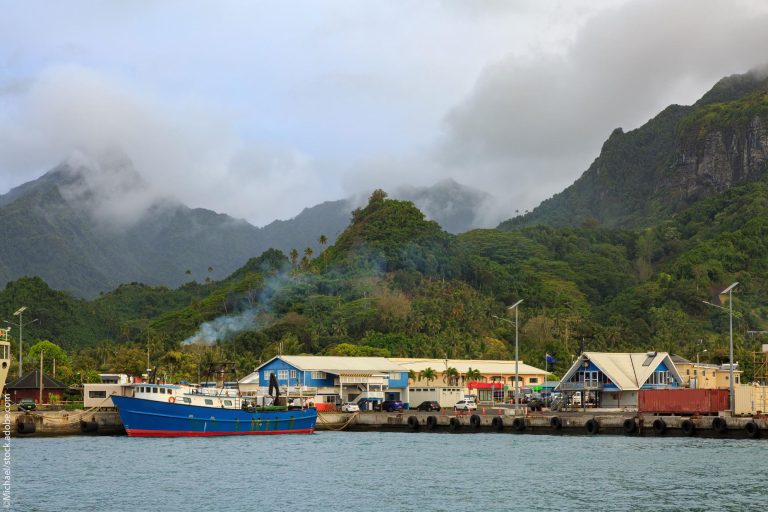
The European Union and the Cook Islands have signed a new protocol to the sustainable fisheries partnership agreement for a duration of seven years (2025-2032).

This renewed protocol will grant the European Union fleet operating in the Pacific Ocean access to some of the richest and healthiest tuna stocks worldwide, for a total of 40 fishing days per year.

In return, the EU financial support will continue to foster the sustainable development of the fisheries sector and blue economy in Cook Islands.

The EU contribution over 7 years will amount to €3.22 million (US$3.74 million), i.e. €460,000(US$534,000) per year. €295,000(US$343,000) will be dedicated every year specifically to support Cook Islands sustainable fisheries management, control and surveillance capacities, and blue economy development. In addition to EU funding, EU shipowners will pay €90,000 for the authorisation giving them the right to fish for 10 fishing days in the country’s waters.

This protocol reinforces the EU and Cook Islands’ shared commitment to sustainable fisheries and mutual economic progress, and to continuing a fruitful collaboration in fisheries governance. Both parties being active actors within the Western and Central Pacific Fisheries Commission (WCPFC), the protocol strikes a fair balance between environmental sustainability and economic viability, ensuring significant fishing opportunities for the EU fleet while respecting the ecosystem’s needs.

Commissioner for Fisheries and Oceans Costas Kadis said:“Our partnership agreements have gained worldwide recognition as a benchmark for good fisheries governance. The European Union is pleased to continue its fruitful fisheries partnership with Cook Islands over the next seven years. With the renewal of the fisheries protocol, European Union vessels will be able to continue fishing in one of the healthiest tropical tuna stocks. We are particularly proud to contribute, through our sectoral support, to the development of the Cook Islands fisheries sector and blue economy.”

Pamela Maru, Secretary for the Ministry of Marine Resources of the Cook Islands and Costas Kadis, European Commissioner for Fisheries and Oceans, sign the new Implementing Protocol to the Sustainable Fisheries partnership Agreement.

The new protocol will provisionally apply as of the date of its signature by the parties and will thus allow the fishing activities of EU vessels in Cook Islands waters as of 9 December 2025. It will enter into force as soon as the ratification process by both parties has been completed, which for the EU implies the consent of the European Parliament.

The EU sustainable fisheries partnership with the Cook Islands is part of the network of tuna fisheries agreements with other countries of the region. It is part of EU efforts to increase food security and promote adequate supply for consumers.

The fisheries partnership agreement (SFPA) concluded between the EU and Cook Islands on 14 October 2016 is tacitly renewed every eight years.

To be operational, it requires an implementing protocol, setting conditions for EU fishing activities and contributions to the sustainable development of Cook Islands fisheries sector. The new protocol will replace the previous one, which expired in December 2024.

ADB, Air Niugini sign $36 million deal to modernise fleet and improve Air Transport in PNG

0

The Asian Development Bank (ADB) and Air Niugini Limited (Air Niugini) have signed a US$35.8 million financing package to help modernise the fleet of Papua New Guinea’s (PNG) national airline, improving its efficiency and further raising safety standards.

This initiative will enhance PNG’s domestic and international connectivity and contribute to the island nation’s social and economic growth.

The package includes a US$19 million loan from ADB’s capital resources and a US$16.8 million loan administered by ADB from the Leading Asia’s Private Sector Infrastructure Fund 2 (LEAP 2). The funds will finance the purchase of six Airbus A220-100 aircraft, replacing older models with more reliable, fuel-efficient planes.

“This project highlights ADB’s commitment to sustainable and inclusive development in PNG,” said Officer-in-Charge of ADB’s Papua New Guinea Resident Mission Soon Chan Hong. “By supporting Air Niugini’s fleet renewal, we aim to improve the country’s connectivity, boost economic growth, and enhance air travel safety in the Pacific region.”

Air travel is crucial for PNG’s economy, as the country’s challenging terrain limits land transport options. Air Niugini plays a central role in connecting communities both domestically and internationally. The new aircraft are expected to be 20 percent more fuel-efficient than older models, reducing costs and environmental impact.

LEAP 2 is an ADB-managed fund with a US$1.5 billion commitment from the Japan International Cooperation Agency. It focuses on sustainable private sector infrastructure projects that reduce carbon emissions, improve energy efficiency, and provide affordable health care, education, and communication services to ADB’s developing member countries.

Founded in 1973, Air Niugini is PNG’s national airline and a wholly state-owned enterprise, operating an extensive domestic network and international routes to Australia, Asia, and the Pacific. The airline is committed to safe, reliable, and efficient service, supporting PNG’s economic and social development.

NRL sets itself as unity force against China in PNG

0

In the PNG Chiefs, James Marape sees a “national unity project” akin to South Africa’s Rainbow Nation Rugby World Cup win in 1995.

The Papua New Guinea prime minister hopes the incoming NRL team will get kids in school and companies investing in the economy, transforming his nation.

“Sport has more unification than any other pursuit of life,” Marape said in Sydney on Tuesday.

“Look at the Nelson Mandela strategy using rugby union to unite South Africa … we find common unity behind a team.”

Marape was visiting Australia for an annual PNG investment conference in Sydney, also attended by Anthony Albanese.

The PNG leader was wrong-footed by a goosestep from colourful ARL Commission chairman Peter V’landys, who said rugby league would be a tool to repel Chinese influence.

“Having rugby league there for the community as a whole – taking the kids to school, bringing all the people together like a glue,” V’landys said on Tuesday.

“No matter how much investment China makes in PNG, it can never achieve that.

“You can never achieve the heart and soul and brain of the PNG person – and we can in sport.”

Marape hurriedly stepped in to affirm support for critical Chinese investment in his country.

“I want to quickly say a word or two, a big thank you to China and all our bilateral partners,” he interrupted.

Divisions at home and abroad are the last thing Marape is hoping for from the team’s historic entry into the NRL in 2028, saying he wants the Chiefs to be a “national unity project”.

However, it’s plain that Australia – which is spending AUD$600 million (about K1.6b/US4398.34 million) on the team – hopes the Chiefs will give a diplomatic boost with PNG at Beijing’s expense.

Albanese hailed the Chiefs as an opportunity for education investment across the largely rural nation.

“Prospects of representing the Chiefs in the NRL when (PNG kids) grow up will encourage education, because (they will) have to be at school to play,” the prime minister said.

Under Albanese, Australia has made vast commitments to deepening the trans-Torres relationship.

The recent Pukpuk treaty, which elevates PNG to Australia’s third defence ally, will drastically increase defence co-operation.

Australia maintains a high level of development aid for its northern partner, which includes climate financing.

Australia was also investing hundreds of millions of dollars in infrastructure projects such as ports and highways designed to help diversify the traditionally resources-heavy PNG economy, Albanese said.

The PNG leader wasn’t short of a rhetorical flourish of his own though, enticing the hundreds of companies in attendance with a substantial offer.

“When the economy hits K200 billion (about AU$71 billion/US$47.13 billion), I will drop corporate tax,” the leader of the K135 billion (US$31.83 billion) economy said to wrap up his speech.

As to who would eventually coach the much-anticipated NRL team, V’landys ensured Panthers multi-premiership-winning mentor Ivan Cleary would have an awkward few days ahead.

“I’ll say something controversial – there’s a reason why the prime minister was at Penrith,” he said.

Viliame Kikau extends with Dogs through 2028 season

0

The Bulldogs have held off rival clubs to lock down star forward Viliame Kikau through to the end of the 2028 season.

The Fijian powerhouse was initially contracted for the 2026 campaign and was in high demand before signing a two-year extension to remain at Canterbury.

Kikau has played a key role in the club’s rise to a premiership contender and is desperate to help the Bulldogs win their first title since 2004.

“I’m very happy to be staying at the Bulldogs,” he said.

“This club has embraced my family and I since day one so it was an easy decision to re-sign.

“I love being part of what we’re building here. We’ve made great progress over the past couple of years, but we want to achieve more – I want to help this club win its next premiership,” he said.

Chinese Taipei compromise clears way for landmark South Pacific Albacore deal

0

By Pita Ligaiula in Manila, Philippines

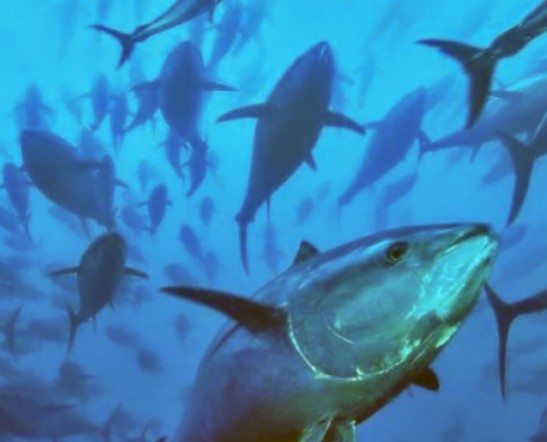
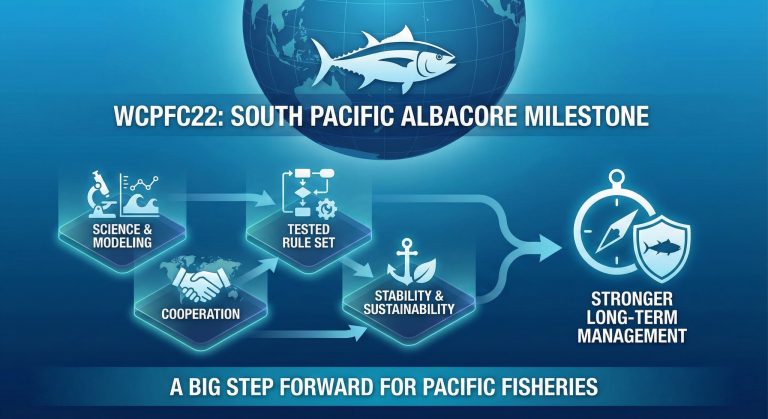
The Western and Central Pacific Fisheries Commission (WCPFC) Friday adopted a long-awaited management procedure for South Pacific albacore tuna, ending years of negotiation and clearing the way for the first harvest strategy for the species.

Members settled on Harvest Control Rule(HCR7),a compromise formula that Pacific states say will stabilise the fishery and major fleets say they can live with.

The decision came after days of tense discussion and last-minute compromises from key fishing nations. Chinese Taipei and China, two of the largest longline fleets in the region, dropped their preference for a higher-catch model to allow a consensus deal to go through.

WCPFC Chair Dr Josie Tamate declared the adoption a milestone for the Commission.

“The South Pacific albacore tuna management procedure is now adopted.

Thank you, members. This is a milestone for the commission, and I know there’s still a lot of work to be undertaken this year, but this is a huge win for the commission, so thank you very much for all your hard work throughout the week, and for us to reach this milestone decision,” she said.

Chinese Taipei said it accepted HCR7 only after showing what it described as its “maximum flexibility.”

“Firstly, we do appreciate the time and the effort of our FFA members and the other CCM to work closely on this critical issue,” its delegate told members.

“Our fishing fleet has a long history of operations in the Western and Central Pacific Ocean. This region is where hundreds of our vessels and tens of thousands of our fishery depend on their livelihood.”

They warned that HCR7 will bring significant cuts.

“The total fishery last year was around 63,000 metric tons. This means that more than 12 percent cuts will be made immediately from the current status after we adopt the MP.”

Despite the impact, Chinese Taipei said it would not block consensus.

“In the spirit of cooperation, we are prepared to show our maximum flexibility and compromise. We have no intention of blocking the preference of the majority member, namely the adoption of HCR 7 in the MP.”

The delegation urged members to consider its challenges during implementation.

“Lastly, we urge relevant members to take our difficulty into consideration during future formulation on implementing measures. We will continue to uphold goodwill, sincerity, and a cooperative spirit and work with all members to promote the sustainability of the resources.”

China, the largest catcher of South Pacific albacore in the region said it also stepped back from its preference for HCR10.

“China expressed its gratitude to the FFA for submitting this proposal. China is the world’s largest catcher of South Pacific albacore in the convention area of the WCPFC. The establishment of HCR bears on the core interests of China’s fishing industry.”

Despite the healthy state of the stock, China said it recognised overwhelming support for HCR7.

“Given the healthy status of the South Pacific albacore staff, China initially thought of a higher catch limit. Nevertheless, China has taken note of the broad support for the HCR7 among members of the FFA.”

China said it respected the needs of small island developing states.

“As a developing country, China fully recognises the vital importance of South Pacific albacore resources for food security, local economic, and communication stability for states. And we therefore understand and respect the position of FFA members.”

But Beijing insisted that its historical fishing record must be considered later.

“We therefore urge that in future allocation of fishing opportunities between EEZs and the high seas, historical catch records and fishing efforts be taken into full account as a key factor.”

The Cook Islands welcomed the deal and praised the collective effort that delivered it.

“Getting to this point in developing the management procedure proposal, it’s been a collective effort. Not just by the 17 FFA members, Chair, but by all the CCMs around this table.”

The Cook Islands said the decision sends a strong message that the concerns of small island states were heard.

“It’s taken enormous effort, compromise, and understanding for all of us to get to a point where we can really start looking at some robust management for South Pacific albacore, to improve the economic situation of this fishery.”

Acknowledging Chinese Taipei’s concerns, the Cook Islands signalled ongoing support.

“In recognition of the potential implications this might have on its fleet… FFA members undertake to work closely with Chinese Taipei and to seriously take into account its interests, challenges, and needs in the finalisation of the South Pacific Albacore Implementing Measure in 2026.”

They stressed the process is far from over.

“Our work does not end here. It will continue through to the Intercessional Working Group next year… and then again in one year’s time here at WCPFC 23.”

American Samoa said it accepted the final compromise despite earlier favouring HCR13.

“American Samoa would like to thank our fellow CCMs… and working across the floor to adopt an MP in the spirit of the interventions made by Chinese Taipei and China.”

It said a unified approach was more important than pushing for its preferred option.

“While we believe that HCR 13 would be preferential… after further review and consideration of our earlier position, we also accept HCR 7 to ensure a unified approach.”

They said HCR7 strikes the right balance.

“HCR 7 provides an acceptable, vulnerable biomass and catch stability, and will help to ensure stable market conditions while not overly restricting potential catch opportunities to CCMs.”

New Caledonia backed the adoption of HCR7.

“New Caledonia supports the adoption of the MP as proposed here, incorporating HCR 7. That will ensure that we can maintain our long-term stability in catch levels and yields.”

It thanked Chinese Taipei and China for their flexibility.

“New Caledonia thanks the delegation of Chinese Taipei and China for their flexibility in this hard and difficult negotiation.”

It stressed the need for territories to be properly included in upcoming talks.

“We would like to emphasise the need for members around the floor to fully consider our specific needs and to effectively consult and include the territories in next year’s discussion regarding the implementation measure for South Pacific albacore management procedures.”

The adoption of HCR7 is seen as the most significant step yet in securing the long-term future of the South Pacific albacore fishery — a cornerstone species for longline fleets and the economies of several Pacific states.

For now, members are celebrating the breakthrough. The harder work — allocations, implementation, and monitoring begins next year.


Fiji hails ‘monumental’ South Pacific Albacore breakthrough at WCPFC

0

By Pita Ligaiula in Manila, Philippines 

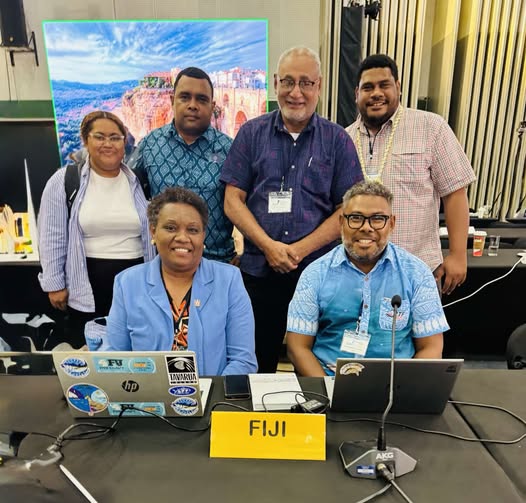
Fiji says the adoption of the South Pacific Albacore Management Procedure (MP) at WCPFC22 in Manila is a “monumental achievement” that marks a decisive shift toward science-driven fisheries management across the region.

Speaking after the decision was gaveled through, Fiji’s Principal Fisheries Officer Meli Raicebe said the MP represented one of the most important milestones for Pacific tuna management.

“The adoption of the SPA MP is a monumental achievement, making a decisive shift towards a fully implemented science-driven harvest strategy,” Raicebe said. “It is one of the region’s most important initiatives.”

He said the outcome showed the strength of collective action within the Commission.

“The decision is a powerful testament to the unity and commitment of the WCPFC membership to science-based fisheries management, and with that, we acknowledge the work that has been put through.”

Raicebe said Fiji believes the MP delivers on the region’s responsibility to safeguard the fishery.

“With this achievement, Fiji believes that we have delivered on our mandate to protect the long-term sustainability and economic viability of this fishery, ensuring a predictable future for our communities, fishing industries, and other economies that depend on South Pacific albacore.”

He credited the compromise shown by members across the table.

“We would like to thank and recognize all those that have contributed towards this achievement, the FFA Secretariat, our science providers, our broader FFA membership, the SPG bloc, and other CCMs that have all come to a compromise to have the MP adopted.”

Raicebe also acknowledged the role of the Tuna Commission.

“Lastly, Madam Chair, it would be remiss on our part if we failed to acknowledge the work of the Commission Secretariat and your good self in the swift process throughout the meeting. Thank you for the fine effort and leadership.”

The adoption of HCR7 under the South Pacific Albacore MP ends years of gridlock and sets the foundation for a fully developed harvest strategy for one of the region’s most economically critical tuna stocks.


WCPFC adopts landmark South Pacific albacore management procedure after years of deadlock

0

By Pita Ligaiula in Manila, Philippines

 The Western and Central Pacific Fisheries Commission (WCPFC) wrapped up its annual meeting in Manila Friday with a major win for Pacific tuna fisheries, agreeing to a long-awaited management procedure for South Pacific albacore — a billion-dollar species central to the economies of many island states.

In an exclusive interview with PACNEWS, WCPFC Chair Dr Josie Tamate said she was “very, very happy” with the outcome, calling the agreement a top priority and a long time coming.

“The Commission has finally adopted a Managing Procedure for South Pacific Albacore. I’m very, very happy,” she said.

“That was my top priority for this meeting. Mainly there’s been a lot of work coming through the year, and to get it across the line, it’s all the hard work of the members. But also I want to recognise the FFA members, especially the Southern Islands who have worked tirelessly throughout the year.”

She said members pushed through the usual sticking points to deliver the result Pacific states had sought.

“It’s not easy, but the outcomes of today’s meeting was what we wanted. It was just a matter of getting all the members working through the details. It’s always the details that come through. We’ve still got work to do in implementing the management measure, but I think in terms of stepping in the right direction, we’ve done that. I’m really happy with that,” Dr Tamate told PACNEWS after WCPFC22 in Manila.

Asked about the significance of the decision for Pacific communities that rely on tuna, Dr Tamate said the management procedure sends a strong signal of stability.
“The step in the direction of adopting the Management Procedure is the necessary first step, the next step that we need to do. And this complements some of the work that FFA members have done this year in terms of their allocation process,” she said.

“So next year we’ll be again continuing to work on analysing some of those details. I want to say that it is a big positive signal. I hope that it will help the small island states, especially those FFA members who, like Fiji for example, who have a big Albacore tuna fishery that they rely on their own.”

She said the Commission’s job is clear to keep key Pacific tuna stocks sustainable.

“In terms of sustainability, I think this is the work of the Commission is to make sure that we do have management procedures as we work on the harvest strategies. It’s just a way of making sure that we do have the key stocks in the Western Central Pacific are sustainable.”

Transshipment — one of the Commission’s most contentious issues saw no breakthrough.
“There was no decision on the transshipment. So work continues,” Dr Tamate said.

“I think the current CMM, the Conservation Management Measure, still applies. In that measure, transshipment is banned in the high seas, but there are exceptions. And those are some of the details that will continue.”

She said the debate is far from new.

“I’m sure the Commission will continue to work through, because this is not the first meeting that we’ve discussed transshipment. It’s been ongoing. Last year it was discussed in Fiji, and because there was no working group at that time, they didn’t see any progress, so the Commission decided to agree to suspend that working group.”

She said keeping the issue alive is critical.

“So it’s back in the Commission. I don’t think it never went away, but I think it’s having it discussed here, even though there’s no agreement on the way forward, but I think it’s having that, keeping it in the Commission, it will enable further discussion as part of the Commission’s work.”

Dr Tamate also welcomed progress on Article 30 — the provision recognising the disproportionate burden borne by small island developing states.

“Article 30, yes. I think that’s a very important milestone, an achievement that FFA members have been calling for,” she said.

“There is a disproportionate of burden from managing the fisheries… There’s a need to support the capacity of the small island states to be able to meet the requirements, meet the obligations.”

Countries agreed to a terms of reference for the review and a reporting template — both steps Pacific members had long pushed for.

“That agreement is part of the Commission’s responsibility to make sure that those seats are not burden by the decision that’s been made by the Commission,” she said.

The Pew Charitable Trusts welcomed the agreement, calling it a decisive moment for Pacific fisheries.

Dave Gershman, a senior officer working on international fisheries, said: “Pew commends the Western and Central Pacific Fisheries Commission (WCPFC) for adopting a management procedure for south Pacific albacore tuna.

“This US$1 billion fishery is critically important to many Pacific Island economies, and this long-term approach automatically sets fishing limits based on the stock’s health, to ensure sustainability of the species for the foreseeable future.

“Critically, this adoption also means that South Pacific albacore fisheries can maintain a sought-after ecolabel that identifies them as a good choice. As consumers demand more accountability and sustainability from tuna companies, this adoption is a signal from WCPFC members that they take the concerns of the public, and their conservation mandate, seriously.

“To complement this promising new management plan, effective implementation will be needed. Governments should work together next year to finalise their effort and put words into action,” he said.

WWF Pacific’s Fisheries Conservation officer, Seremaia Tuqiri said the adoption was overdue but significant.

“WWF expressed its relief and appreciation at the adoption of the management procedure of the South Pacific albacore tuna. It has taken over 10 years to get to this stage.

“Economic interest is often the driving force for decisions made so for the cooperating members of the WCPFC to come to an agreement on a harvest control rule that balances development aspirations, food security, economic development, and the long-term stability of a highly migratory fish stock speaks volumes of the sacrifice, goodwill, and sincerity that exists,” said Tuqiri.

The adoption of the South Pacific albacore management procedure (SPA MP) marks one of the Commission’s most significant achievements in years, giving Pacific states hope for a more predictable, sustainable future for one of their most valuable fisheries.

But the message from Dr Tamate, PEW, and WWF is the same: the job is not finished

The real test begins with implementation next year.

“Albacore is our lifeline” as South Pacific Group pushes hard at WCPFC22

0

By Pita Ligaiula in Manila, Philippines

Pacific countries most dependent on South Pacific albacore have delivered a clear message at WCPFC22 in Manila — this fishery is critical to their survival, and the Tuna Commission must act decisively to secure its future.

The South Pacific Group (SPG), a sub-regional coalition within the Forum Fisheries Agency (FF)A Membership, says South Pacific albacore underpins the economic viability of southern longline fisheries and the coastal communities that rely on them.

Formed under an MOU signed by Cook Islands, Fiji, Niue, Samoa, Tonga and Vanuatu, the SPG was created to strengthen cooperation on oceanic fisheries management, with South Pacific albacore as its top priority.

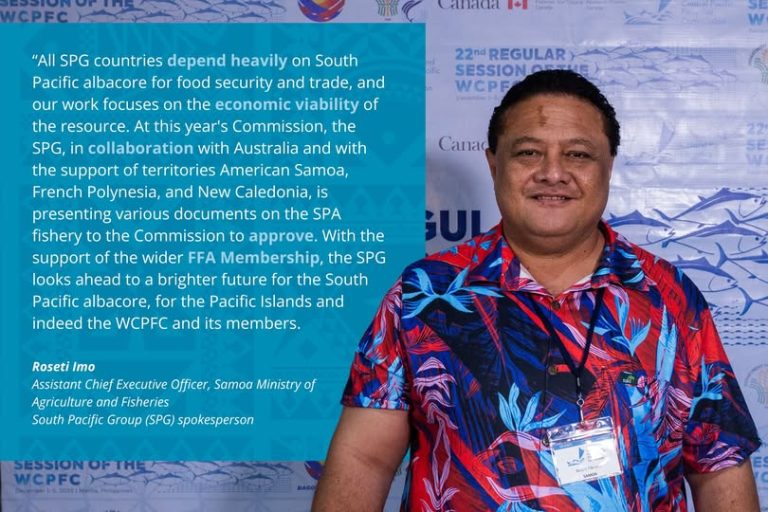
“All SPG countries depend heavily on South Pacific albacore for food security and trade, and our work focuses on the economic viability of the resource.

“At this year's Commission, the SPG, in collaboration with Australia and with the support of territories American Samoa, French Polynesia, and New Caledonia, is presenting various documents on the SPA fishery to the Commission to approve.

With the support of the wider FFA Membership, the SPG looks ahead to a brighter future for the South Pacific albacore, for the Pacific Islands and indeed the WCPFC and its members,” said Roseti Imo, Assistant Chief Executive Officer of Samoa Ministry of Agriculture and Fisheries and SPG spokesperson.

Since 2023, the SPG has been driving major work on southern longline fisheries management — shaping sustainability measures, tabling technical proposals, and steering FFA’s collective position on South Pacific albacore.

Its efforts are anchored in the South Pacific Group Strategy 2023–2028, which aims to rebuild the fishery, strengthen economic returns, and deliver stronger governance for southern fisheries.

With WCPFC22 expected to decide on the long-delayed management procedure for South Pacific albacore late Friday, the SPG says the stakes are high — not just for the region but for the credibility of the Commission itself.

SPG Members: Cook Islands, Fiji, Niue, Samoa, Tonga (current Chair) and Vanuatu.

WCPFC faces tough calls on Bigeye Tuna as SPC warns key decisions needed now

0

By Pita Ligaiula in Manila, Philippines

The Western and Central Pacific Fisheries Commission (WCPFC) is heading into a final phase on bigeye tuna, with scientists warning that major choices must be made this week to keep the region’s harvest strategy work on track.

A detailed paper from the Pacific Community’s Oceanic Fisheries Programme (SPC-OFP) laid out the critical decisions WCPFC22 must take to advance a Management Procedure (MP) for bigeye tuna — a commitment the Commission is expected to deliver by 2026.

The paper summarises several years of technical work and stresses that the Commission now needs to provide “further input… to guide future work.” It highlights six areas where WCPFC22 must make clear decisions, including the target reference point, FAD closure assumptions, output metrics, and how to handle the large share of bigeye catch taken by fisheries outside the MP’s control.

WCPFC21 previously identified three candidate target reference points (TRPs) for bigeye, all based on the 2012–2015 spawning biomass level. SPC says Commission members must now consider whether these TRPs reflect their actual management objectives — and whether they should be treated as targets or thresholds, each requiring different probabilities of achievement.

The paper also warns that bigeye tuna is a genuinely mixed fishery challenge. Only about 27 percent of total bigeye catch is taken by the tropical longline fleet — the part controlled by the MP. About 17 percent is caught in Indonesia, Philippines and Vietnam archipelagic waters, where reporting is uncertain, and catches have been increasing.

SPC is proposing “sensitivity scenarios” that test the MP’s performance under both current conditions and potential increases in catch outside the MP’s reach — including recent shifts in Indonesia’s domestic fisheries.

Another major issue is the purse-seine fishery and the role of fish aggregating device (FAD) closures. SPC’s interim analyses assume the current closure system continues, but some members want MPs tested without a FAD closure baseline. Others argue the closure period should be part of the MP itself. SPC says this is now a political decision that must be clarified by the Commission.

The Scientific Committee (SC21) earlier endorsed much of the technical approach and noted the need to integrate bigeye work with harvest strategies for yellowfin, skipjack, and South Pacific albacore. SC21 also stressed that performance indicators used for bigeye should be aligned with those for yellowfin.

But time pressure is building. The harvest strategy workplan already requires a bigeye MP in 2026, and SPC warns that the annual meeting–SC cycle leaves “limited opportunities for substantive discussion” next year.

The paper suggests WCPFC consider additional mechanisms for strategic guidance during 2026 — a point echoed strongly by WWF Japan.

Intervening for WWF, Uematsu Shuhei warned that delays on bigeye and yellowfin would have consequences.

“If Harvest Strategy with Management Procedure and Harvest Control Rules for both species agreement delay, not only it will sustainable fisheries become more distant, but also it could have negative impact on fisheries and markets in the future,” he said.

Push to end shark-fin loophole as Sharks Pacific calls for full transparency at WCPFC22

0

By Pita Ligaiula in Manila, Philippines

Sharks Pacific has delivered a sharp warning to the Western and Central Pacific Fisheries Commission (WCPFC22), calling for full transparency and tougher action on shark protection as members debate alternative shark-management measures under Conservation and Management Measure (CMM) 2024-05.

Policy Director Bubba Cook told delegates the Tuna Commission is failing its legal obligations to conserve non-target species, stressing that oceanic whitetip sharks remain “precariously perched on the cliff of extinction” despite slight signs of recovery.

“We would also like to address CMM 2024-05 and the proposed Alternative Measures for sharks. First, Sharks Pacific would like to thank the EU for its comments in support of the safe release and handling guidelines and FFA for their intervention. We would like to the remind the Commission that it is bound to manage and conserve Non-Target, Associated, and Dependent Species (NTADS) and that year after year, we continue to fail these non-target species,” Cook said.

“While some have said ‘it could be worse’, which is true – we prefer to take the view that it SHOULD be better. This Commission is mandated to ensure that it IS better.”

Cook said the NTADS review exposed fundamental weaknesses in shark data, undermining every conservation measure on the books.

“The NTADS review made it painfully clear that we have a data quality crisis, and it is undermining every shark measure we have, as well as the credibility of this Commission,” he said.

Sharks Pacific backed 21st Regular Session of the WCPFC Scientific Committee (SC21’s) call for targeted improvements through the Regional Observer Programme – Intersessional Working Group (ROP-IWG), including species identification, length-data standards and post-release mortality assessments.

He said the region’s extremely low observer coverage especially in the longline fishery is leaving shark management blind.

“The most critical issue for sharks, or any other NTADS remains too high mortality, assisted by abysmally low observer coverage—particularly in the longline fishery. We can’t monitor bycatch, verify gear-use rules, evaluate safe-release practices or calculate mortality without observers,” he said.

“Without significantly improved coverage, including integration of EM, we are effectively managing sharks in the dark.”

Cook delivered his strongest criticism on the alternative measures option under CMM 2024-05, calling it a poorly monitored loophole that some members appear to welcome.

“The ‘alternative measures’ pathway is a loophole that lacks transparency, and cynically, likely welcomed by some members in this room,” he said.

“The alternative measures provision was created as a narrow exception, conditioned on ‘enhanced monitoring’, but it’s hard to see the enhancement when the process remains obscured.”

He warned that shark-finning rules cannot be enforced if only the users of the loophole can see how it is functioning.

“This Commission has repeatedly affirmed that combating shark finning is a priority. Yet we’ve built a reporting system where the only people who can see whether the exception is functioning are the same ones using it. That is not transparency; that is insulation that borders on an abuse of process.”

Cook said the Tuna Commission must decide at 23rd Regular Session of the Technical and Compliance Committee (TCC23) whether the alternative measures are effective or whether it is time to end the experiment and require fins-naturally-attached for all members.

“But let me be blunt you cannot meaningfully evaluate a loophole you’re not allowed to look into,” he said.

With shark populations still under severe pressure and alternative measures facing rising scrutiny, Cook told delegates that the Commission’s credibility is at stake.

“Year after year, we continue to fail these non-target species,” he said. “It should be better, and this Commission is mandated to ensure that it is better,” he said.

The WCPFC22 meeting will end on Friday.

Stay connected

529FansLike
172FollowersFollow
156SubscribersSubscribe
- Advertisement -