Home Blog Page 103

Fiji to restore permanent presence in Auckland – diplomat

0

The Fijian government plans to reopen its consulate in Auckland to assist the Fijian diaspora and harness trade development opportunities in Aotearoa.

Fiji’s High Commissioner to New Zealand Ratu Inoke Kubuabola told RNZ Pacific this is an important function that needs to be restored, following the restoration of international trade functions to the Ministry of Foreign Affairs by Sitiveni Rabuka’s coalition.

Ratu Inoke said the portfolio was moved from Foreign Affairs to Ministry of Trade by the previous Bainimarama-led government. The re-opening of the Auckland consulate will ensure services are streamlined and efficient, both for the Fijians in New Zealand and trade.

“There was previously a Fiji Consulate Office in Auckland, which was closed after the portfolio for International Trade was transferred from the Ministry of Foreign Affairs to the Ministry of Trade under the previous administration,” Ratu Inoke said.

“The [Fiji] Mission is currently in the preliminary stages of re-establishing its long-term presence in Auckland, prior to formally notifying the New Zealand government of Fiji’s intention to re-open the consulate.”

Fiji’s Foreign Affairs Ministry chief executive Dr Raijieli Taga was in Wellington in the past week for a visit and discussed the matter with Ratu Inoke and his team.

Ratu Inoke said more than half of consular clients who access services in Wellington travel from Auckland, while others come in from other parts of New Zealand.

“It therefore makes practical sense to bring services closer to them,” he said, noting that while the Fiji High Commission currently provides consular services in Auckland on a monthly basis, “this is an interim measure, and a more permanent solution is required.”

The consular team from Wellington travels to Auckland every month to register those who need passport services and other related issues.

The team also serves members of the Fijian community in Niue and the Cook Islands.

Ratu Inoke said once the Auckland office becomes fully operational, all consular services that were previously available only in Wellington will be accessible in Auckland.

These services will include passport lodgement, certificates of identity, citizenship applications, visa applications, and applications for birth, single status, marriage, and death certificates, as well as police clearance.

The high commission has received many complaints from members of the Fiji diaspora in New Zealand about delays in receiving new passports over the years.

Ratu Inoke said they have raised the issue with government departments involved, adding they continue to look for solutions that would ensure efficient and timely processing of requests.

“We do understand the challenges our diaspora face when it comes to getting their new passports in a timely manner,” he said.

“I can confirm raising this issue with our capital. The mission is guided by our governments policies in making such decisions and we are constantly looking how to improve services to the diaspora.”

On trade, Ratu Inoke said the re-opened consulate aims to strengthen Fiji’s visibility among potential investors seeking to expand or establish business in Fiji.

It is anticipated that the designated Consul-General, supported by two trade officers, will work closely and strategically within a government-targeted approach, guided by the Mission in Wellington to maximise opportunities and elevate Fiji-New Zealand bilateral trade to a higher level.

Recent visits by the former Minister for Trade, Manoa Kamikamica and the Minister for Agriculture Tomasi Tuinabuna highlighted the need to strengthen trade relations.

Minister Tuinabuna said during his November visit that while Fiji has a lot of commodities that could be exported to New Zealand, there is a need to ensure that the systems support the market, so the opportunities are fully utilised.

Another area that is being boosted and which will also become a part of the Auckland consulate services is the Recognised Seasonal Employer (RSE) Scheme program.

Thousands of Fijians now work under the scheme here in New Zealand.

In trying to ensure that the workers receive the support they need so that they can continue to assist families back at home with remittances, the Fijian government has secured the service of a fulltime RSE Liaison Officer.

Ratu Inoke said since joining the RSE scheme in 2015, a total of 4977 Fijian nationals has been able to work in New Zealand.

“The economic benefits of the scheme, together with its tangible impact, have been significant-particularly within our rural communities,” he said.

Fiji’s new RSE country liaison officer Greg Traill has been tasked with providing support, guidance, and pastoral care to all Fijian workers, as well as raising awareness of their rights and responsibilities under the scheme.

He will also monitor and address issues affecting both Fijian workers and approved employers, and work to ensure a constructive and cordial relationship between all parties involved.

Fiji’s previous Auckland consulate-general included Mikaele Yasa, Dr Ahmed Ali, Ilaitia Damu, Meli Waqa, and Peni Bolatagici.


Pacific Youth, Climate Justice, and the Myth of Political Change in Fiji

0

The year ahead will show whether Fiji’s political old guard can cede to a new generation, or if it will merely continue feeding on the aspirations of the young.

By Merewalesi (Mere) Nailatikau

2026 promises to be an eventful voting year for Fiji. Campaign noise is rising, and the country’s political parties are courting young candidates in an effort to mobilise a disengaged youth vote.

Across Asia, youth-led movements have driven political upheaval, from Sri Lanka in 2022 to Bangladesh in 2024 and Nepal in 2025. Human Rights Watch’s Meenakshi Ganguly observed, “These movements weren’t driven by a desire for political change alone. They were driven by young people seeking better lives.”

Young people across global contexts are demanding structural change that meets existential needs, outlasting political parties and regimes. Yet with a national median age of 28, Fiji’s male-dominated, gerontocratic political class bears little resemblance to its demographic reality. If the familiar adage that the young must learn from their elders holds true, it is also worth considering that elders might learn from the young – not merely when electorally convenient.

Six years ago, Fijian youth were among the 27 Pacific law students who blazed an audacious trail from a Vanuatu lecture hall, through the Pacific Islands Forum and the United Nations General Assembly, to what is deemed the most significant climate opinion in international law.

The Pacific Island Students Fighting Climate Change (PISFCC) and World’s Youth for Climate Justice (WY4CJ) spearheaded a landmark Advisory Opinion from the International Court of Justice (ICJ), affirming states’ legal responsibilities to prevent climate harm, cooperate internationally, and protect human rights.

PISFCC’s journey has been one of sharing power and enabling succession – an anomaly in Pacific societies like Fiji’s, where young people lack models for genuine intergenerational handover.

As PISFCC’s director, 29-year-old Fijian Vishal Prasad, recalled, “To be really youth-led, we had some support in the beginning, but very quickly we had to figure out succession, how people would exit as they aged out, and how to do that responsibly.”

With succession as a core principle instead of an afterthought, those involved from the outset carried the weight of outsized expectations.

“We always had this thought in our heads: ‘We can’t mess this up,’” Prasad said. “The doors that opened for us through this campaign, we can’t close them for the people coming behind us.”

In conventional politics, solidarity over popularity is a losing strategy – not so for the ICJ AO campaign. With early backing from the Vanuatu government and networks like the Pacific Islands Climate Action Network (PICAN), young proponents eschewed solitary visibility in favour of collective solidarity.

“Making inroads in Asia-Pacific was very difficult,” Prasad recalls. “Our Asia colleagues said the Pacific has it good. In much of Asia, civil society isn’t viewed positively, and young people even less so – together, that’s a double no.”

Forging connections through the WY4CJ, Asian and Pacific youth worked cross-regionally to build relationships with governments, leveraging their expertise in international law, diplomacy, community building, and activism.

In the Pacific, Vanuatu’s early adoption of the youth-led cause, followed by the backing of regional institutions, allowed the movement to spill into global arenas. Progress did not hinge on partisan political popularity, but on young people collaborating to secure political will from their governments in support of a livable future.

“Vanuatu was the outlier,” Prasad said. “From the first meeting, they told us, ‘We’re taking this on, and you will be equal partners.’”

In Prasad’s home country, it took far longer.

“For Fiji, it took two years. We did events, wrote op-eds, everything. No one was interested. The Pacific Islands Forum was the tipping point. Once that happened, suddenly the climate justice AO was ‘a thing,’” Prasad recalled.

Weeks after the long-awaited ICJ Advisory Opinion, the movement’s gains were tested when Vanuatu’s Climate Minister Ralph Regenvanu warned that Australia’s approval of the Woodside North West Shelf gas project could breach the court’s findings. While disappointing, it was not surprising to close observers that the Fijian government was silent. Fiji had in fact missed the ICJ submission deadline on the question of states’ responsibilities regarding climate change. In stark contrast, Fiji did appear before the ICJ in a separate case in support of Israel, on the matter of its activities in the Occupied Palestinian Territory.

Pressing on with expanding the impact of the ICJ’s landmark advisory opinion on climate change, and continuing to work closely with Pacific youth, Vanuatu has introduced the zero draft of a UN General Assembly resolution. Drafted by a cross-regional global committee, the resolution aims to clarify and strengthen legal obligations for climate action, and advance climate justice by operationalising the Advisory Opinion.

“What Vanuatu is trying to do post-COP is reinforce the Advisory Opinion,” Prasad explained. “To create mechanisms for implementation, and to address the structural injustices blocking progress. It’s about shifting the climate conversation into spaces where small island states have real power.”

Similarly, young Fijians confronting strained health and education systems, a drug crisis, an HIV epidemic, and escalating gender-based violence are calling for structural, intergenerational change, not merely a change of government. Experience has heightened these demands, given that Fiji’s most recent government transition began with a vote from ministers to raise their own salaries. Three years later, prospects for young people remain as precarious as ever.

As with the borderless nature of climate change, young people also recognise the interconnectedness of struggles across the globe, as well as the connection between climate change and human rights. This expansive outlook has enabled Pacific youth climate advocates to build global alliances, avoiding the myopic thinking that dominates national partisan politics.

The year ahead will show whether Fiji’s political old guard can cede to a new generation or will merely continue feeding on the aspirations of the young. Fiji’s aging demagogues would do well to heed what the youth-led climate justice movement is demonstrating – that political office is not a prerequisite for impact.

Moana Pasifika defeat Fijian Drua in Lautoka

0

A DOMINANT first half performance by Moana Pasifika enabled them to defeat the Fijian Drua 40-26 at Lautoka’s Churchill Park.

Moana Pasifika captain Miracle Fai’ilagi was instrumental for his side, bagging two tries in the first half.

The strength in the forward pack was the key contributing factor for the Moana Pasifika. They were strong up the middle and dominated the contact areas.

It was a very slow start from the Fijian Drua, and they were playing out of rhythm. Debutant half-back Issak Fines-Leileiwasa did not produce good ball from the rucks, and his defence on the fringes was poor as the big Moana Pasifika forwards targeted him head-on.

Semisi Tupou Ta’eiloa was the ruthless enforcer for the Moana Pasifika, running solidly with the ball from the back of the scrums.

Moana Pasifika scored four tries in the first half while Drua managed to grab two before the break. The visitors led 28 – 12.

Virimi Vakatawa held up well in the Drua midfield. The former French rugby star is the latest signing to the Fijian Drua franchise.

In the second half, the Moana Pasifika continued their onslaught. They quickly spread the ball out wide, and Fai’ilagi produced another spectacular try.

The Drua scored one back with fullback Ilaisa Droasese diving over in the left corner. The momentum changed for the Drua as they injected seasoned halfback Frank Lomani into the game.

At 33-19, the Drua mounted a comeback, but the Moana Pasifika defence was firm.

And whenever Moana had possession, fly-half Patrick Pellegrini dictated the pace of the game and was brilliant with his tactical kicking. By now, Moana was trying to slow the game down to maintain their lead.

Eventually, a long-range kick by Ponipate Loganimasi sparked another chance for the Drua. After a successful lineout, the Drua rumbled up the middle to score under the posts.

The Drua were just one converted try away from leveling the scores, but with 10 minutes left on the clock, Moana Pasifika sealed victory with a final try to replacement flanker Ofa Tauatevalu.

Final score at full time was Moana Pasifika 40 – 26 Fijian Drua.

Solomon Islands ratifies Pacific Resilience Facility as region pushes toward 2026 launch

0

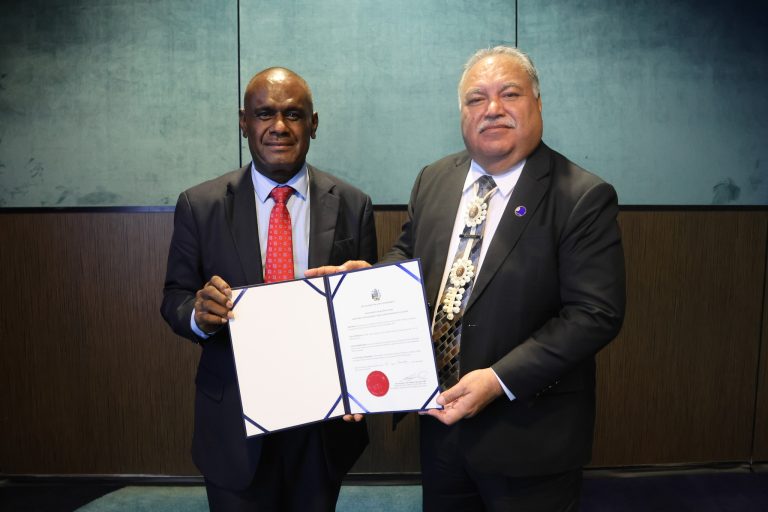
Solomon Islands has handed over its instrument of ratification for the Pacific Resilience Facility (PRF), marking another step toward activating the Pacific-led climate and disaster financing mechanism.

On 27 January, Prime Minister Jeremiah Manele presented the instrument to Pacific Islands Forum Secretary General Baron Divavesi Waqa.

The Solomon Islands is a key supporter and signatory of the PRF Treaty, which was signed during the 54th Forum Leaders Meeting in Honiara in September 2025, when Prime Minister Manele served as Forum Chair.

With 15 Pacific leaders having signed the treaty, the region is moving toward making the PRF legally active by 2026.

Meanwhile, the 6th PRF Legal Co-Drafting Workshop is underway in Nadi, Fiji.

Senior officials from Forum Member countries are meeting to advance the legal foundations of the facility.

The workshop is chaired by Minister Counsellor for the Solomon Islands High Commission to Fiji,Esther O’Brien. It will be followed by the 1st Financial Rules Co-Design Workshop, aimed at advancing the institutional frameworks required to operationalise the financing mechanism.

The PRF is designed as a Pacific-led climate and disaster resilience financing initiative anchored in regional ownership, accountability and long-term sustainability.

Separately, a Pacific Region Infrastructure Facility (PRIF) mission to Tuvalu included the Pacific Islands Forum Secretariat’s Pacific Quality Infrastructure Principles Adviser, Titi Tutuvanu-Schwalger.

The mission continued engagement with the Government of Tuvalu on integrating the Seven Pacific Quality Infrastructure Principles into national infrastructure planning.

The work complements PRIF’s support to update Tuvalu’s National Infrastructure Investment Plan, with a focus on ensuring future investments are sustainable, resilient and aligned with long-term development priorities.

Follow-up in-country support and targeted training will be delivered based on needs identified during the mission.

Population decline in FSM and RMI

0

By Stephen Howes

The urge to survive is a powerful one, for both an individual and a country.

Nauru, whose population was decimated by infectious disease as a result of colonialism, still celebrates Angam Day on 26 October every year. This was the day in 1932 when the birth of a baby brought Nauru’s population up to 1,500, a minimum number thought necessary at the time to guarantee the future survival of the Nauruan people.

Two Pacific countries currently facing a declining population are the Federated States of Micronesia (FSM) and the Republic of the Marshall Islands (RMI).

RMI’s population fell from 53,158 in the 2011 census to 42,418 in the 2021 census, a decline of 20 percent. According to the SPC, its population now (presumably 2025) is only 36,914.

The situation with FSM is more complex. According to official statistics, its population continues to grow, reaching 105,381 in 2024, up from 104,832 in 2021 and 102,843 in 2010. However, authoritative sources, including the IMF and the United States government, note that in fact FSM’s population has fallen. A census was conducted in 2022, but the results have not yet been officially released; the government’s figures rely on extrapolating earlier trends which are now out of date. Veteran analyst and commentator Francis Hetzel wrote in 2024:

Over the past decade, Federated States of Micronesia has lost a large chunk of its population, according to a 2022 census that still has not been formally released. Its population plummeted from 102,000 to 71,000 over the previous ten years (2012-2022), thus marking a loss of 30 percent of its population.

The U.S government reports a 31 percent decline in FSM population between 2010 and 2023, and the IMF reports a similar figure. A recent academic study of FSM reports a 25 percent reduction.

The fear that some Pacific island countries could eventually be almost or completely abandoned goes back at least to the ANU professor of geography, Gerard Ward, whose 1989 article predicted this fate for several of them.

So far, however, the experience of the Pacific is that population declines are temporary and are followed by periods of population stabilisation or growth.

Nauru’s population recovered from the lows of almost a century ago to reach 12,000 today, though it did suffer a minor decline in population in the early 2000s when its economy struggled.

Palau, like FSM and RMI, has a “compact state” relationship with the United States. It experienced a population decline from 20,000 in the early 2000s to 18,000 in recent years, but its population too seems to have stabilised.

Niue and Cook Islands are also relevant examples as they have similarly open-ended migration rights to New Zealand that Palau, FSM and RMI have with the United States. Niue and the Cook Islands both had higher populations in the past. Today, they are both high-income states with stable populations.

Niue’s population fell from a peak of 5,200 in the late 1960s to just 1,900 in the early 2000s, but has stabilised at that level since. Cook Islands had a population of above 20,000 in the early 1970s. It fell to around 15,000 during its economic crisis in the mid-1990s, but has since recovered and stabilised at around 17,000.

All three of Cook Islands, Niue and Palau have achieved high-income status, with incomes per person well in excess of the World Bank’s US$14,000 threshold (see Figure 9 of this recent discussion paper). Good jobs back home both deter outward migration and attract migrants from other countries, thus helping to stabilise the population.

Both FSM and RMI are heavily dependent on foreign rents, specifically revenue from aid and fishing licenses. A smaller population means higher rents per person and, therefore, a higher income per person.

Some of this positive feedback from migration to per person income may already be apparent in these two countries. RMI’s national income (measured in terms of GNDI) grew rapidly in the 2010s: at an average per-person rate of 5.1 percent between 2010 and 2019. Using the official population numbers, FSM’s national income per person grew more slowly, at an average rate of 2.5 percent. But if we use what appear to be the actual population numbers for FSM, its per-person income growth is about three percentage points higher, and so at least as high as RMI’s.

However, it is far from guaranteed that a declining population will boost per-person income enough to lead to population stabilisation. Both FSM and RMI are upper-middle rather than high-income economies. Neither has been successful at attracting much in-migration (unlike high-income and tourism-reliant Palau — according to its 2020 census, in a labour force of 14,000, 5,300 workers are overseas-born).

From a policy perspective, neither FSM nor RMI will want to surrender its migration rights. Indeed, with the crackdown on migration in the US, American demand for compact-state labour is only going to increase.

What both countries can do is make it more attractive for their citizens to stay at home. The recent introduction by RMI of a universal income payment (funded by the grants provided to it by the US as part of the compact state arrangement) should be understood in this context. Since late last year, all RMI residents, including children, are entitled to a payment of US$800 per person. Though not generous enough to make this a universal basic income payment, it is a bold move. RMI has been scolded by the IMF for not targeting this payment at the poor, but that misses the point. The country wants all residents to stay, and especially the more skilled and higher earning.

In summary, the population declines that FSM and RMI are experiencing, while dramatic, need not be bad news. Three other Pacific island countries that have experienced recent, significant population declines — Niue, Cook Islands and Palau — have all since seen their populations stabilise and have either retained or achieved high-income status. Whether, when and at what level population stabilises in FSM and RMI remains to be seen.

Samoan chief jailed for more than 16 years after slavery trial

0

A Samoan chief found guilty of enslaving two people in Auckland has been sentenced to more than 16 years in prison.

Moeaia Tuai was found guilty by a jury last year of numerous charges related to slavery, rape and indecent assault.

He was Thursday sentenced in the Auckland High Court to 16 years and four months’ imprisonment with a non-parole period of eight years.

An 18-month joint investigation by police and Immigration New Zealand was launched in 2024 after the victims came forward with allegations of the 63-year-old’s offending.

Detective Inspector Warrick Adkin said the offending related to two Samoan nationals Tuai arranged to bring to New Zealand in 2016 with the promise of “a good education and a better way of life”.

“But that’s not what happened. Instead, he put them to work, kept their wages and assaulted them.”

Adkin said for the victims to stand up in court against a Matai was “significant in their culture”.

“But they did it, and their compelling evidence led to a conviction.”

Adkin added the investigation team worked “tirelessly” to bring the case to court – and he acknowledged their work along with the specialist agencies who support the victims throughout the process.

Immigration New Zealand national manager of immigration investigations Jason Perry said they are committed to supporting police to ensure those who deliberately harm or take advantage of others were held accountable.

“Coordinated action like this is essential to protecting vulnerable people and raising awareness.

“If you see signs of exploitation, report it.”

Fiji churches unite with Police in frontline battle against drug crisis

0

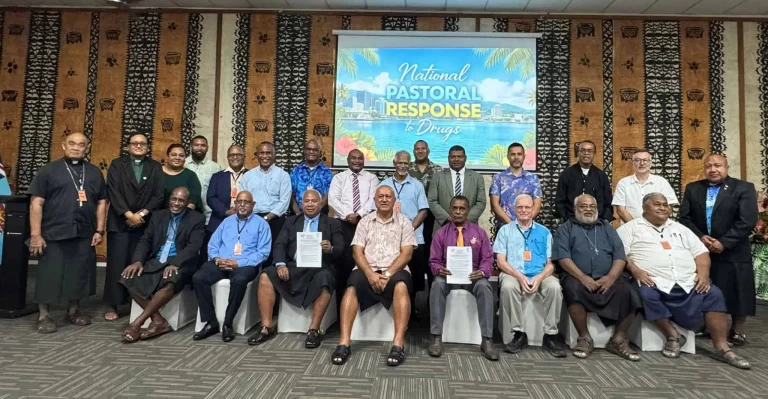
In a landmark show of unity, churches across Fiji have committed to tackling the nation’s escalating drug crisis, pledging a compassionate and coordinated response alongside government authorities.

The commitment was formalised at the National Ecumenical Workshop on a Pastoral Response to Drugs, hosted by the Fiji Council of Churches in Suva, where faith leaders and government officials joined forces in what they described as “a tough, tough, tough fight.”

A joint statement adopted by the gathered denominations declared the crisis to be “more than a ‘crime problem’—it is a complex health, social, spiritual, and cultural emergency that threatens belonging, identity, and hope.”

Minister for Policing Ioane Naivalurua, speaking candidly at the workshop, said his participation was unexpected but necessary.

“This is an ambush. I was not expecting to make a remark, but I see this as a directive from the Fiji Council of Churches and I’ve accepted it,” he said.

“Much has been achieved over the last two days. I have sat at the back and observed your engagement and presentations. I stand this afternoon on behalf of government to sincerely say thank you. This is not an easy subject—it is a tough one, and the work ahead will be even tougher.”

He praised the churches’ strengths in addressing the crisis, saying they were already well positioned.

“The church, in our view, is already weaponised. You are structured, organised, and well led. More importantly, you are connected to where things are happening—you feel the heartbeat on the ground,” he said.

“Above all, your arsenal is a heart of love. I believe that is a key component of the work ahead.”

Minister Naivalurua urged faith leaders to remain united and vigilant.

“This battle needs to be fought at the front line. A key part of fighting at the front is being alert, courageous, and standing firm—because if you fall, your home, your family, your village is taken over,” he said.

Drawing on an example from Indonesia, he shared how communities in Bali had taken responsibility for protecting their families and neighbourhoods.

“They look after their business, their women, their children—and keep their streets and homes clean,” he said.

“The key question for us is whether we, here in Fiji, can take responsibility for looking after our homes, families, and children—not just for today, but for the future.”

He emphasised the importance of duavata, the Fijian principle of unity.

“Duavata has two key components: good relationships and working together. Without unity in this fight, it becomes much tougher—if not impossible. I ask and pray that we remain one.”

The churches’ statement outlined pastoral, practical, and prophetic commitments to address the crisis.

Leaders pledged to “resist shaming and language that dehumanises people who use drugs,” and to embody a Good Samaritan approach— “staying present, listening without judgement, walking with families, and helping people take their next safe step toward care.”

They also committed to creating confidential, non-judgemental pathways for support, referral, and follow-up to break the culture of silence, shame, and fear.

Acknowledging the limits of enforcement alone, the churches endorsed a balanced response—described as “black gloves and white gloves”—where prevention, early intervention, healing, and family strengthening stand alongside law enforcement.

The strategy includes investing in prevention in schools and communities, supporting credible treatment and rehabilitation services, and strengthening aftercare.

“We affirm that enforcement matters, but enforcement alone cannot heal a nation,” the statement said. “We commit to a unified, compassionate, trauma-informed response that turns prayer into presence and faith into faithful action.”

To ensure sustained impact, the churches agreed to hold annual days of prayer and awareness, maintain regular briefings with police and health authorities. Each church will also develop a local action plan and uphold strict standards of confidentiality and safe-church practice.

Minister Naivalurua closed with a call for continued collaboration.

“The government is committed to working with you. The key is our ability to stay together. Every step and every action counts in looking after our young men and women and keeping our home safe,” he said.

The gathering concluded with a shared prayer for courage and compassion, calling for churches to become places of refuge, truth, and healing.

Pacific Regional GBV Counselling Framework launched to strengthen survivor support across the region

0

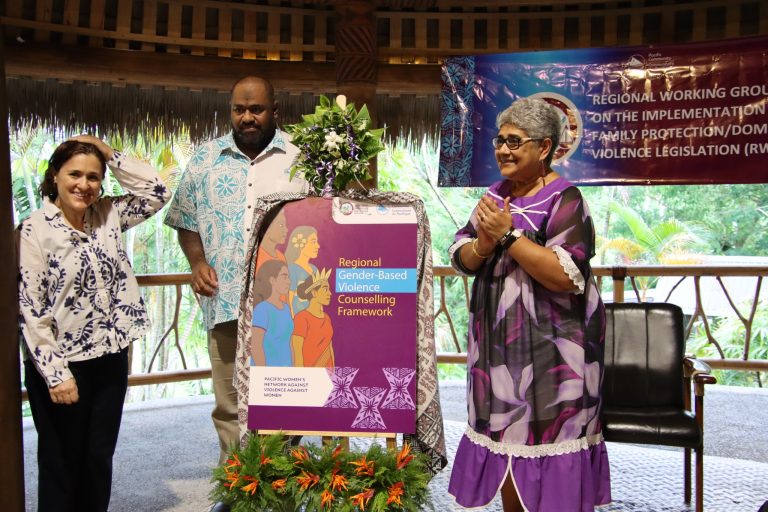
The Regional Working Group on the Implementation of Domestic Violence/Family Protection Legislation (RWG), together with the Pacific Women’s Network to End Violence Against Women, launched the Regional Gender Based Violence Counselling Framework as part of GESI week at the Pacific Islands Forum Secretariat on 12 February 2026.

The Framework is a Pacific-led and Pacific-owned guidance designed to strengthen counselling standards for survivors of gender-based violence across the region.

It is a culmination of years of collaboration between RWG member governments, crisis centres from across the Pacific region, counsellors and civil society organisations, responding to widespread challenges identified by countries in implementing domestic violence laws.

Prior to this work, only three Pacific countries had national GBV counselling standards in place: Tonga, Solomon Islands, and Kiribati.

Developed through extensive consultations in Kiribati, Samoa and Papua New Guinea, and guided by the lived experiences and voices of survivors, the Framework establishes minimum standards for ethical, safe and survivor centred counselling practice.

It provides clear guidance on confidentiality, safeguarding, professional conduct and accountability for all service providers, from government counsellors to women’s crisis centres and faith-based organisations centred counselling practice.

Speaking at the launch, alternate Chair to the outgoing Chair of RWG, Livai Sovau, Legal Adviser for the Department of Women and Social Development Affairs, Government of Nauru, emphasised the significance of the milestone:

“This Framework reflects our shared commitment to ensuring that every survivor of violence is met with dignity, respect and professional care, no matter which country they are in. It is Pacific-built, tested, and will help 13 RWG member states and governments strengthen or establish national counselling standards that protect our families and communities”

Chair of the Pacific Women’s Network to End Violence Against Women, Shamima Ali, highlighted the power of this partnership and its meaning for frontline workers across the region:

“For decades, crisis centres have been the backbone of safe, confidential support for survivors, often operating with limited resources but with deep commitment. This Framework brings governments and civil society together around shared standards that put survivors first. It is a milestone for our region, a testament to our collective strength, and a tool that will help ensure no survivor is ever left without safe, ethical support.”

SPC’s Principal Strategic Lead for Pacific Women and Girls, Mereseini Rakuita, reflected on the deeper regional significance of the Framework:

“This Framework is a major milestone for our region. With 2 in 3 Pacific women experiencing violence, it is essential that our laws are backed by safe, rights-based, survivor centred services. This Framework strengthens our ability to turn commitments into action and ensure real protection for women and girls across our Blue Pacific.”

Both the RWG and the Network acknowledged the Government of New Zealand, through the Ministry of Foreign Affairs and Trade, for its long-term support which enabled the consultative process, drafting and validation of the Framework. They also recognised the Pacific Community (SPC) for its coordination and leadership as Secretariat to the RWG throughout the development of this regional resource.

As countries move to adapt the Framework nationally, partners emphasised that it will play a critical role in strengthening domestic violence legislation, improving service quality and ensuring consistent, accountable support for survivors across the region.

“This is a gift from Pacific governments and CSOs to our people,” added Sovau “Together, we have created something that will protect lives, strengthen services and ensure that our region continues to progress, our way, for our people.”

Nauru moves to change name to Naoero

0

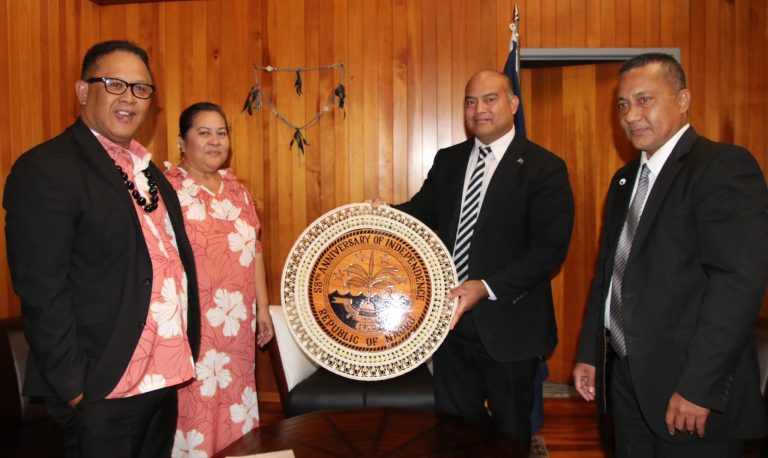
The Nauru Government has tabled a constitutional amendment that would change the country’s name from “Nauru” to “Naoero”, with the proposal now set for further parliamentary process and a national referendum.

The Constitution (Amendment) (No.2) Act 2026 was tabled in Parliament on 29 January 2026. It has not yet been passed. Under Article 84, the bill will be laid over for 90 days before returning to the Order Paper for debate on its Second Reading.

The proposed amendment to the Constitution of Nauru 1968 seeks to replace all references to “Nauru” with “Naoero”. References in any written law would also apply, and any reference to the term “Nauru” would be deemed to mean “Naoero”.

President David Adeang tabled the bill and said that while the name “Nauru” has been recognised internationally since independence, the proposed change seeks to more faithfully honour the nation’s heritage, language and identity.

“Nauru emerged because Naoero could not be properly pronounced by foreign tongues, and was changed not by our choice, but for convenience.

“Today, we have the opportunity to bring our name home,” President Adeang said in a statement, as he called for support at a national referendum.

If approved, the name change would be reflected across the country, including the renaming of the national aircraft and ships, and in the country’s official identity regionally and internationally, including at the United Nations, as well as across national records and symbols.

The government noted that other nations have also changed their country names to better reflect and honour their cultures and languages, including Eswatini, Türkiye and, closer to home, Chuuk.

The change requires a two-thirds majority vote in Parliament. If passed, it will then go to a national referendum, where all eligible Nauruan voters will decide whether to change the name from “Nauru” to “Naoero”.

Tonga’s newly appointed Prime Minister takes on Champion role for Weather Ready Pacific Programme

0

The Weather Ready Pacific (WRP) programme has received a major boost with Tonga’s newly appointed Prime Minister, Lord Fakafanua, graciously accepting the role of championing the Weather Ready Pacific Programme.

Confirmed during his recent meeting with the Director General of SPREP on 30 January 2026, this marks a significant milestone for regional efforts to strengthen weather and climate resilience across the Pacific.

It also signals Tonga’s strong commitment to lead the way in championing flagship, Pacific-led initiatives that address the escalating impacts of climate change, while strengthening the resilience of communities across the region.

Through its sustained political leadership and advocacy, Tonga continues to demonstrate how steadfast national commitment can drive collective regional action and inspire greater international support for a safer, more climate-resilient Pacific.

The Weather Ready Pacific (WRP) Programme was developed by the Pacific for the Pacific through the Pacific Meteorological Council and endorsed at the 51st Forum Leaders Meeting to support countries to strengthen National Meteorological and Hydrological Services (NMHSs), improve early warning systems, and ensure life-saving weather, climate and other extreme events information reaches communities when it matters most.

By taking on the role of Champion, the Tongan Prime Minister brings political leadership and a credible voice that will help amplify the programme’s message among international partners and donors. This high-level advocacy is expected to strengthen engagement with development partners, multilateral agencies and climate finance institutions, positioning Weather Ready Pacific as a critical investment for safeguarding lives, livelihoods and economies in the Pacific region.

“The Weather Ready Pacific programme is about saving lives and protecting livelihoods from extreme events,” the Prime Minister said.

“Reliable, timely and accessible weather and climate information empowers our communities to prepare, respond and adapt in a collaborative, transformative and sustainable way. I am proud to champion this programme and to advocate for stronger global support for Pacific-led solutions.”

The Champion role will also support greater alignment between regional priorities and global commitments under frameworks such as the Sendai Framework for Disaster Risk Reduction, the Paris Agreement, and the UN Early Warnings for All initiative. By showcasing Pacific leadership and success stories, Weather Ready Pacific aims to demonstrate the high return on investment that comes from strengthening meteorological services and early warning systems.

SPREP, which coordinates the Weather Ready Pacific programme in close partnership with Pacific NMHSs and regional stakeholders, welcomed the appointment. The organisation noted that having a Head of Government as Champion sends a strong signal of the programme’s importance and urgency.

“We are grateful to have the Honourable Prime Minister of Tonga as our WRP Champion,” said the Director General of SPREP, Sefanaia Nawadra.

“Lord Fakafanua will bring another level of support for the work that we do at the political level and will help bring more awareness to the importance and life-saving nature of this work. It also continues a legacy of support from Tonga’s Leadership since the inception of Weather Ready Pacific initiative to its realisation and approved by the Leaders in Tonga in 2024,” he added.

With renewed momentum and high-level leadership and support, Weather Ready Pacific is well positioned to attract increased and sustained funding from international partners, ensuring Pacific countries are better equipped to anticipate, prepare for and respond to weather related severe events and other earth system hazards, now and into the future.