


Australia has placed the Pacific at the centre of its foreign policy strategy, strengthening security partnerships, climate resilience financing and regional infrastructure as it seeks to protect its interests in an increasingly contested Indo-Pacific.
Australian Foreign Minister Penny Wong says the Albanese Government has made the Pacific its first foreign policy priority, recognising that Australia’s security and prosperity are closely tied to the stability and resilience of its neighbouring island countries.
In outlining Australia’s foreign policy direction since the government took office in 2022, Wong said Canberra had shifted towards a more active regional engagement, based on partnerships, mutual respect and practical cooperation.
“Our security begins in our region; that is why it is our first foreign policy priority,” Wong said.
She said Australia had strengthened its relationships with Pacific Island countries through a series of bilateral agreements covering security, economic cooperation, climate change and mobility.
These include the Pukpuk Treaty with Papua New Guinea, which entered into force in July 2026, the Ocean of Peace Alliance with Fiji, the Falepili Union with Tuvalu and the Nauru-Australia Treaty.
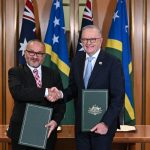
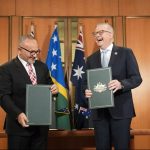
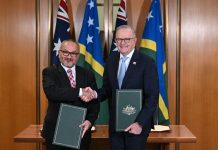
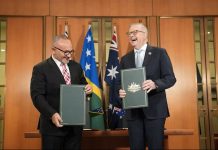
Australia has also signed the Nakamal Agreement with Vanuatu and is working towards signing a new comprehensive treaty with Solomon Islands on Wednesday
Wong said the agreements reflected Australia’s commitment to working with Pacific countries as equal partners and supporting regional priorities.
“These agreements – unthinkable in 2021 – are a result of our unflagging diplomatic efforts and the reliability and credibility we have with our Pacific partners,” she said.
She said Australia had also responded to Pacific calls for stronger action on climate change, which the region considers its greatest security threat.
Australia provided AUD$100 million (US$66 million) as foundational funding for the Pacific Resilience Facility (PRF), a Pacific-led, owned and managed fund designed to help communities prepare for disasters, adapt to climate change and protect livelihoods.
Wong said the initiative reflected Australia’s commitment to ensuring climate finance reached Pacific communities.
Australia has also invested in regional infrastructure and connectivity, including more than 10,300 kilometres of undersea telecommunications cables, connecting all Pacific Islands Forum members to the global cable network.
The Australian Government has committed AUD$2.1 billion (US$1.39 million) in project financing through the Australian Infrastructure Financing Facility for the Pacific in 2026, supporting 67 projects across 13 Pacific countries and Timor-Leste.
The investment includes 36 off-grid renewable energy projects.
Wong said Australia’s two-way trade in goods and services with the Pacific had increased by 20 percent over the past year, reinforcing the region’s importance to Australia’s economic interests.
She also highlighted Australia’s AUD$400 million (US$265 million) support for the Pacific Policing Initiative and its AUD$600 million (US$398 million) contribution to the Pacific Islands Forum’s Waqa Moana initiative to combat illegal drug trafficking.
“Our work reflects the principle that guides our engagement: Pacific-led, Australia-backed,” she said.
Wong said Australia supported the Pacific Islands Forum’s Ocean of Peace vision, describing it as a region where security was built through cooperation among Pacific countries rather than the strategic ambitions of outside powers.
“When we support the PIF vision of an Ocean of Peace, we are describing a region in which security comes from cooperation among its own peoples, not from the security ambitions of outsiders,” she said.
She said Australia had also rebuilt its development assistance programme, with more than 75 cents of every Australian development dollar now directed to the Indo-Pacific.
Wong’s foreign policy statement identifies four priorities guiding Australia’s international engagement: the region, relationships, international rules and resilience.
She said the priorities were increasingly important as strategic competition between the United States and China, economic coercion, technological disruption and climate change reshaped the international environment.
Wong said Australia wanted a peaceful, stable and prosperous Indo-Pacific where countries, regardless of size, could make their own sovereign decisions without coercion.
‘Our strategic objective is straightforward: a peaceful, stable and prosperous Indo-Pacific. We seek a region where no country dominates, and no country is dominated,” she said.
She added that Australia would continue to strengthen its partnerships and regional presence while supporting Pacific regionalism and the ability of island countries to determine their own futures.