

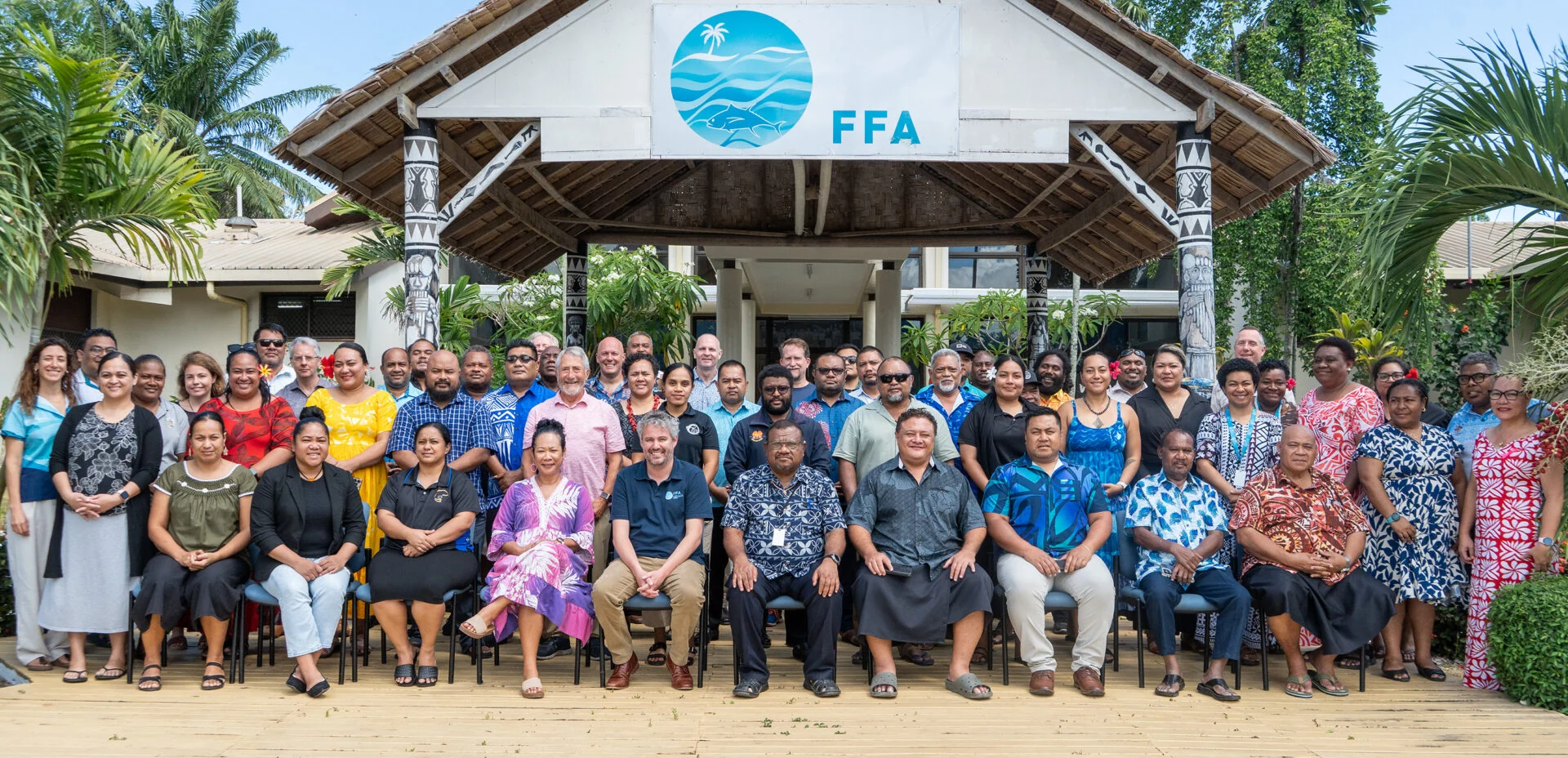
The 17 Members of the Pacific Islands Forum Fisheries Agency (FFA) will push for a landmark management procedure for bigeye tuna at the upcoming 23rd Regular Session of the Western and Central Pacific Fisheries Commission (WCPFC23) in Port Vila, Vanuatu.
The proposal is among several fisheries management priorities formally submitted to the Commission following the 22nd Management Options Consultation (MOC22), a weeklong series of meetings involving FFA Members, partners and stakeholders on key regional fisheries management issues.
The outcomes of MOC22 were endorsed yesterday at a Special Forum Fisheries Committee (FFC) Officials Meeting in Honiara, before being submitted to the Commission.
If adopted, the proposed bigeye tuna measure would be the Commission’s first management procedure covering both purse seine and longline fisheries, two major fishing methods used to catch tuna.
It would be an important step towards strengthening the management of the world’s largest bigeye tuna stock, which accounts for approximately 40 percent of global bigeye tuna catches and, according to the latest stock assessment, has never been overfished.
Managing bigeye tuna remains a challenge because both purse seine and longline fisheries catch the same stock. Existing restrictions on purse seine fishing help protect bigeye tuna but also reduce fishing opportunities and potential revenue for Pacific Island countries, while benefiting longline fisheries.
FFA Members are seeking a more balanced approach that protects bigeye tuna while recognising the economic interests of Pacific Island countries and ensuring that conservation responsibilities are shared more fairly between the two fishing methods.
Other proposals submitted by FFA Members include new arrangements for managing South Pacific Albacore, stronger fisheries reporting and monitoring and stronger management of transhipment activities.
For South Pacific Albacore, FFA Members are seeking agreement on how fishing opportunities should be allocated between coastal States and high seas fisheries and established rights on the high sea; supported by robust monitoring and reporting; for the implementation of the Management Procedure adopted by the Commission in December 2025. The proposal is grounded on the recognition of rights and special requirements of Pacific Small Island Developing States and Territories (SIDS) and of the Commission’s agreed allocation criteria.
FFA Members are also calling for stronger fisheries monitoring and compliance, including a prohibition on transferring fish between vessels on the high seas until the Commission adopts clear guidelines. Other priorities include improving fisheries data reporting and protecting Pacific Island countries’ fishing rights and economic interests as climate change affects tuna distribution.
FFA Director-General Noan David Pakop acknowledged the commitment demonstrated by Members throughout the consultations.
“Members, the 22nd Management Options Consultation demands flexibility, compromise and commitment to our collective interests and I recognise that this is not always a straightforward process. However, over the past few days, your engagement has once again demonstrated the strength of our membership: your ability to come together, reconcile differing views and work towards consensus,” Pakop said at the FFC Officials Meeting.
With their common positions now endorsed and formally submitted, FFA Members will focus on building support for their proposals ahead of WCPFC23, scheduled for 30 November – 05 December 2026 in Port Vila, Vanuatu.
The 17 FFA Members include Australia, Cook Islands, Federated States of Micronesia, Fiji, Kiribati, Marshall Islands, Naoero, New Zealand, Niue, Palau, Papua New Guinea, Samoa, Solomon Islands, Tokelau, Tonga, Tuvalu, and Vanuatu.