
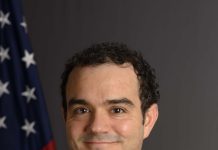


The United States is looking to connect its law enforcement operations in the Pacific with expertise and investigations in South Asia as criminal networks expand across the Indo-Pacific, U.S Assistant Secretary of State Cartwright Weiland says.
Weiland said the United States was examining possible links between criminal networks targeted by its RIPTIDE initiative and drug trafficking networks operating in South Asia.
He said the connections between South Asia and global drug markets were still becoming clearer, but US authorities were aware of Chinese-based money laundering networks and links to Latin American criminal groups.
“We’re already working with essentially every law enforcement agency in the Pacific, but INL has sections throughout South Asia as well,” Weiland said during a virtual press briefing.
The Bureau of International Narcotics and Law Enforcement Affairs (INL) has an established presence at major U.S embassies across Asia, which Weiland said could help connect investigations and expertise across the region.
He cited the bureau’s work in Thailand and Cambodia on scam centres and sexual exploitation, saying that experience could be applied as similar criminal activities emerge in Pacific countries.
“Those sections in those larger embassies on mainland Asia, they have more experience that is now unfortunately transferable to the smaller Pacific nations that are just starting to see some of this criminality that has not been witnessed previously,” he said.
Weiland said U.S law enforcement personnel in different parts of Asia were dealing with different aspects of the same problem and would increasingly be able to support each other.
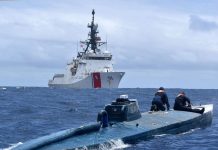
On Fiji, Weiland said the country’s large exclusive economic zone (EEZ) posed a major challenge for maritime surveillance and drug interdiction, particularly given the limited number of patrol vessels available to Pacific countries.
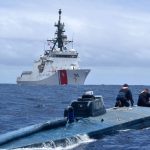
He said the United States was working to provide maritime domain awareness technology to help Fiji and other island nations monitor activity across their waters and identify vessels suspected of trafficking illicit drugs.
“The large EEZ is maybe the most important aspect of this problem to realise and to consider,” he said.
The technology would allow countries with small naval fleets to monitor activity across their EEZs and improve their ability to detect suspicious vessels and shipments on the high seas.
Weiland said the tools were largely technological but declined to identify the specific systems or companies involved.
He said similar technology was being used in Latin America, where criminal networks and illegal, unreported and unregulated (IUU) fishing operations also exploit large maritime areas.
“It’s really by utilising technology that we’re able to give them the tools that they don’t have as yet,” he said.
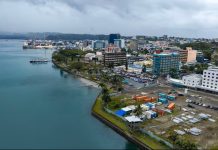
Weiland also confirmed that the US was looking at expanding its presence in Suva, although he did not provide details of what the expansion would involve.
The comments come as the United States increases its law enforcement engagement with Pacific countries to address drug trafficking and other transnational crime.