
The 46th Green Climate Fund (GCF) Board meeting has approved 21 projects, accredited 16 new partners, and adopted policies to set the stage for the next programming period (GCF-3).
The USD$1.97 billion in new climate finance also included additional financing for an existing facility.
The total is the largest approved at a single GCF Board meeting. In 2026, GCF approvals total USD$3.3 billion, a new annual record.
The balance sheet efficiency measures introduced at the last Board meeting unlocked additional funding capacity, contributing to the record approval.
The new approvals bring GCF’s portfolio to 379 projects and programmes with USD$22.3 billion in GCF funding across Africa, Asia-Pacific, Latin America and the Caribbean, and Eastern Europe, Central Asia and the Middle East, amounting to USD$87.3 billion when including co-financing.
GCF efficiency reforms are becoming the new normal; 13 of the 15 projects subject to the Efficient GCF standard met it, with an average review time of six months against the nine-month target.
Direct Access Entities (DAEs) will manage 34 percent of the funding approved at the Board meeting, marking strong support for increasing direct access. Five of the projects are the first single-country projects for their countries: Algeria, Cameroon (two projects), Moldova and Yemen.
The projects also include the first direct sovereign loan responding to the Belém call to action for the Congo Basin Forests. Two Brazilian projects (FP326 and FP327) are the first GCF projects approved from the pipeline of a GCF Readiness-supported country platform: the Brazil Climate and Ecological Transformation Investment Platform.
The Board approved 16 new accreditation applicants, 9 of them DAEs. Thirteen are the first entities accredited under the Revised Accreditation Framework, with an average review time of four months against the nine-month service standard, again showing the impact of Efficient GCF. Maldives Finance and Leasing Company Private Limited (MFLC) becomes the first national DAE of Maldives.
In preparation for the GCF-3 replenishment, the Board approved two landmark policies: an updated Policy for Contributions for GCF-3 with greater flexibility to engage with contributors and the Fund’s first-ever Policy for Contributions from Other Sources to mobilise contributions from non-sovereign and alternative sources.
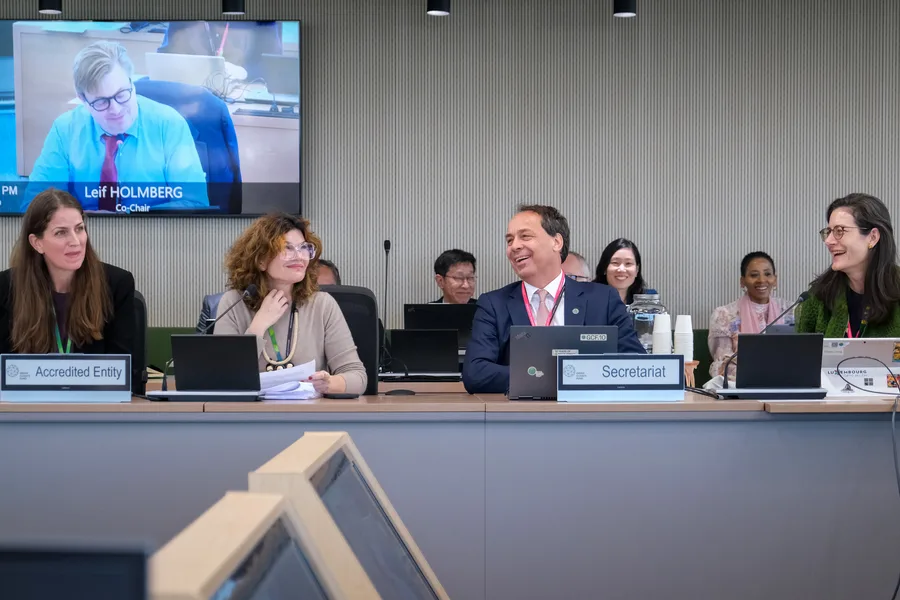
After two years of service, this board meeting was the last to be co-chaired by Leif Holmberg of Sweden and Seyni Nafo of Mali.
Co-Chair Leif Holmberg, Sweden, said: “This Board meeting has once again demonstrated GCF’s ability to deliver climate finance at scale. With a record level of project approvals and the agreement of a significant package of policies, the Board has laid a strong foundation for the replenishment of GCF’s third programming cycle. These outcomes reflect a Fund that continues to evolve and strengthen, enhancing its capacity to support developing countries and reinforcing confidence in GCF’s ability to deploy climate finance effectively and deliver tangible results on the ground.”
Co-Chair Ambassador Seyni Nafo, Mali said:“The outcomes of this Board Meeting clearly show GCF’s ongoing determination to meet the climate priorities of developing countries. I am particularly pleased at how we are continuing to deliver on our pledge to strengthen country ownership: 34 percent of the finance approved at this Board will flow through national and regional Direct Access Entities. We are also bringing GCF finance to first single-country projects in Algeria, Cameroon, Moldova and Yemen. Approving almost USD 2 billion at this Board Meeting is what delivering at scale means: more finance, through country institutions, reaching more countries and communities.”