

By Pita Ligaiula
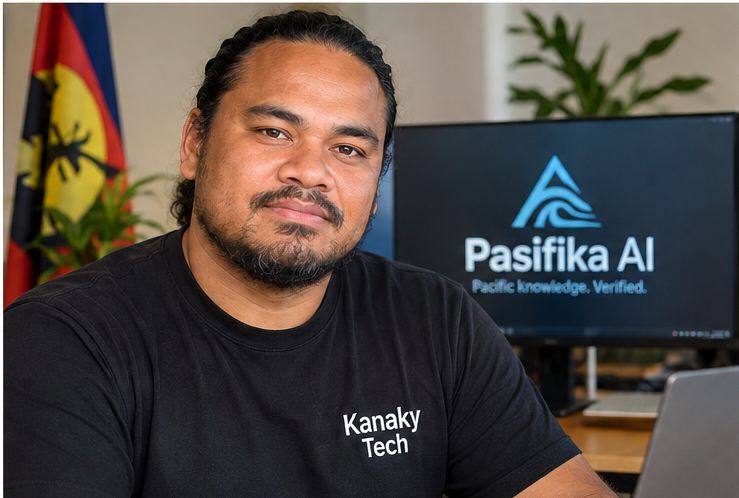
Building artificial intelligence that is genuinely aligned with Pacific values means accepting that the system may sometimes be less impressive, less fluent and less complete, according to Pasifika AI creator Kevyn Wahuzue.
Wahuzue, founder of Kanaky Tech and creator of Pasifika AI, said the practical test of the Pacific’s newly adopted AI principles was not how confidently a system answered questions, but how it behaved when it did not know.
“In practice it has meant accepting worse product metrics,” Wahuzue told PACNEWS.
He said an AI system that refuses to answer, flags an unverified word or provides several institutional references instead of producing a single confident response could appear less capable in demonstrations.
“A system that refuses, that flags an unverified word, that returns five institutional references instead of one confident paragraph, is a less impressive demo.
“It answers fewer questions completely” Wahuzue said.
Wahuzue said the commercial AI industry generally rewards fluency, making it important for Pacific developers and institutions to deliberately build safeguards into systems.
“It means the refusal is a feature you design and pay for, not an error you apologise for.
“It means restricting where the system may look even though that shrinks what it can answer,” he told PACNEWS
He said AI developers should also publish a system’s limitations alongside its capabilities and distinguish between making technology accessible and giving it authority.
“The tool can be free and easy to use without that making it a voice for anybody,” he said.
Wahuzue said the biggest risk posed by mainstream AI systems in Pacific communities was not necessarily obvious offensive content, which could be identified and corrected.
He said the more serious risk was AI producing confident answers on Pacific cultures, languages and histories where the available source material was limited.
“They answer smoothly about things they have almost no material on, and that answer becomes the default reference for a student, a teacher, a journalist, a public servant’
“Under-representation in training data does not show up as silence. It shows up as confident invention,” he told PACNEWS
Wahuzue said the problem could become more serious when inaccurate AI-generated information entered published material and was later incorporated into other AI systems.
“Invented material gets published, indexed, and read back in by the next generation of models,” he said.
Wahuzue warned that a fabricated word or distorted cultural account could eventually become part of the available record about a language with few speakers, while making it difficult to identify where the information originated.
“Communities with the least digitised material are the most exposed, which is precisely backwards,” he said.
Wahuzue said Pasifika AI could be expanded through partnerships with Pacific governments, universities, cultural institutions and communities.
He said such partnerships would be necessary if the project was to develop beyond the work of one person.
“Yes, and I would welcome it.
“It is the direction the project has to go if it is to be more than one person’s work,” he told PACNEWS
But Wahuzue said community ownership would need to be built into the structure of any partnership.
Communities or institutions should decide what material can be included, what must remain outside the system and have the ability to require its removal without having to negotiate for it, he said.
He also said source and dictionary material should remain under the control of its owners rather than being absorbed into a system from which it could not be recovered.
The project should also never claim a mandate broader than the one actually granted, while communities must have a genuine right to say no.
“What I can offer is the working system, the technical build, and a design that is already structured around named sources and stated limits.
“What I cannot offer, and would not, is a promise that the technology substitutes for the people who hold the knowledge,” Wahuzue told PACNEWS
As Pacific governments and regional organisations move from adopting AI principles to developing and deploying AI systems, Wahuzue said there were three practical questions they should ask.
The first was where an AI system is permitted to obtain its information.
“A vendor who cannot show you their source list is asking you to trust a boundary they will not describe,” he said.
The second was how the system behaves when it does not know the answer.
He said procurement processes often focus on the quality of an AI system’s best answers, while giving insufficient attention to its failure cases.
“The behaviour that matters in a cultural or public-service context is the failure case, because that is where the harm lives, and it is almost never tested,” he told PACNEWS
The third was to keep ownership separate from access.
“Deploying a tool is not the same as ceding authority to it,” Wahuzue said.
Wahuzue said the Pacific principles’ emphasis on human-centred and culturally aligned AI would ultimately be tested by whether communities retained the power to reject or withdraw from a system after it had been deployed.
“The practical test of that is whether communities retain the power to say no after the system is live — not only during the consultation before it is bought,” he said.