


Women from across the Pacific have called for stronger recognition of their voices in climate decision-making, warning that the region’s climate challenges cannot be separated from the wider global crisis.
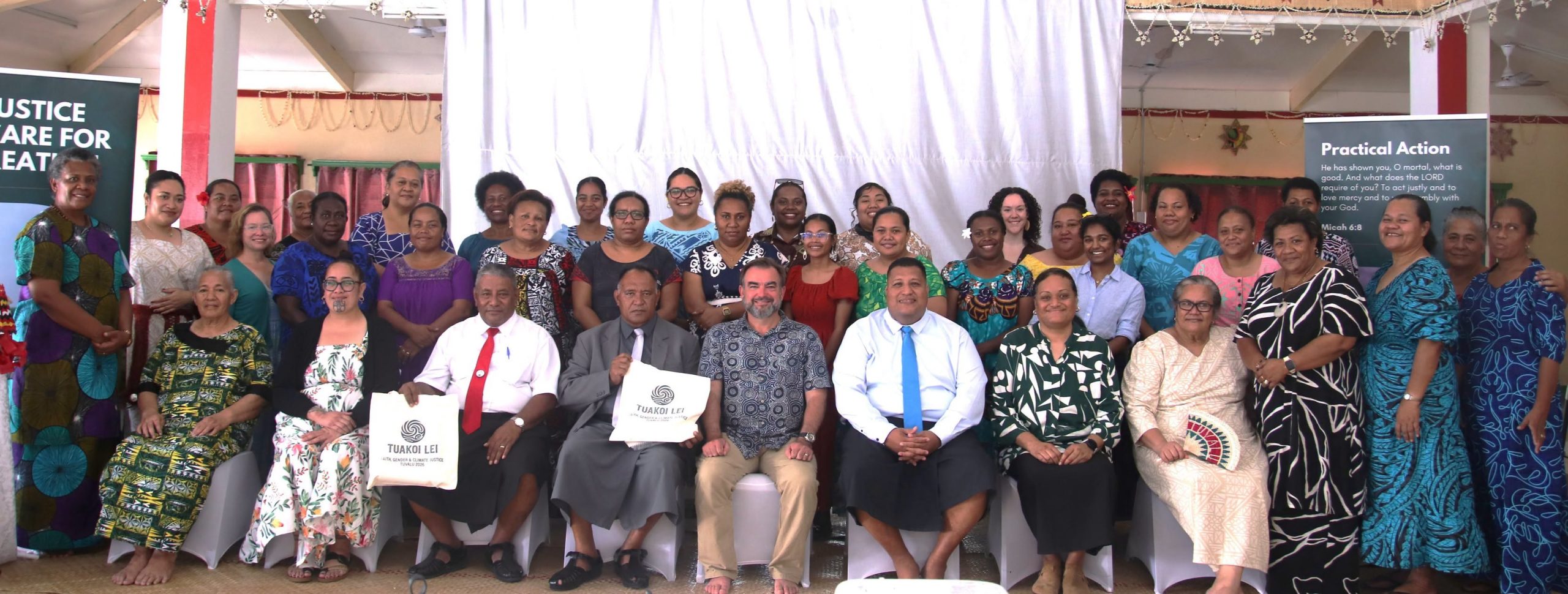
The call came at the conclusion of the Tuakoi Lei Regional Convening in Tuvalu, where women delegates adopted a Kalaga ke Fakatino (Call to Action) outlining their priorities ahead of global climate negotiations.
The Pacific Council of Churches (PCC) said the convening reinforced the need for women, girls, communities and churches to have a meaningful place in the global climate conversation.
Tuvalu’s Minister of Home Affairs, Climate Change and Environment, Dr Maina Talia, joined the closing session and responded to the outcome statement.
He encouraged women delegates staying on for the Civil Society Organisation meeting to continue carrying forward the Call to Action and ensure women’s voices remain part of the climate dialogue.
The Council said the convening took place against a backdrop of growing uncertainty, including geopolitical tensions and concerns over the region’s future.
Minister Talia reminded participants that despite this uncertainty, communities were called to act through “neighbourly love.”
The Council said this required a broader understanding of who a neighbour is and recognition that the impacts of climate change do not stop at national or regional borders.
“What happens in the Global South will ultimately impact those living in the Global North,” the statement said.
It said Pacific communities, oceans, economies and futures are deeply interconnected with those of communities around the world.
The Pacific Council of Churches said the Tuakoi Lei message captures the need for greater solidarity between communities facing shared challenges.
In Tuvalu, Tuākoi Lei means “Good neighbour. Loving neighbour.”
The Council said the phrase should be understood as more than a cultural expression.
“It is an invitation — to see one another, to listen to one another, to care for one another, and to recognise that none of us can face the challenges of our time alone,” it said.
The statement called for a rethink of relationships between the Global South and Global North, arguing that the wellbeing and future of communities in both regions are connected.
“What happens to our neighbours eventually reaches us,” the Council said.
“What happens in the Pacific matters to the world. What happens in the Global South matters to the Global North.”
The convening was held as part of the lead-up to the next round of global climate negotiations and provided a platform for Pacific women and girls to contribute to climate discussions.
The Pacific Council of Churches said the meeting reaffirmed the importance of ensuring women and communities are not simply consulted but are able to speak, participate and contribute to global climate dialogue.
The Call to Action will now be carried into the wider civil society discussions and climate advocacy process.
The Council urged participants to leave Tuvalu with a renewed commitment to “rethink, reimagine and reconnect” and to become the neighbours the world needs.
“Tuākoi Lei. Good neighbour. Loving neighbour,” the statement concluded.