



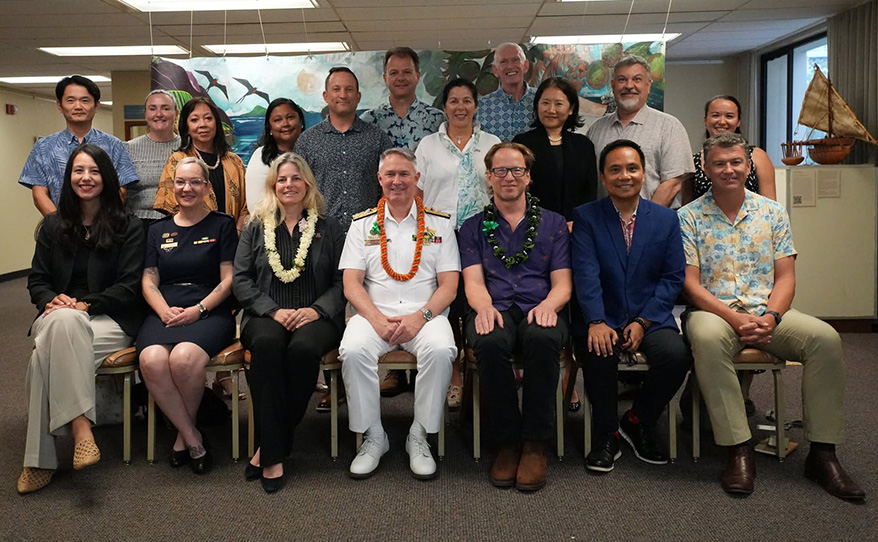
Vice Admiral Justin Jones, Australia’s Chief of Joint Operations, spoke at a roundtable discussion at the East-West Centre during a visit to Honolulu for Exercise Rim of the Pacific (RIMPAC) 2026.
Australian Consul-General in Honolulu Greg Wilcock moderated the discussion, which brought together defence, diplomatic, academic, industry, and regional leaders to discuss the future of Indo-Pacific security, Pacific engagement, leadership development, and strategic dialogue.
“Security, economic resilience, emerging technologies, critical infrastructure, and disaster preparedness are interconnected challenges that require cross-disciplinary solutions,” said East-West Centre President Celeste Connors during her opening remarks.
“At the East-West Centre, we often speak about economic security as a foundation for regional stability. Today’s conversation is an important reminder that security and prosperity are mutually reinforcing, and that neither can be achieved without strong partnerships.”
Vice Admiral Jones described the Pacific region as Australia’s primary area of military interest within its global theater with hundreds of operations, activities, and other investments. He discussed the importance of an “integrated defence” not just between the Australian Navy, Army, and Air Force, but also Australian public servants and private contractors.
“Defence needs to be seen more as a whole-of-government endeavor rather than just something the Department of Defence does,” said Jones.
He went on to describe deterrence as “changing the calculus of adversaries such that they believe that investment in war or other activities is not worth the initial outlay.”
While he noted that establishing credibility and capability are central to the idea, Jones underscored the importance of the ‘cognitive’ aspects of deterrence. That is, viewing issues through the mindset of target audiences, adversaries, and competitors can inform strategic action to shift perceptions as necessary.
In turn, he noted that messaging around exercises like RIMPAC should emphasise not only the convening power of the United States, the U.S Pacific Command (PACOM), and the Pacific Fleet, but also the collective power of a coalition of 30 nations with more than 40,000 personnel coming together to rehearse warfighting functions—a dramatic evolution from the six nations involved during Jones’s first RIMPAC in 1990.
He further discussed how other joint exercises like Talisman Sabre have similarly evolved over his career to be designed around training objectives set by the now 19 participating nations, asserting that these coalitions of allies and like-minded partners are valuable in deterrence messaging.
“Our National Defence Strategy has made it very clear that a defining feature of our environment is U.S-China competition,” said Jones. “We are on the periphery of that as an ally of the US and a contributor and participant in the region.”
Jones acknowledged Australian commentary questioning the country’s involvement in the South China Sea, noting that 60 percent of Australia’s trade moves through that region. Thus, he argued that it is in Australia’s interest to contribute to “the global good that is maritime security” to protect Australia’s economy and prosperity.
In addition to highlighting strong relationships with Southeast Asia and Japan, Jones discussed how Australia’s bilateral arrangements with various Pacific Island countries have also been designed to be mutually beneficial.
He highlighted Operation Solania, which coordinates with the Pacific Islands Forum Fisheries Agency on maritime surveillance and patrol operations. These operations aim to detect and deter illegal, unregulated, and unreported fishing activity, thus protecting and supporting the economic development of Pacific Island countries.
“We see no credibility in an Australia-centred Pacific region. When we talk about security arrangements in the region – ‘Pacific solutions to Pacific security problems’ channeled through the Pacific Islands Forum – we mean it, because we see that as much more sustainable over the long term,” said Jones.
“Australia might be providing a good deal of the ‘software’ and occasionally the ‘hardware,’ but we want that collectively to be owned by the Pacific Island countries.”
Jones went on to discuss how Australia cooperates with Pacific Island countries on shared challenges related to natural disasters in the region via the Pacific Response Group formed in 2024 by the South Pacific Defence Ministers Meeting.
He described the Pacific Response Group as a body of people from militaries across the region, particularly in the southwest Pacific, designed to rapidly deploy as a planning team in the event of a natural disaster. Initially hosted and led by Australia and now New Zealand, he noted that the hope would be to hand leadership over to the Pacific to ensure that it remains Pacific-centric and responsive to the needs of Pacific nations.
“One thing that gives me confidence is everything I see here at RIMPAC,” said Jones.
“Nations working together in like-minded coalitions give me a lot of confidence that we’re absolutely on the right track and working with the right people that are invested in the security of our region, which is to everyone’s benefit,” said Jones.