

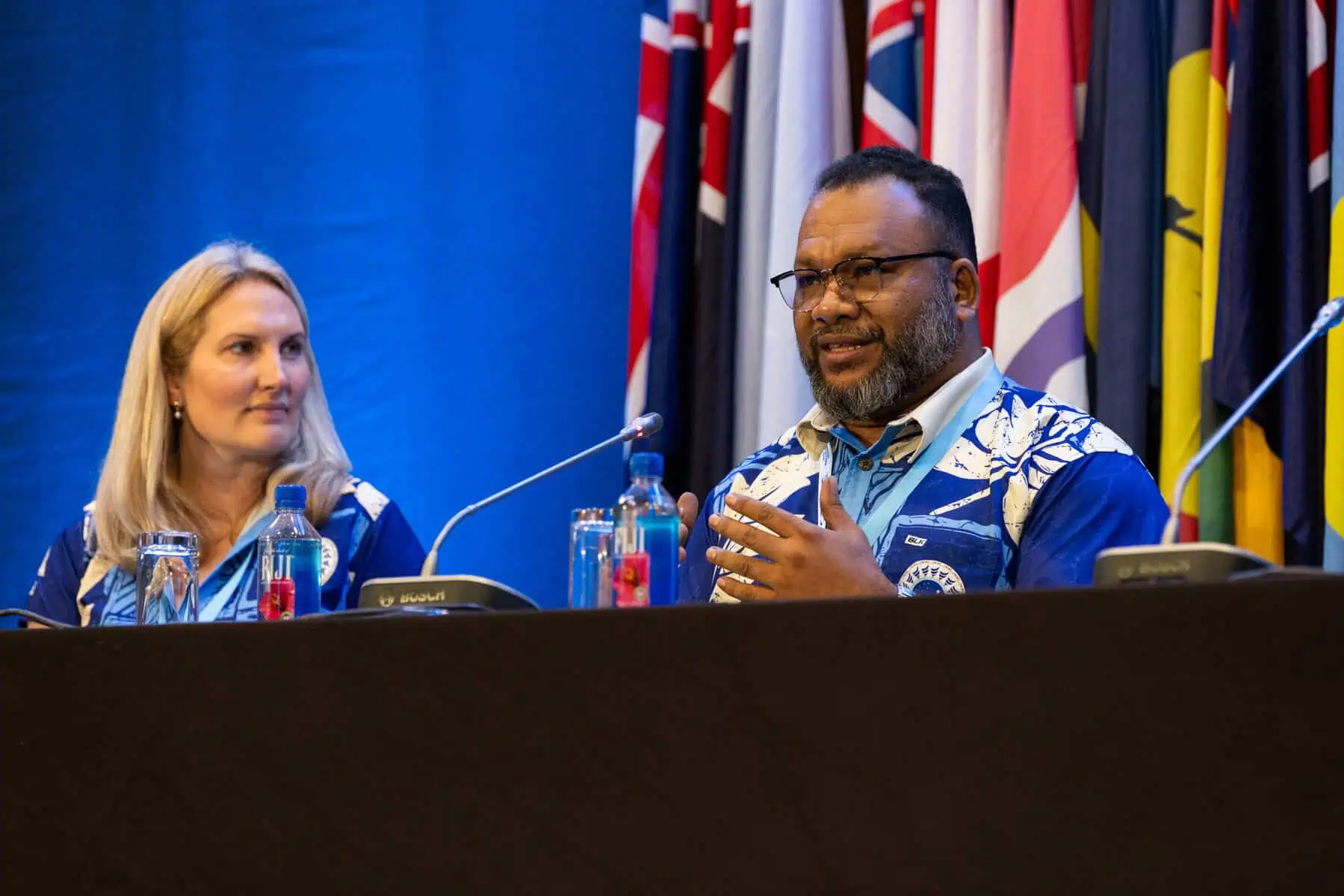
Papua New Guinea’s media sector is pushing back against a new era in which social media, misinformation and artificial intelligence are reshaping the country’s information landscape, according to Media Council president Neville Choi.
At the Pacific Peace and Security Dialogue, Choi said the government’s move to treat social media as equivalent to mainstream journalism triggered calls for regulation and forced the media industry into sustained talks with officials over a draft Media Development Bill and a new AI framework.
“In 2023, our national leadership started to take notice of social media,” Choi said.
“What happened next was our national leadership started positioning social media as the same as mainstream media.”
That shift, he said, set off a wider policy debate.
“There were calls for regulation. There were calls for no standards in news and media,” he said, adding that the industry initially saw itself “being pushed into a corner with social media, totally unregulated.”
Choi said the dispute has since moved into a more constructive phase.
The Media Council has spent two years lobbying government on the draft policy, which he said has gone through five versions and now includes industry recommendations before being approved by the National Executive Council.
“That was a win on our part,” he said.
The government has also changed its own communication habits.
“Ministries now increasingly publish directly on their social media pages instead of relying on media releases to mainstream outlets, a shift he described as revealing both the scale and the risk of an “unregulated media” environment.”
He added the policy response was broadening beyond media regulation to artificial intelligence.
PNG has published an AI framework for government systems, but Choi said the process was difficult because no frontier template could simply be imported into a country with “over 800 plus languages and different cultures.
A special parliamentary committee, he said, has also been examining whether mainstream media is doing enough to counter misinformation and disinformation and has recommended stronger legal protections for journalists, including amendments to criminal law to make assaults on journalists prosecutable as criminal offences.
“It hasn’t been an easy ride working with government,” Choi said.
“But both government and media, we both now recognise that the focus should be on our people and how they engage and how they use social media.”
He argued that the answer was not to reject technology but to pressure-test it.
“Stress test everything. Every AI programme, if you’re incorporating it, stress test it.”
The media sector, he added, is trying to do just that through training and public education.
At the second PNG Media Summit, held on World Press Freedom Day, the main goal was to build skill sets and understanding of AI within Papua New Guinea’s mainstream media.
Choi said the broader message for the public is that technology should be a tool, not the destination.
“Look at the problem and choose the AI to solve the problem rather than seeing AI as the endgame,” he said.
For PNG’s media and government, the challenge now is whether the country can build a durable system for verified information in an environment where social media is growing faster than the rules that govern it.
“We are still learning as we go. We are working as hard as we can in the industry to ensure that we are up to the job of informing our audiences,” he said.