

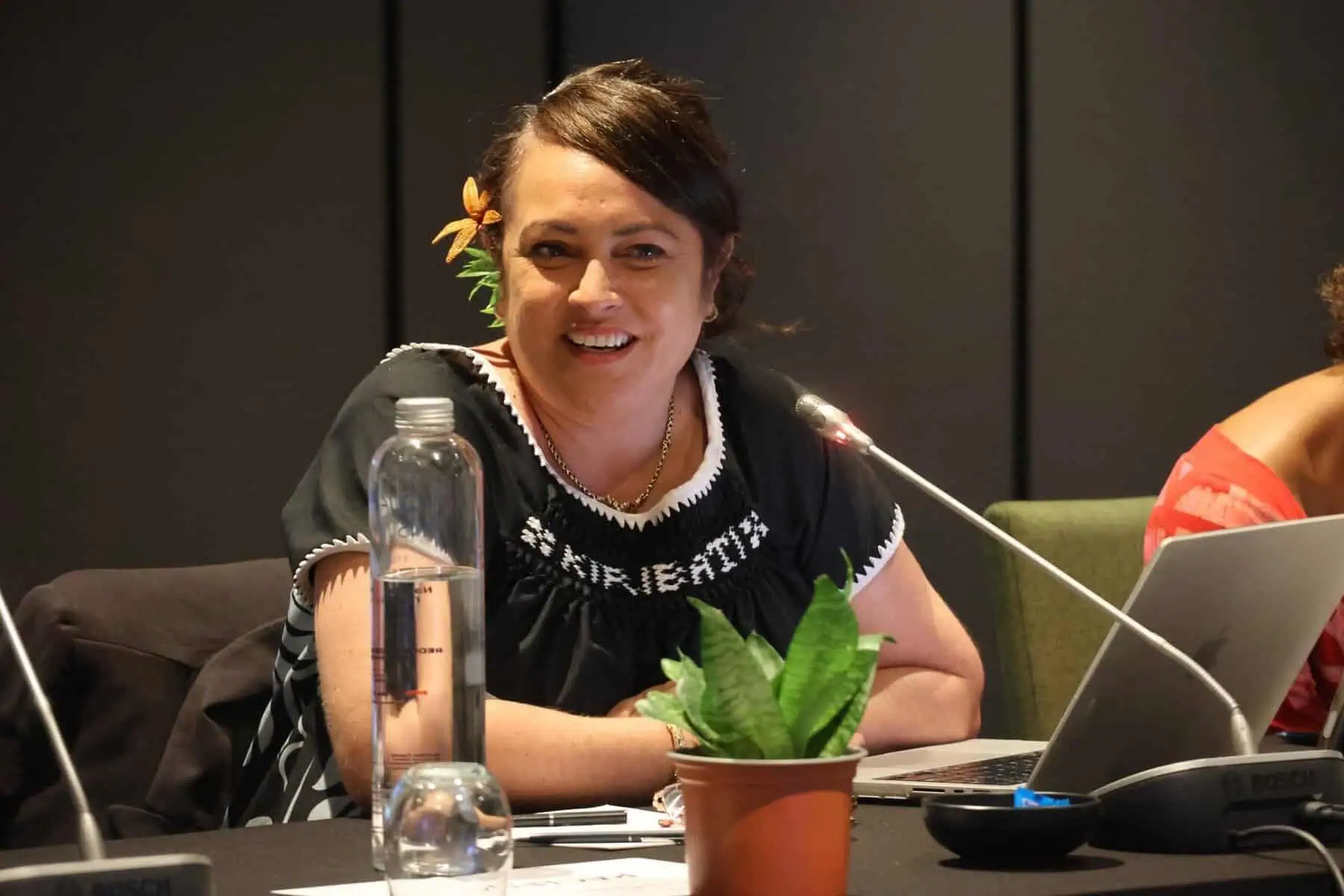
Kiribati’s top minister for women, youth, sport and social affairs has warned that the Pacific’s digital transformation is reshaping community life at speed.
Ruth Cross-Kwansing said the change brought opportunities and serious risks for young people, elders and public safety.
Speaking at the Pacific Peace and Security Dialogue on the human security dimensions of the Boe Declaration on Regional Security and the 2050 Strategy for the Blue Pacific, Cross-Kwansing said the region must confront the darker side of social media, misinformation and online manipulation if it wants to turn its peace-and-security vision into reality.
For Kwansing, the challenge is immediate and local. Kiribati, she said, was spread across 21 inhabited islands and 3.5 million square kilometres of ocean, making digital networks both essential and destabilising.
“What connects us, apart from our culture and the long, wonderful history that we have, is the social connections that we are able to form. But those same connections now move through platforms that can spread information faster than governments can respond,” she said.
“The information that can spread across social media is faster than any government vehicle or any government official that can work to respond.
“The threat and the solution are sitting in pretty much the same device.”
The minister argued that this paradox is hitting young people hardest. In her telling, social media algorithms are shaping how Pacific youth see themselves and the world, often amplifying harmful narratives and normalising damaging behaviour.
“Our young people are at a time of great influence in their lives,” she said, and what they consume online can shape their “thoughts and their narratives and their worldview.”
When those messages are toxic, she warned, the effects are not abstract.
“It is contributing to the mental health challenges and to harmful narratives about what they’re positioned and what their opportunities in the world are.”
The result, in her view, is a distorted sense of reality that can take a generation “down a real dark hole of perception.”
Cross-Kwansing also drew a direct line between online behaviour and the region’s struggle with gender-based violence.
The difference between a harmful exchange in a village and one amplified online, she said, is that digital spaces can validate and multiply abusive ideas.
“There’s a difference between having a conversation in your house or in your village, as opposed to a conversation that’s taking place online.
The risks, she added, are not limited to the young. Older people and professionals are also vulnerable to scams and misinformation.
“Our elders are also quite vulnerable,” she said, pointing to fake investment schemes and other online deceptions that can drain savings and undermine trust.
Her remarks pushed the session away from generic celebration of technology and toward a harder assessment of what digital life is doing to Pacific societies.
She acknowledged that online tools can help communities respond to crises and share information quickly. But she said the region is now facing “so many dangers” alongside those benefits, and leaders have a duty to respond.
“That’s our job as leaders. To be able to identify and then develop solutions for those problems.”
The region, she suggested, can no longer afford to treat social media, misinformation and online abuse as side issues.
“They are now central to the safety of young people, the dignity of communities and the resilience of the Pacific itself,” she said.