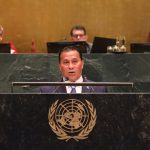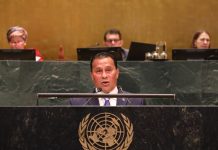

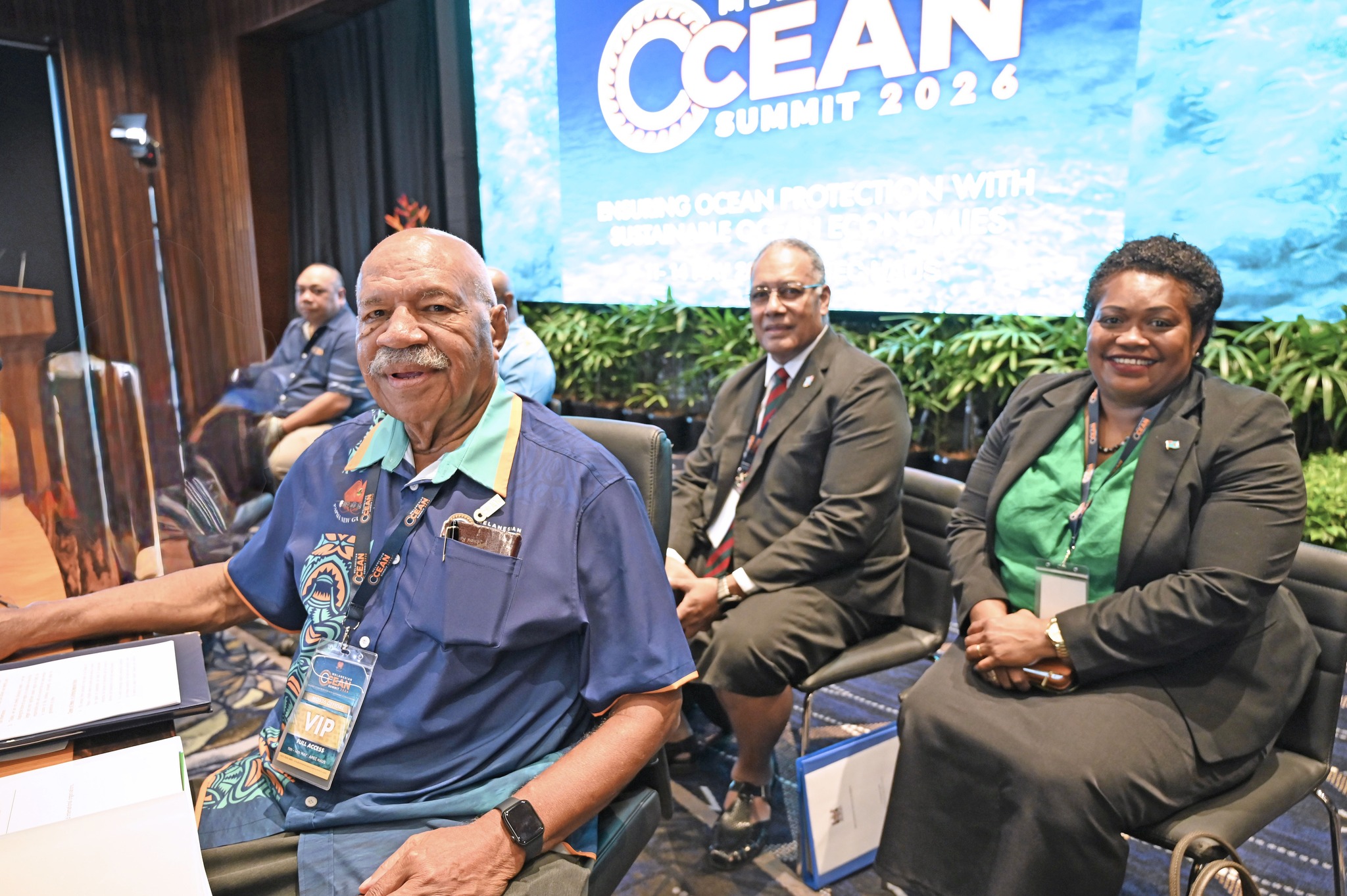
Fiji Prime Minister Sitiveni Rabuka has reaffirmed Fiji’s commitment to regional ocean leadership, sustainable blue economies, and collective Pacific stewardship during his address at the inaugural Melanesian Ocean Summit in Port Moresby.
While delivering his remarks Tuesday, Prime Minister Rabuka emphasised that the Pacific Ocean remains central to the identity, livelihoods, security, and future of Pacific Island nations.
“Fiji comes to this Summit as a Large Ocean State, with the ocean not only surrounding us, but shaping who we are as a people, as an economy, and as a nation. For Fiji, the ocean is not simply a resource. It is our food security, our climate shield, our transport corridor, our culture, our identity, and our inheritance,” Rabuka stated.
“Today, we are not merely discussing oceans, we are shaping the future of our region. As custodians of one of the largest and most significant oceanic regions on Earth, the responsibility rests with us to ensure that our ocean remains a source of life, resilience, prosperity, and peace for generations to come.
“The ocean is not simply a resource. It is our food security, our climate shield, our transport corridor, our culture, our identity, and our inheritance.”
The Prime Minister reaffirmed Fiji’s strong support for the regional vision of an “Ocean of Peace”, describing the Pacific as a region that must continue to be defined by cooperation, solidarity, sustainability, and shared prosperity amid growing global geopolitical competition.
He highlighted Fiji’s national ocean governance efforts, including the implementation of Fiji’s National Ocean Policy and the Climate Change Act 2021, which commits Fiji to sustainably managing 100 per cent of its ocean spaces and protecting 30 per cent as Marine Protected Areas by 2030.
As part of this commitment, Fiji intends to designate up to 15 percent of its waters as Marine Protected Areas by the end of 2026.
The Prime Minister also outlined progress on Fiji’s Marine Spatial Planning process and Blue Economy Framework, aimed at balancing sustainable economic growth with ocean conservation, climate resilience, and community wellbeing.
In supporting the proposed Melanesian Ocean Corridor of Reserves (MOCOR), Prime Minister Rabuka described the initiative as a practical expression of regional solidarity and collective stewardship.
“MOCOR represents a bold and timely step forward, recognising that our oceans do not end at national boundaries, and that our stewardship responsibilities must therefore extend across them,” he said.
Prime Minister Rabuka further called for strengthened regional cooperation in ocean science, maritime security, sustainable fisheries, climate adaptation, and blue economic development.
As part of Fiji’s proposals to the Summit, the Prime Minister announced support for advancing a Melanesia Blue Shipping Initiative focused on developing climate-resilient and low-emission maritime transport systems to improve regional connectivity and reduce transport costs across the Pacific.
He also reaffirmed Fiji’s continued leadership on global ocean and climate issues through its roles in international ocean governance processes, including the United Nations Ocean Conference, the Paris Agreement, and preparations towards pre-COP31 and COP31.
Prime Minister Rabuka concluded by urging Melanesian nations to work together to ensure the Pacific Ocean remains a source of peace, resilience, prosperity, and security for future generations.
“Our responsibility is clear: to protect the ocean that has protected us, to manage it wisely, and to ensure that future generations inherit a healthy, secure, resilient, and thriving Blue Pacific,” he added.
At the end of the first plenary session, the Melanesian leaders present signed the MOCOR Declaration.
Fiji’s endorsement further represents our sub-regional commitment to strengthen the protection, sustainable management, and stewardship of the Pacific Ocean and its marine resources.