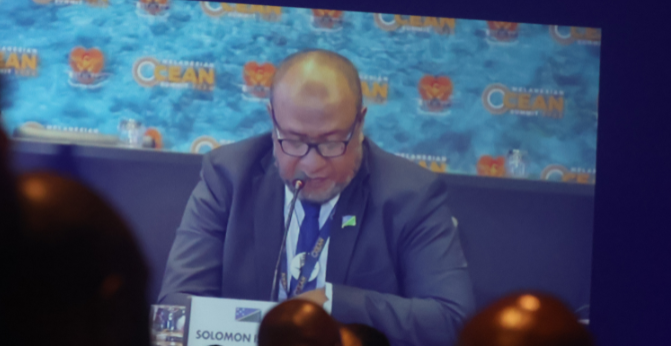
The Solomon Islands has formally declined to endorse a new regional ocean declaration, with High Commissioner William Soaki delivering a pointed defense of indigenous governance and constitutional due process.
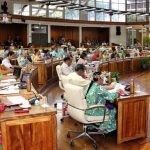
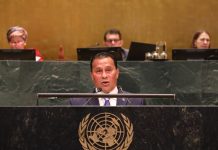
Speaking at the Melanesian Ocean Summit in Port Moresby Tuesday, Soaki framed the Solomon Islands’ position not as an act of obstruction, but as a commitment to a vision of cosmic harmony that rejects modern, secular pragmatism.
In an address, High Commissioner Soaki challenged the conventional view of environmental management.
” The ocean is not a resource to be managed from above,” Soaki stated.
“It is a living system of which we are part. The human person is not the absolute master of the universe, but an interdependent component.”
He said that the Solomon Islands’ approach to the ocean is rooted in a totality that predates colonial influence.
He emphasised that the nation never ceded sovereignty over its customary governance systems through colonial treaties.
Central to the High Commissioner’s address was the concept of More, an operational framework the Solomon Islands cabinet endorsed in mid-2025.
He clarified that this framework is a recognition of existing traditions rather than a new initiative.
” There is no external secretariat directing what Solomon Islands does in its own waters,” Soaki said.
“There is no funding deploying resources in our Exclusive Economic Zone (EEZ) without our consent.”
He described the nation’s participation as a voluntary cooperation among willing states, emphasising that the Solomon Islands remains at the summit in a technical capacity only.
The High Commissioner was candid regarding the legal barriers preventing the signing of the summit’s declaration.
He noted that the proposed document: Has not undergone required domestic processes. Lacks clearance from the Attorney General.
Has not been endorsed by the Solomon Islands Cabinet.
“These are not procedural preferences,” he stressed.
“They are the constitutional mechanisms through which our sovereign commitments are authorised.”
Invoking the history of his hosts, Soaki drew a parallel to the 1975 constitutional deliberations of Papua New Guinea’s founding fathers. He quoted their refusal to rush independence for the sake of quantitative change, choosing instead to focus on “lqualitative change.”
” The quality of a foundation matters more than the speed of construction,” Soaki concluded.
“The question Solomon Islands brings today is not ‘Can we produce a document?’, but ‘What kind of governance will it actually create?’” he said.