

If we’re not at the table, we’re not on the menu.
It is a sharp line that captures the urgency Pacific leaders are feeling as energy pressures mount across the region.
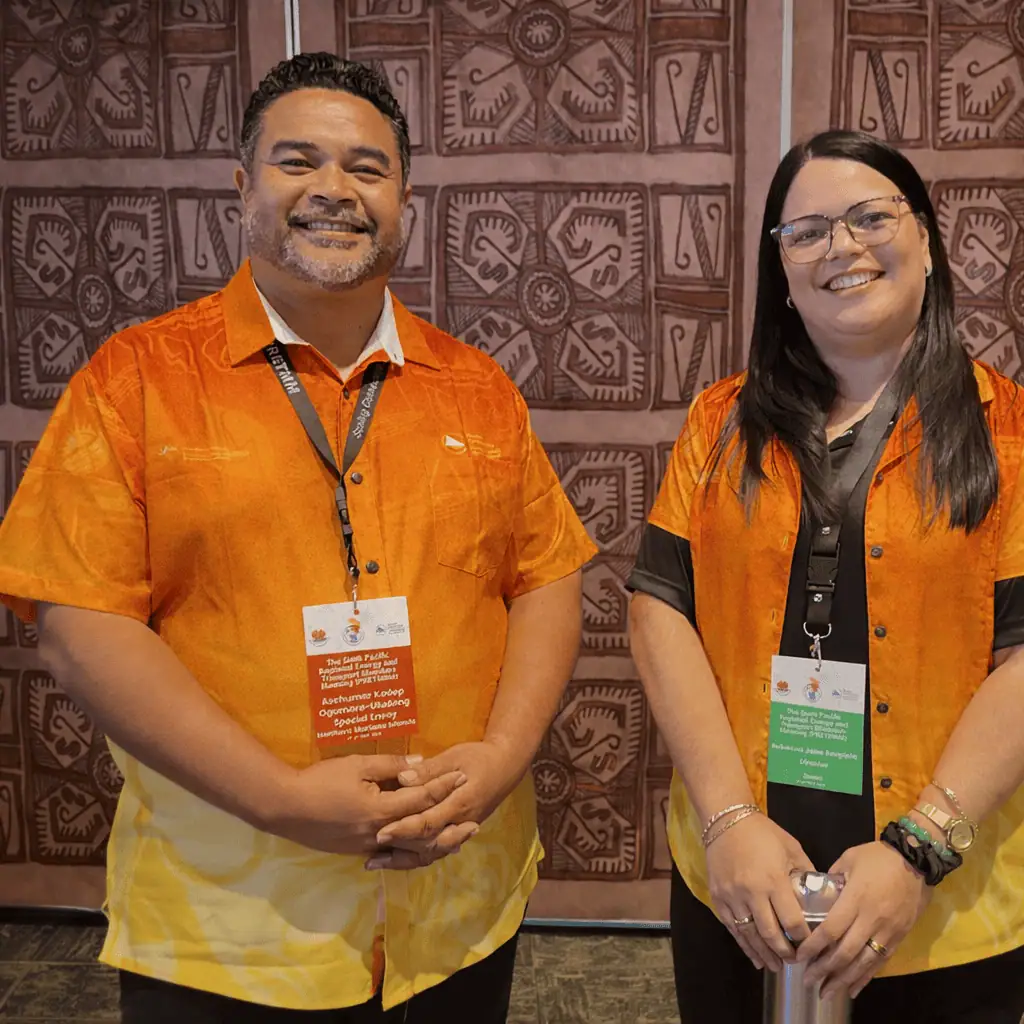
Speaking at the Senior Energy Officials Meeting ahead of the Sixth Pacific Regional Energy and Transport Ministers’ Meeting (PRETMM), Guam Energy Office Director Rebecca Jean Respicio said Pacific collaboration is no longer optional. It is essential.
For Guam, a US territory often seen as better resourced than many Pacific Island nations, the lesson is clear: energy vulnerability does not discriminate.
“While we have unique differences, we also have very similar needs,” Respicio told Islands Business.
And despite Guam’s stronger federal systems, she says there is much to learn from Pacific Island neighbours who have long navigated crisis with limited resources.
“We think we’re westernised and ahead, but we really do learn from the islands. It brings us back to what is important,” she said.
That shared reality is fuel.
Across the Pacific, imported fuel remains the backbone of power, transport and emergency response leaving island nations exposed to global conflicts far beyond their shores.
For Guam, tensions in the Middle East and instability around Iran have already pushed fuel prices upward.
But when storms hit, the stakes change, fuel stops being just an economic issue.
It becomes a survival issue.
“Without power, people rely on generators, and fuel and diesel become a huge need,” Respicio said.
“The supply becomes tighter, and the cost is so high. That’s when you realise fuel is not just energy; it’s survival.”
That reality is playing out in real-time in the Northern Marianas.
Still recovering from a Category Five super typhoon, parts of the islands remain without electricity, with full restoration expected to take up to 90 days.
Northern Marianas Special Envoy Aschumar Kodep Ogumoro-Uludong says the crisis has exposed just how fragile island energy systems remain.
“We still don’t have power,” he said.
“Our brothers and sisters from Guam sent a whole crew of linemen to help us repair and restore.”
The timing could not be worse.
Just as global fuel markets began reacting to conflict in Iran, the Northern Marianas were hit by disaster.
“A week after war broke out in Iran, we had already recorded fuel price increases,” Ogumoro-Uludong said.
“Within that context of price increases, we then get hit by a Category Five disaster.
“The full impacts of what’s taken place halfway around the world have yet to be fully realised in our region, and that’s worrying.”
It is this double vulnerability—global price shocks and climate disasters—which underscores the importance of meetings like PRETMM.
In Port Moresby this week, Pacific leaders are grappling with the region’s biggest energy questions: how do we accelerate renewable energy, strengthen maritime transport, secure fuel supplies, and build resilience in a way that leaves no Pacific Island nation behind?
Pacific energy leaders are not only talking about resilience anymore; transition has become the hot topic of discussion.
Discussions in meeting rooms and outside of meeting rooms have focused on how to keep power running when shipping routes are disrupted, how to secure fuel, what alternatives are available, and how to rebuild energy systems, maritime transport, and security.
For Guam and the Northern Marianas, these are not policy questions. They are lived realities.
One of the key conversations at the meeting is financing, and Guam asks whether Pacific regional funding mechanisms can be accessed by US territories to strengthen energy resilience alongside federal support.
Respicio says those conversations matter because solutions cannot be built in isolation.
For Ogumoro-Uludong, being in the room matters just as much.
“We are very thankful for this opportunity provided by SPC to gather with our brothers and sisters from the Pacific region, to learn best practices in the energy space, to network and to highlight our own challenges,” he said.
For many here, the Pacific’s energy transition is no longer simply about moving away from fossil fuels. It is about making sure the next cyclone, the next supply chain disruption, or the next global conflict does not leave islands in the dark.