

Australia is set to supply 3,500 new Australian Combat Assault Rifles (ACAR) to the Papua New Guinea Defence Force (PNGDF), along with improvements to armouries to ensure they are securely stored.
Through this deal, the rollout of replacement weapons will include further work on armouries, as well as additional steps to enhance weapons security.
Already Chief of the PNGDF, Rear Admiral Philip Polewara, has expressed concern that his defence force lacks the facilities to safely store the new weapons.
“Lethal items like weapons and ammunition, we have to be honest with ourselves and be realistic, whether we have the capacity or we have the facilities to keep all these items that we bring in,” he told the ABC.
This deal, worth around $35 million (US$25 million), remains sensitive.
In response to specific queries from Australia Defence Magazine, ADF said, as alliance partners, Australia and PNG were working closely to strengthen interoperability between our defence forces, including through discussions on a small arms capability partnership.
“This cooperation reflects our shared commitment to the Alliance which enables our militaries to work more closely together, streamline standard operating procedures and maximise training opportunities during exercises,” a spokesperson ADM.
“Over many years, Australia has invested in the upgrade and sustainment of PNG Defence Force armouries as part of its Defence Cooperation Programme. This has included ongoing maintenance of magazines and armouries, as well as the installation of alert systems to notify Defence Force personnel in the event of security breaches.
“As part of this partnership, Australia continues to work with PNG on measures that support the safe and secure management of weapons, alongside broader capability uplift.”
The spokesperson said Defence applied robust governance and risk mitigation processes to all provisions of military equipment to foreign governments, implemented in full compliance with Australia’s international obligations.
The new weapons will be manufactured by Thales at its Lithgow Arms facility in Lithgow, NSW. The Lithgow factory has manufactured weapons for Australian soldiers since 1912.
Thales declined to comment on the PNG deal, citing sensitivities associated with defence capability matters and export arrangements.
Australia isn’t a large exporter of military small arms, though that wasn’t always the case. Lithgow manufactured large numbers of SLR rifles which were supplied to Commonwealth nations though the 1960s and 70s.
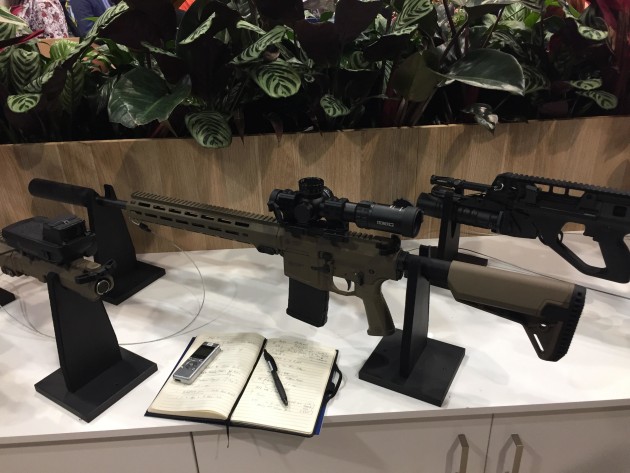
ACAR is an AR-pattern rifle developed in response to the US military’s decision to move to the new 6.8 x 51 cartridge and new SIG rifles which deliver improved, long-range ballistics and better performance against modern body armour.
Thales also developed a bullpup pattern rifle with handling characteristics similar to the in-service EF88 rifle, the Australian-made variant of the Austrian Steyr AUG which was adopted in 1988.
The ACAR will certainly be a contender for Australia’s new infantry weapon under the ongoing project Land 159 to refresh Australian Defence Force (ADF) weapons systems.
ACAR is offered in a range of calibres including the familiar 7.62×51 NATO, 5.56×45 NATO and the new 6.8×51 cartridge.
Neither Defence nor Thales have stated the chambering of ACAR rifles for PNG, though it’s likely to be the familiar 5.56 NATO, in keeping with their current M16A2 rifles.
Neither would comment on whether this is the first sale, or the first significant sale of ACAR rifles to anyone.
This deal was initially announced in October last year at the PNG-Australia Ministerial Forum, with Defence Minister Richard Marles saying rifles would be supplied over the next four years. With work on armouries, the value is $35 million (US$25 million).
Defence Industry Minister Pat Conroy said Australia would also be supplying 4500 new uniforms made to the same standards as ADF uniforms, although with PNGDF camouflage pattern.
Some further details emerged from the Senate estimates hearing in February, the main takeout being that there was no competitive tender.
PNG features a significant law and order issue, particularly in its highland’s region. Where once warring tribes duked it out with spears and bows and arrows, they now employ military pattern small arms, with significantly higher casualty rates.
Leakage from the PNG military and police accounts for many of those guns, typically via corruption. Others are imported across porous borders.
Australian defence aid to PNG has included improvements to armouries. One consideration is to be able to rapidly lock down sources of weapons in the event of soldiers revolting.