

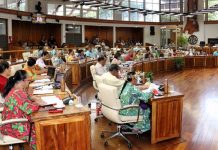

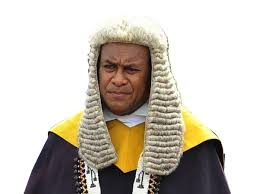
Solomon Islands Chief Justice Sir Albert Palmer has ruled that Prime Minister Jeremiah Manele acted unconstitutionally by delaying the convening of Parliament in the face of a pending motion of no confidence.
In a landmark judgment delivered Tuesday, Palmer found that once a motion of no confidence has been validly lodged and the required notice period has expired, the Prime Minister is under a constitutional duty to ensure Parliament meets at the earliest opportunity to determine the issue.
“Any delay or inaction in such circumstances is unlawful,” the chief justice said before a packed courtroom.
“The Prime Minister is under a constitutional duty to ensure the motion of no confidence is brought before Parliament at the earliest opportunity,” Palmer declared, adding that failure to do so constitutes a breach of the Constitution.
The ruling underscores that the Prime Minister has no legal authority to delay, obstruct or avoid a no-confidence motion once it has matured and is ready for debate.
Palmer stated that by not convening Parliament, the Prime Minister effectively frustrated the constitutional mechanism designed to test whether a government still commands the confidence of the majority of MPs.
This, the chief justice added, strikes at the heart of Solomon Islands’ system of democratic governance, which is founded on the principle that executive power must remain accountable to Parliament.
Palmer pointed out that in such situations, the Prime Minister has only two lawful options: resign from office or face Parliament.
“Avoiding Parliament altogether is not permitted under the Constitution.”
Furthermore, Palmer said the delay had created a “constitutional impasse”, where a valid motion of no confidence exists but cannot be determined because Parliament has not been convened.
Such a situation, the chief justice noted, undermines the country’s democratic framework by preventing Parliament from performing its constitutional role.
Prime Minister Manele lost his majority last month after 19 members of his coalition, including 12 ministers, defected and teamed up with the Opposition.
Following the shift, a motion of no confidence was formally lodged against Manele. Under the Constitution, such a motion must be given at least seven clear days’ notice before it can be debated.
That notice period has since expired, meaning the motion is now ready for consideration by Parliament.
However, despite the motion maturing, Manele refused to convene parliament, stating that he’ll do so at the appropriate time.
The New Coalition argued that the Prime Minister’s refusal to advise the convening of Parliament was unconstitutional and effectively blocked the lawful process for determining leadership.
The government, on the other hand, maintained that the Prime Minister retains the authority to decide when Parliament should meet.
Addressing the dispute in his ruling, the chief justice reaffirmed that a motion of no confidence is a “central constitutional mechanism” for testing the legitimacy of a government.
He stressed that once triggered, this process must not be delayed or frustrated, as doing so would undermine the principle of majority rule.
Palmer described the Prime Minister as the primary constitutional duty-holder, responsible for ensuring Parliament is able to perform its role.
He ruled that while the Governor-General’s powers are limited, they may be engaged as a last resort if the Prime Minister fails to act.
In its final orders, the chief justice directed the Prime Minister to take all necessary steps to convene Parliament within three days to allow the motion of no confidence to be debated and decided.
The Speaker of Parliament was also directed to ensure the motion is given priority and resolved expeditiously once Parliament meets.
Palmer stated that if the Prime Minister fails to act, the Governor-General’s residual constitutional powers may be triggered as a safeguard to restore the parliamentary process.