


China is expanding its policing footprint across the Pacific, moving from basic training support to more operational involvement in several island countries, raising the stakes in an increasingly contested security space.
A new report on Policing Partnership in the Pacific finds that Beijing’s law enforcement engagement in the region has grown steadily over the past two decades, with Pacific Island countries now forming part of a broader overseas policing strategy.
“China has expanded its foreign law enforcement assistance over the past two decades, and the Pacific Islands have increasingly become part of its policing interventions.”
The report says the nature of that engagement has shifted significantly, with China no longer limited to providing technical assistance.
“What began as support and training has developed into more operationally embedded relationships in several countries.”
This shift signals a deeper level of involvement, where Chinese police personnel are working more closely with local counterparts on the ground, shaping how policing is carried out in parts of the region.
The report highlights that China’s policing presence is not uniform, with some countries seeing far greater engagement than others.
“The picture is uneven.”
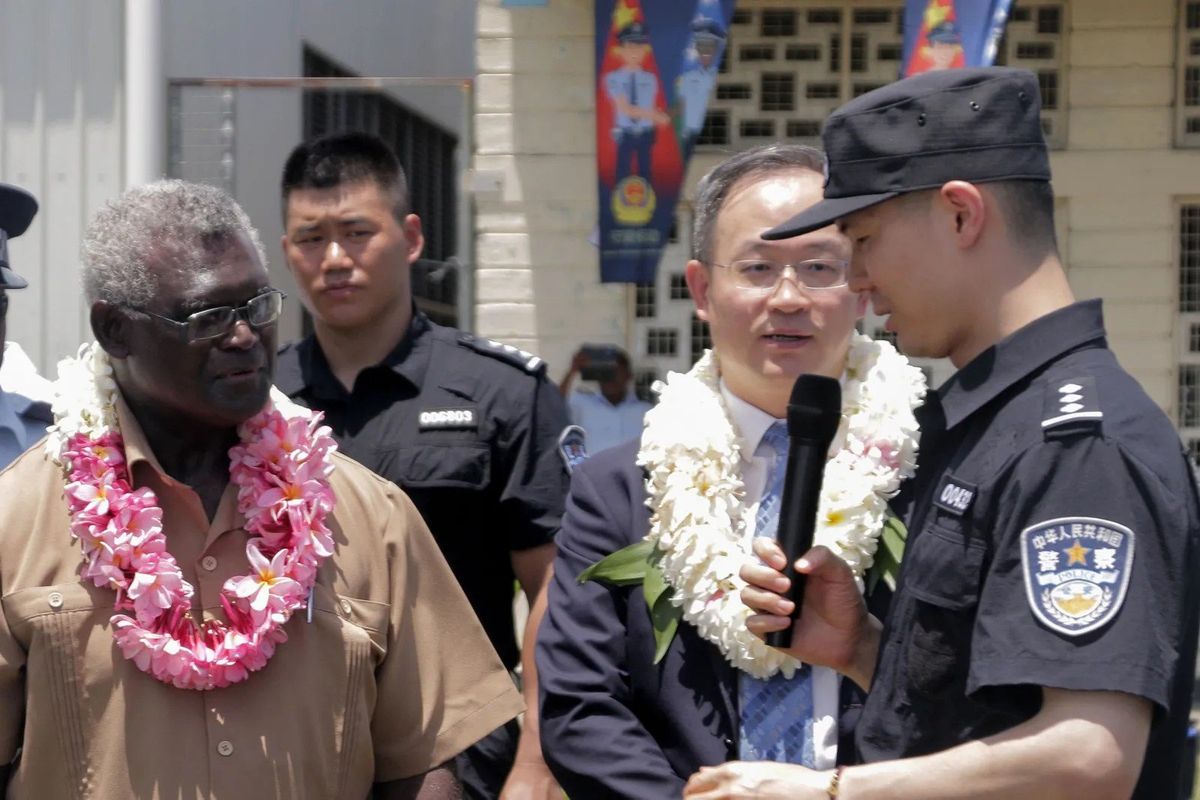
Among Pacific nations, Solomon Islands stands out as the most prominent partner, reflecting a growing and visible security relationship with Beijing.
“Solomon Islands has emerged as China’s most prominent Pacific policing partner, while smaller states like the Cook Islands have also received sustained engagement.”
This uneven pattern reflects both strategic priorities and the willingness of individual Pacific governments to engage with China in the security sector.
In some cases, the report notes that Chinese police teams are not only strengthening ties but also competing with other international partners already active in the region.
“Chinese police liaison teams have in some instances sought to discourage partners from other countries, signalling a willingness to compete at the operational level.”
This points to a shift in the nature of policing cooperation, where multiple external partners are now operating in the same space with overlapping interests.
Despite concerns about growing influence, the report stresses that China’s role should not be seen as displacing traditional security partners.
“China’s role is best understood not as a security takeover but as a cumulative strategy that is reshaping the region’s policing landscape.”
Instead, it describes a gradual process in which China is building relationships, increasing its presence, and expanding its role over time.
This approach allows Beijing to strengthen its influence without triggering a direct confrontation with established partners such as Australia and New Zealand.
“Traditional partners like Australia – which remains the key security partner in the South Pacific – and New Zealand are adapting, and Pacific governments are diversifying rather than choosing sides.”
Australia continues to play a central role in regional security, but the report notes that it, along with New Zealand, is adjusting to a more complex environment where new actors are becoming more active.
For Pacific Island governments, the growing number of security partners presents both opportunities and challenges.
The report makes clear that countries in the region are not aligning exclusively with any one partner but are instead pursuing a strategy of diversification.
By engaging with multiple partners, Pacific nations are seeking to maximise support, build capacity, and maintain strategic autonomy.
However, this balancing act is becoming more difficult as competition between external powers increases.
One of the key findings of the report is the changing nature of policing itself in the Pacific.
“The stakes, however, are rising: what was once a technical domain has become a more politically contested space.”
Policing, once seen as a largely technical area focused on training and capacity building, is now tied more closely to broader geopolitical dynamics.
This shift means that decisions about policing partnerships are no longer purely operational but carry political and strategic implications.
The report suggests that China’s growing role in this space is part of a wider effort to expand its influence across multiple sectors in the Pacific.
While the report does not frame China’s actions as a direct challenge to existing security arrangements, it highlights the cumulative impact of its engagement.
Over time, increased cooperation, training programs, and operational involvement are reshaping how policing is conducted and who influences it.
For traditional partners, this means adapting to a more competitive environment.
For Pacific Island countries, it means navigating a more complex set of relationships while safeguarding national interests.
The report indicates that the trajectory of China’s policing engagement is likely to continue, with further expansion possible as relationships deepen.
As a result, policing in the Pacific is no longer just about maintaining law and order — it is increasingly linked to broader strategic competition and influence in the region.
The challenge for all parties will be managing this shift while ensuring that policing remains effective, accountable, and aligned with the needs of Pacific communities.