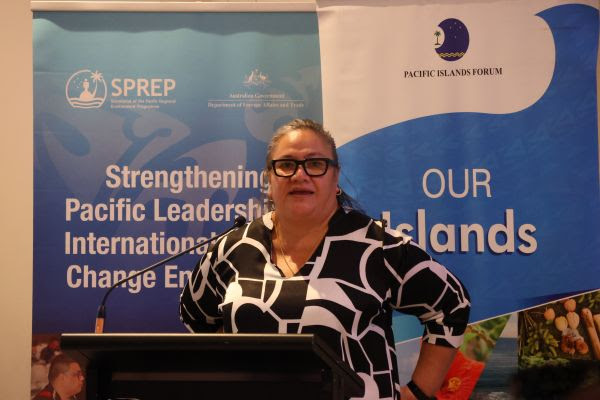
Pacific leaders continue to view climate change as the region’s most serious security challenge, Desna Solofa, Deputy Secretary General of the Pacific Islands Forum Secretariat, said at the Regional Climate Security Dialogue in Brisbane on Monday.
“Pacific Leaders have been clear for many years that climate change is the single greatest threat to their livelihoods, security and wellbeing of the peoples of the Pacific.”
Opening the Regional Dialogue on Climate Security in the Pacific in Australia, DSG Solofa said Pacific leaders established the region’s approach to climate security through the Boe Declaration on Regional Security adopted in 2018.
“The Boe Declaration recognised that security in the Pacific must be understood comprehensively, encompassing human security, environmental security and the resilience of our communities and ecosystems.”
She said the declaration was followed by the Boe Declaration Action Plan endorsed in 2019 to guide implementation across the region.
Solofa said the region has since strengthened its response to climate-related security risks.
“This includes the Pacific Islands Forum Leaders’ Declaration on Sea Level Rise and Statehood, reflecting the region’s determination to safeguard sovereignty, identity and rights in the face of existential climate threats.”
She also cited the development of national security policies recognising climate change as a national security risk, the Pacific Regional Framework on Climate Mobility, and the Pacific Regional Guide on Climate Security Assessment.
Solofa also highlighted the Kainaki II Declaration, adopted by Forum leaders in 2019.
“The Kainaki II Declaration, a landmark commitment by Pacific Islands Forum Leaders in 2019, declaring a climate crisis and demanding urgent global action to limit global warming to 1.5 degrees. It is the strongest climate statement by the Forum, calling for increased emissions cuts and climate finance.”
Despite regional action, Solofa said the climate threat has intensified.
“While our understanding and response has deepened, the threat that our Leaders collectively identified in 2018 has not diminished. In fact, it is now more acute than ever.”
She warned that global emissions continue to rise and the world is not on track to limit warming to 1.5 degrees.
“For the Pacific, climate change is not only an environmental issue. It is a defining peace and security challenge for our region.”
Solofa said climate change affects coastal communities, food systems, water resources and national development.
She also stressed that climate impacts affect communities differently.
“These impacts are not experienced equally – women, youth, persons with disabilities, and marginalised groups often face heightened risks.”
“Ensuring Gender Equality and Social Inclusion are central to our climate security dialogue, strengthens resilience and promotes peace across all communities.”
Solofa said the region’s approach to peace and security is reflected in the Blue Pacific as an Ocean of Peace Declaration.
“The Blue Pacific as an Ocean of Peace Declaration endorsed by Forum Leaders last year reflects a distinctly Pacific understanding of peace and security.”
“It is one that emphasises cooperation over competition, prevention over reaction and collective stewardship of our shared ocean and environment.”
Addressing climate security is critical to sustaining peace in the region, said Solofa.
“In this context, addressing climate security is not only about managing risks. It is about protecting the conditions that allow peace, stability and prosperity to endure across the Blue Pacific.”
“Climate, peace and security must therefore be understood as a core pillar of sustaining our Ocean of Peace.”
Solofa said upcoming global climate negotiations will be an opportunity for Pacific countries to strengthen their advocacy.
Later this year the international community will gather for pre-COP31, which will be hosted in Fiji, supported by under the COP31 partnership framework.”
“For the Pacific, COP31 represents an important opportunity to continue elevating the region’s voice on issues that are central to our future.
These priorities include protecting the 1.5°C temperature limit, increasing climate finance, addressing loss and damage, and supporting communities threatened by sea level rise.
“The work undertaken through this Dialogue will help strengthen the regional evidence base on the peace and security implications of climate change and will support Pacific leadership in these global discussions.”
Solofa said Forum members are currently developing a Regional Peace and Security Action Plan under the 2050 Strategy for the Blue Pacific Continent.
“One of the proposed strategic focus areas in the consultation draft is Climate, Peace and Security, and this dialogue provides an opportunity to draw on the experience of Forum Members and partners to help shape how this priority is reflected in the Action Plan.”
She encouraged participants to engage actively in the discussions. That is the task before us.”
“Over the coming days, I encourage participants to engage openly in this discussion. To share lessons from national experiences. To explore where the gaps remain, and to identify practical ways that the region can continue strengthening its approach to anticipating and responding to the peace and security implications of climate change.”
Solofa said regional cooperation will remain critical.
“By working together, we can continue advancing a Pacific-led approach that protects our communities, strengthens resilience, and supports the vision of a peaceful and secure Blue Pacific Continent.”
She thanked Australia for hosting the meeting in Brisbane and acknowledged support from the United Kingdom.