

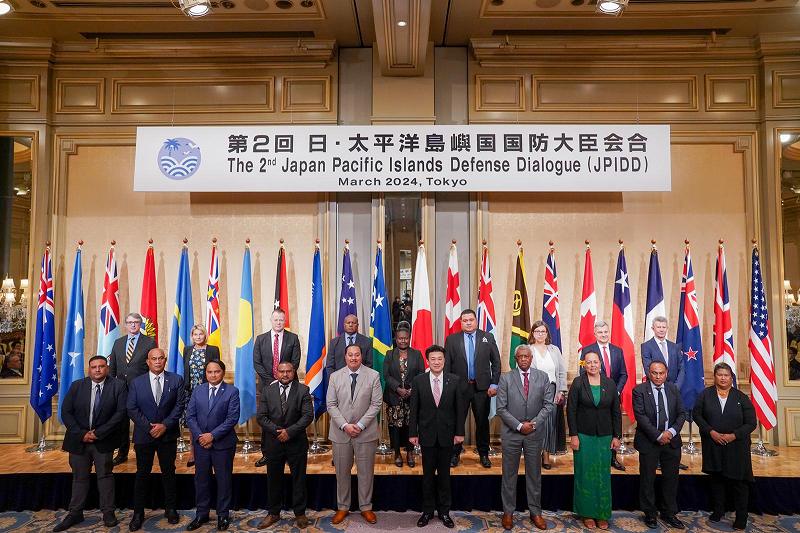
Japan’s Defence Minister Shinjiro Koizumi has called for stronger regional interconnectivity to safeguard the Pacific as an “Ocean of peace,” warning that the region faces three interconnected security challenges.
Delivering his keynote address titled “The Pacific – at the centre of resilient connectivity” at the Japan-Pacific Islands Defence Dialogue (JPIDD) on Monday, Koizumi said the Pacific “has never been a wall that divides us” but a shared space binding nations together.
“To safeguard the Pacific as the ‘Ocean of peace’,” he said, “with you—the custodians of the Blue Pacific Continent—at the very centre, let us strengthen the bonds among all those gathered in this hall, and together build a region that is autonomous, resilient, and enduring.”
Koizumi outlined three major challenges confronting the region: climate change, threats to maritime order, and what he described as the “weaponisation of everything.”
“Rising sea levels, cyclones, floods, and droughts driven by climate change—these are not merely environmental challenges,” he said. “As you yourselves have repeatedly and powerfully conveyed to the world, this is nothing less than the greatest threat to security.”
On maritime security, he warned that illegal, unreported and unregulated fishing, smuggling, trafficking, and transnational crime are eroding sovereignty and weakening the rule of law.
“Distinguished delegates, without the rule of law at sea, there can be neither peace nor prosperity,” Koizumi said.
He also highlighted cyber threats, disinformation and economic coercion as emerging dangers.
“The boundary between peacetime and contingency, between military and non-military, between truth and fake news- these are no longer clearly visible,” he said.
Koizumi stressed that these “three turbulent waves” are interconnected and cannot be addressed by any one country alone.
“Our responses, too, must be interconnected—mutually reinforcing, and firmly bound together,” he said.
He proposed what he called a “multilayered network of interconnectivity,” grounded in protecting a free and open “ocean of peace” based on the rule of law.
“It is not about someone creating a single, massive framework and pressing you into it,” he said. “Rather, it is about the noble resolve held by you—the custodians of the Blue Pacific Continent—the resolve that the future of your own countries and of this region must be chosen by yourselves.”
Koizumi cited practical examples of cooperation, including Operation Christmas Drop and coordinated disaster responses in Tonga, as evidence that “countries that share the same spirit connect their respective efforts, generate synergy, and transform those efforts into strength for the region as a whole.”
“This is the power of interconnectivity,” he said.
He said Japan’s approach aligns with the Pacific-led 2050 Strategy for the Blue Pacific Continent, which calls for coordinated regional responses.
Koizumi then outlined three pillars of action: “connecting people,” “connecting crisis response,” and “connecting resilience.”
On people-to-people ties, he highlighted Pacific cadets studying at Japan’s National Defence Academy and announced the launch of a “Next-Generation Leadership Security Programme.”
“It is a new effort designed to enable practitioners to build face-to-face relationships of trust with one another,” he said.
On crisis response, he said Japan is supporting maritime domain awareness and maritime law enforcement across the region, noting that the Japan Maritime Self-Defence Force visited twelve Pacific countries last year for joint training.
“Going forward as well, together with you, we will continue to build a region that is resilient in the face of crises and disasters,” he said.
On resilience, Koizumi pointed to cybersecurity, the malicious use of AI and disinformation as “real and present dangers.”
“Strengthening cybersecurity, ensuring the sound and responsible use of AI, and addressing disinformation — on these challenges as well, we will work together with you,” he said. “Together, we will safeguard democracy and protect the information space.”
Koizumi also signalled a broader strategic outlook, linking the Pacific, Indian and Atlantic oceans.
“What were once the two seas have now expanded into three seas—the Pacific, the Indian, and the Atlantic. And at the very centre of them all lies one sea: our Pacific,” he said.
He reaffirmed Japan’s stance on upholding international law and opposing attempts to change the status quo by force.
“I sincerely hope that this JPIDD will serve as a platform where we stand united in our unwavering commitment to peace – and where we reaffirm that attempts to change the status quo by force must never be tolerated.”
“That is why JPIDD exists. Let us speak candidly, and let us act together,” Koizumi said.