


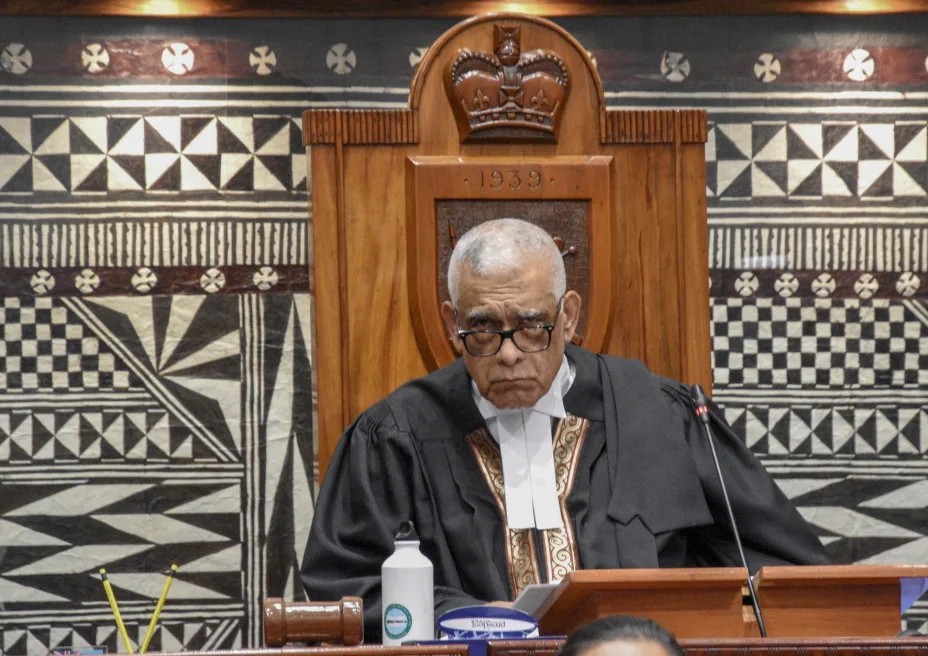
Fiji President Ratu Naiqama Lalabalavu has called for clean, credible and lawful general elections, urging political leaders, candidates and supporters to uphold integrity and respect for the rule of law before, during and after polling.
Speaking at the opening of a new session of Parliament Monday, President Lalabalavu said the strength of Fiji’s democracy rests not only on constitutional checks and balances, but on the conduct of those who participate in the political process.
“The strength of our democracy lies not only in the balance of our institutions, but in the conduct of leaders and citizens alike — not only during elections, but especially in the lead-up to and after elections,” he said.
The President stressed that democratic stability must be protected beyond polling day, warning that reckless behaviour and divisive rhetoric can undermine public confidence in elections.
“To secure our democracy, leaders and political supporters must continue to engage in dialogue, compromise and respect for the rule of law,” he said.
President Lalabalavu called on all who seek public office to conduct themselves responsibly and appealed to political party supporters to exercise restraint in public discourse.
“I therefore call upon all who seek public office, and all who participate in public discourse — in particular supporters of political parties and candidates — to uphold the highest standards of integrity, restraint and respect for our multicultural society,” he said.
He said clean elections are essential to maintaining trust in democratic institutions and ensuring political competition strengthens, rather than divides, the nation.
The President reminded Parliament that democracy is an ongoing responsibility that extends beyond electoral victories and losses.
He urged leaders to set the tone for peaceful, inclusive and issue-based campaigning, adding that how elections are conducted will ultimately shape Fiji’s political maturity and social cohesion.
President Lalabalavu said history would judge not only electoral outcomes, but whether Fiji’s elections were conducted fairly, lawfully and in a manner that respects all citizens.
Lalabalavu emphasised the importance of the rule of law, dialogue and compromise as essential pillars of Fiji’s democracy.
He reflected on Fiji’s constitutional and democratic journey, saying the nation’s progress has not always been easy, but has reinforced the need for leaders and citizens alike to remain firmly committed to lawful and inclusive governance.
“Our nation’s journey through four successive constitutions reflects an ongoing search for fairness, equality and stability,” he said, noting that each constitutional phase has shaped Fiji’s political maturity.
The President acknowledged that Fiji’s democratic path has included periods of difficulty and division, but said these experiences highlighted a critical lesson.
“The journey has not always been smooth, and it underscores the fact that democracy must be actively sustained by dialogue, compromise and respect for the rule of law,” he said.
President Lalabalavu said adherence to the rule of law was not optional, but fundamental to maintaining public trust, safeguarding institutions and ensuring stability in the years ahead.
He urged leaders to approach governance with balance and restraint, stressing the need to anticipate future challenges while protecting the social fabric of the nation.
“We aim for equilibrium, to maintain a sense of balance that positions us to deal with the challenges that will come upon us,” he said.
The President also called for development that is fair, inclusive and sustainable, warning that progress without justice and accountability risks weakening national unity.
“As a nation, we are challenged to review not only how far we’ve come, but also how we collectively prepare for the decades ahead, how we safeguard our community together, and how we ensure that development is fair, inclusive and sustainable for all our people,” he said.
President Lalabalavu said Fiji’s experiences — including moments of political strain — have contributed to a deeper national maturity.
“Each chapter, including moments of difficulty, has contributed to a deeper national maturity,” he said.
He urged Parliament to uphold the rule of law throughout the new session, reminding Members that history will judge not only what is achieved, but how the country is governed.
Meanwhile, President Lalabalavu has highlighted persistent poverty and hardship affecting a significant portion of Fiji’s population, while outlining the guiding principles that will shape Government policy and decision-making in the years ahead.
President Lalabalavu said recent findings showed that at least one part of the population is living below the poverty line, with a further 25 per cent facing hardship just above the poverty threshold in both urban and rural communities.
“These findings reinforce the importance of formulating just policies and programmes that are inclusive, well-targeted and grounded in evidence,” the President said.
He said the Government’s programme for 2026 and beyond aims not only to grow the economy, but to ensure that economic growth delivers meaningful benefits to ordinary citizens.
“Growth must create decent work, protect the vulnerable and invest in the capabilities of our people,” President Lalabalavu said.
He told Members of Parliament that the formulation of government programmes and policies would be guided by three key principles.
The first is unity in diversity, ensuring that every citizen — regardless of background or place of residence — shares in national progress.
The second principle is sustainability and resilience, which he said requires protecting people, the economy and the environment for both present and future generations.
The third principle is integrity and good governance, with a strong focus on strengthening trust in public institutions and public leadership.
“These principles will inform the formulation of legislation, budgetary decisions, institutional reform and public policy across all sectors,” the President said.
He added that they would serve as a compass for national decision-making in the years ahead, as Fiji works to address inequality, reduce hardship and build a more inclusive and resilient society.