
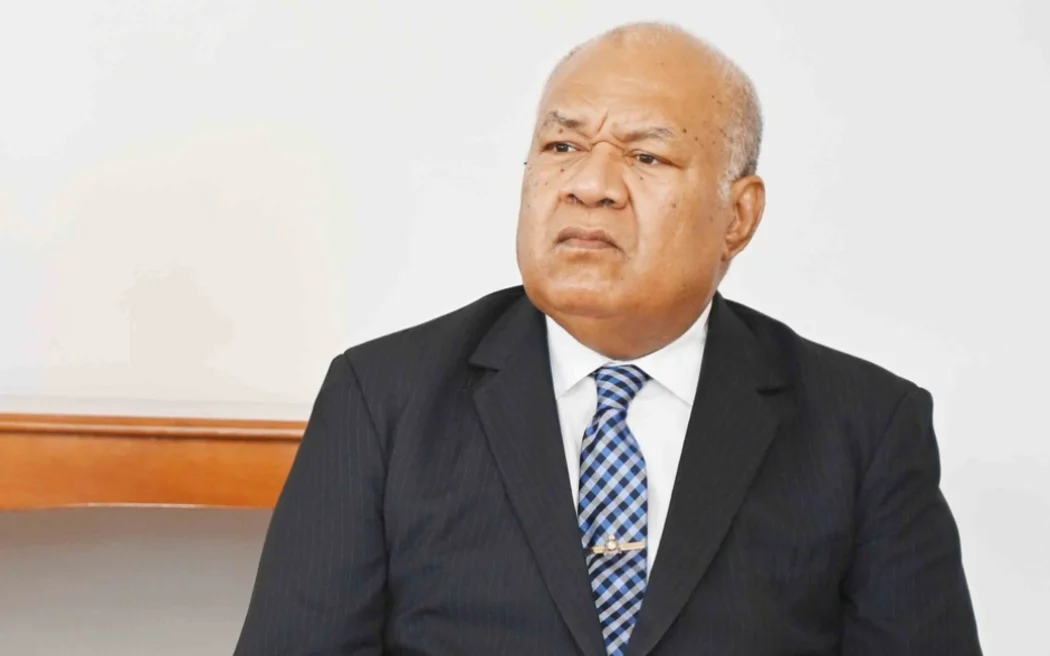
The Fijian government is negotiating a secret deal with the country’s highest-ranking judge after he was accused of corruption in a damning Commission of Inquiry (COI) last year.
Chief Justice Salesi Temo is part of a high-profile clique the inquiry found to have allegedly lied under oath, and obstructed and perverted the course of justice. There were six members of government and four lawyers implicated in the investigation.
Public prosecutors last week threw out all 12 police investigations stemming from the COI due to insufficient evidence.
The inquiry, led by Australian judge David Ashton-Lewis, focussed on the hiring of Barbara Malimali, the former head of the Fiji Independent Commission Against Corruption (FICAC).
Temo’s lawyer, Isireli Fa, told Pacific Waves that Ashton-Lewis exceeded his authority during the COI and his findings against Temo were “defamatory and baseless”.
Fa insists the settlement agreement is “not about money”, and it is the Executive branch that wants to keep it confidential.
“The government is attempting to resolve this matter to ensure that the two arms of [the State] do not fight and engage in litigation that could undermine the government and the whole judicial process,” he said.
“Settlement does not involve a payout and I can’t say any more because it’s still a work in progress with the government.”
“We have signed an agreement but the executive arm (the acting Attorney-General Siromi Turaga and the Solicitor General Ropate Green) wants to amend it.”
“His (Temo’s) main concern is to ensure that the reputation of the Judiciary and the Judicial Services Commission (JSC) remains intact and is above scrutiny,” Fa said.
Ashton-Lewis also described Malimali as “universally corrupt” in a lengthy report following the inquiry, which was redacted and released by Prime Minister Sitiveni Rabuka weeks after leaked copies had emerged.
“She was a pawn in the hands of devious members of government, who wanted any allegations against them or others thrown out,” the judge previously told RNZ Pacific.
Malimali’s lawyer Tanya Waqanika told Pacific Waves at the time that his public remarks had destroyed her client’s legal career.
Rabuka suspended Malimali last May but later rescinded the suspension, then President Ratu Naiqama Lalabalavu revoked her initial appointment.
Public prosecutors later cleared her of an allegation of abuse of office while she was chair of the country’s Electoral Commission.
Fa said the JSC was concerned about the way the inquiry was conducted and it lodged a judicial review in the Suva High Court last year to quash the findings against the organisation and its officers.
Temo is the chair of the JSC and Tomasi Bainivalu, Fiji’s chief registrar, is its secretary. The COI, the acting Attorney-General Siromi Turaga and Justice Ashton-Lewis were named as the other party.
“The COI purported to make findings of facts which were clearly unsupported, in our opinion, when we reviewed its report,” Fa said.
“The JSC’s judicial review was based on our view that Ashton-Lewis acted outside the ambit of the Commission of Inquiry Act by making findings which were contrary to the principles of natural justice.
“It’s well established in law that when you conduct a COI and come up with a finding that affects someone’s reputation, you are supposed to warn them so they are prepared to deal with it.”
“In this case none of that happened, the COI was determined to try and and find wrongdoing wherever it could,” he said.
He said the JSC took issue with the inquiry’s interpretation of certain sections of the FICAC Act and the Constitution.
Fa said the FICAC Act stipulated the JSC’s role was to advise the president on who should be appointed as FICAC commissioner.
“For some reason in this particular case, Ashton-Lewis said that that function could also be carried out by the Prime Minister, which undermined the JSC’s powers to conduct its constitutional function,” he said.
“Ashton-Lewis also contravened the Commission of Inquiry Act by making findings that the Act clearly states cannot be used in any court of law.”
He made findings anyway and recommended to the Police Commissioner, Rusiate Tudravu, that he investigate and lay charges.
“I believe the Attorney-General’s office, which was defending the COI, realised the allegations were unfounded and decided the best way forward was to try and arrive at a settlement.”
Since the inquiry, FICAC has charged the former deputy prime minister Manoa Kamikamica with corruption.
The former Minister for Trade and Communications resigned from Cabinet last October after being charged with one count of perjury. It is alleged that he gave false information to the COI.
Meanwhile, the Fiji Labour Party (FLP) has strongly opposed any out of court settlement.
FLP leader Mahendra Chaudhry said keeping the deal confidential was “repugnant”.