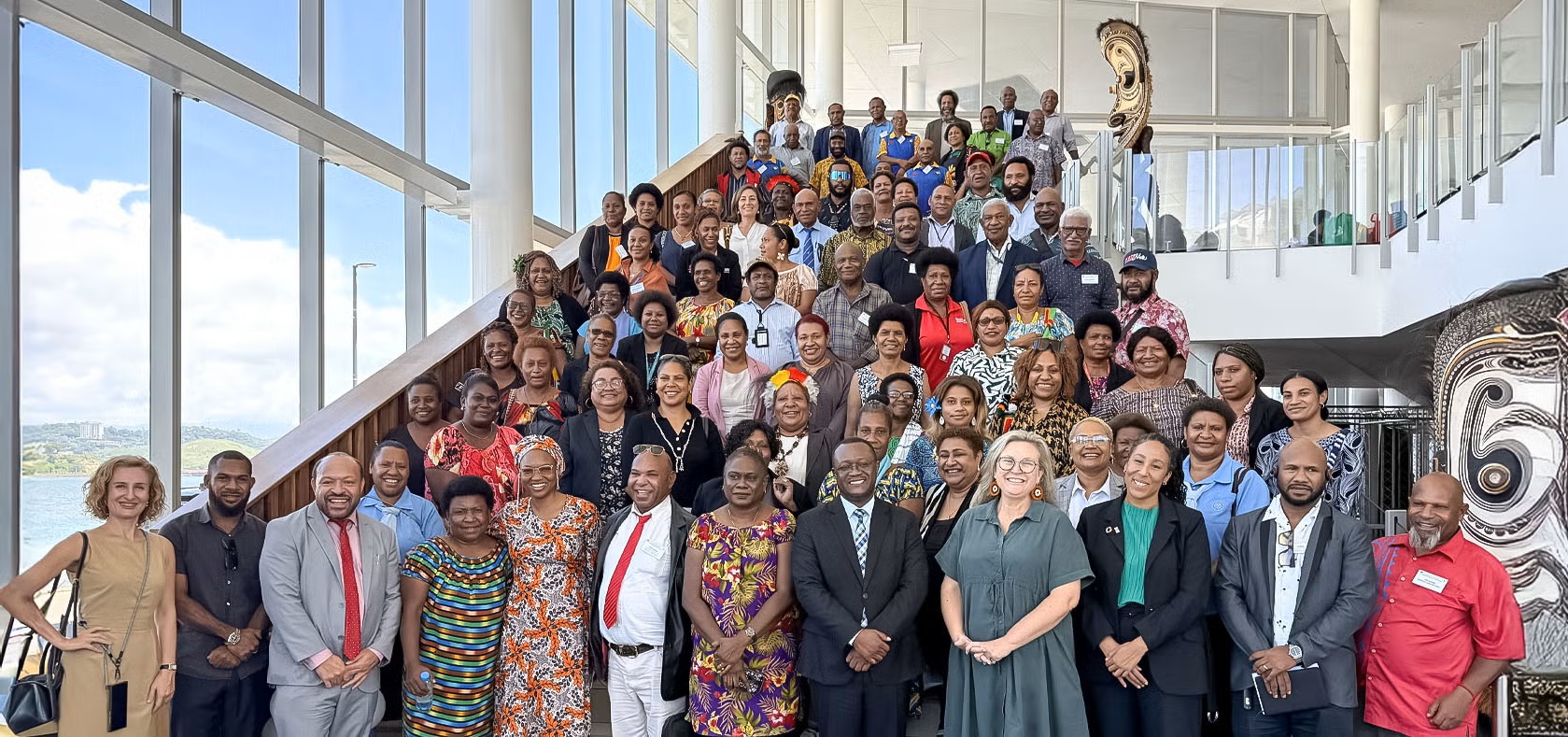
More than 150 participants – including political party representatives, government officials, civil society leaders, young people and aspiring women candidates – gathered on 3–4 December in Port Moresby for the National Forum on Women’s Political Leadership. Convened under the Women Make the Change programme, which is funded by the Australian Government, the two-day event marked a pivotal step in strengthening inclusive political pathways ahead of the Papua New Guinea (PNG) 2027 national general elections.
Convened in partnership with the country’s Integrity of Political Parties and Candidates Commission (IPPCC), the Department for Community Development and Religion (DFCDR), UN Women and the United Nations Development Programme (UNDP), with support from the Government of Australia, the Forum spotlighted the role of political parties and institutions in enabling women’s full participation and leadership in political processes.
“When women and girls are represented at the highest level of decision-making, societies are more prosperous, stable and resilient,” said Elizabeth LeBas, Minister Counsellor at the Australian High Commission. “Australia stands side-by-side and step-by-step with PNG in support of women’s political empowerment.”
Women are still starkly underrepresented in PNG politics. Currently, only three women serve in the 118-member National Parliament, just 2.5 per cent. Although the number of female candidates has increased, success rates remain low due to systemic disadvantages, including limited campaign financing, lack of party endorsement and limited media visibility.
“As more women step forward to serve, Papua New Guinea has an opportunity to build a more inclusive democracy,” said UN Women Country Representative Peterson Magoola. “Political parties must lead this transformation. With our partners, UN Women will continue driving collective action that ensures women are not just participants, but influential leaders in the political life of this nation.”
The Forum also highlighted the voices of emerging women leaders, including an interactive session with young candidates and a regional exchange with Pacific Island leaders who joined virtually. These conversations reinforced shared challenges and regional strategies to advance gender equality in political representation.
“Women’s networks and coalitions are essential not only for mobilising women voters, but also for ensuring safer elections where women’s concerns are prioritised,” said Sabeth Yengis, President of the National Council of Women.
Nicholas Booth, UNDP Resident Representative said: “When it comes to women’s political representation, almost no other country has as far to go as Papua New Guinea. However, I believe that we are in better shape to scale this mountain. In the past years, UNDP has played a key role in establishing the Permanent Parliamentary Committee on Gender Equality and Women’s Empowerment, as well as the Joint Parliamentary Women’s Caucus. These initiatives, along with our ‘Women Make the Change Programme’, have given us the tools to succeed in this difficult task!”
Discussions addressed lessons from the 2022 elections, systemic barriers including outdated electoral laws, and the urgent need for political parties to identify and support capable women candidates in the pre-election phase. Key takeaways and leaders’ recommendations emphasised early support, party accountability and targeted resources for women candidates. As part of this drive, the Forum encouraged parties to nominate multiple candidates in each electorate, as a strategic measure to retain votes and improve women’s chances of success.
A closing session attended by National Capital District (NCD) Governor Powes Parkop reinforced the call to action, focusing on next steps: improved mentoring frameworks, a national database of emerging women leaders and stakeholder collaboration for election reform.
Emmanuel Pok, Registrar of IPPCC, underlined the role of political parties: “To compete and make participation inclusive, aspiring women candidates must become active members of political parties in the electoral process of this country.”
As the country marks its 50th year of independence in 2025, the Forum sent a clear message: inclusive leadership is not only a democratic imperative but also vital to shaping PNG’s future.