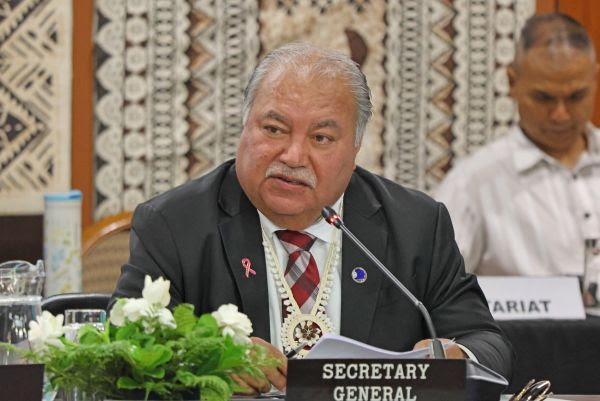
Pacific Islands Forum Secretary General Baron Waqa says the Pacific remains united and firmly present on the global stage, as leaders continue to advance regional priorities following the 54th Pacific Islands Forum Leaders Meeting in Honiara.
Speaking at a press briefing today, Waqa said Forum leaders have sustained high-level engagement throughout the year, including at COP30, the 80th United Nations General Assembly and other regional and global meetings, underscoring a consistent message from the region.
“The Pacific is united, and the Pacific is present,” he said.
He said this year’s Forum theme, “Iumi Tugeda: Act Now for an Integrated Blue Pacific Continent,” reflects both solidarity among members and the realities of a rapidly shifting geopolitical environment.
“The Pacific is experiencing a level of geopolitical interest not seen for decades. With this comes opportunity, but also responsibility,” Waqa said, noting that the end of the year provides a critical moment to take stock and plan ahead.
Waqa identified regional unity as a top priority, describing the Pacific Islands Forum as the region’s central political convening body for dialogue and collective decision-making in a highly contested geostrategic environment.
“In a highly contested geostrategic environment, unity matters more than ever,” he said, adding that the Forum’s role is to “hold the space and to ensure that our unity remains strong.”
He said leaders have also advanced the Blue Pacific Vision through the Ocean of Peace Declaration, which affirms the region’s commitment to peace, stability, and cooperation.
“It reflects Pacific values, and it reinforces the Pacific as a region that seeks security through dialogue, not division,” Waqa said.
He noted that work is now shifting toward socialisation and implementation, including engagement with members, partners, and regional institutions, and ensuring the declaration reshapes how the region engages externally.
On progress against leaders’ decisions, Waqa said the 2050 Strategy for the Blue Pacific Continent continues to guide regional work, with advances made in climate resilience, economic connectivity, and regional cooperation.
He highlighted the ongoing review of the regional architecture as a key part of this effort.
“This review is not about creating new institutions. It is about improving coordination, reducing duplication, strengthening coherence, and strengthening delivery across the regional system,” he said, adding that the process is now moving from recommendations to implementation.
Looking ahead, Waqa said the coming year will focus strongly on implementation and better integration across the regional system, with climate change resilience remaining central alongside economic connectivity and institutional strengthening.
He said leaders expect the regional system to work together more effectively, with the Forum Secretariat supporting coordination and ensuring political direction is reflected in action.
On external engagement, Waqa said the Pacific will continue to engage globally “with confidence and always on Pacific terms,” guided by the 2026 Leaders’ Policy on Partnerships.
He said the policy is designed to ensure partnerships are transparent, aligned, and supportive of regional priorities, particularly amid growing international interest in the
Pacific.
While expressing disappointment that a Pacific COP will not be hosted in Australia next year, Waqa welcomed Australia’s commitment to work closely with Turkey as president of COP31, including plans to host a pre-COP leaders’ summit in the Pacific in 2026.
“This provides an opportunity to elevate Pacific priorities, including the climate-ocean nexus, just transition, and access to climate finance,” he said, stressing that the Forum will continue to anchor regional advocacy, so partnerships strengthen rather than dilute Pacific priorities.