By Pita Ligaiula in Manila, Philippines
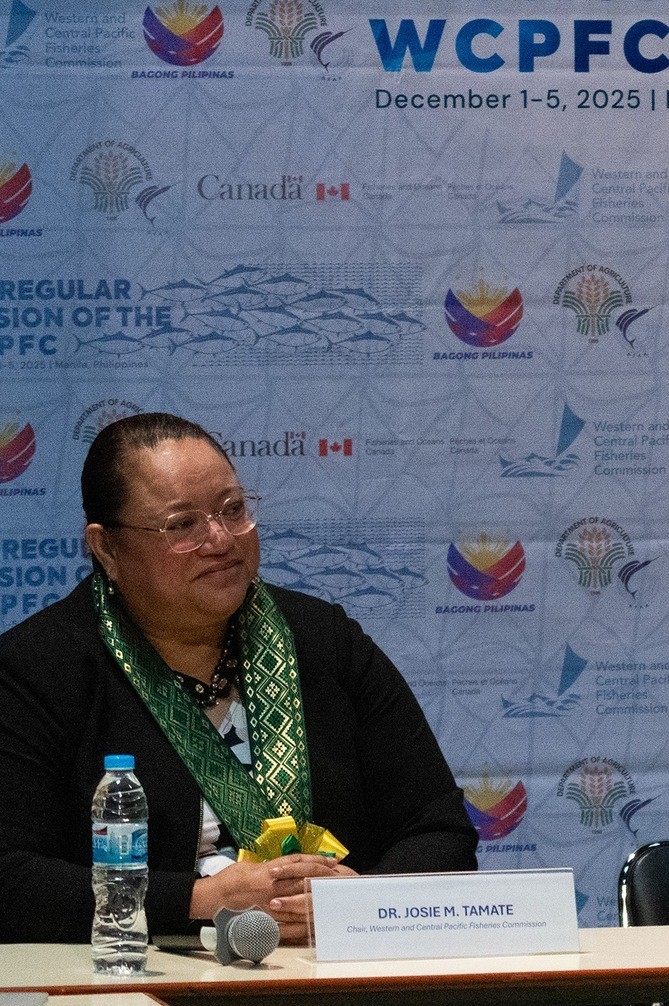
With the Western and Central Pacific Fisheries Commission (WCPFC) under pressure to deliver a long-delayed management procedure for South Pacific albacore, PACNEWS Senior Journalist Pita Ligaiula spoke exclusively with Tuna Commission Chair Dr Josie Tamate in an in-depth interview on this critical week of negotiations in Manila.
Speaking candidly on the challenges, expectations and political pressures facing the Commission, Dr Tamate outlined why she believes members are closer than ever to consensus on the albacore harvest strategy and what is at stake if they fail.
From the economic struggles of domestic longline fleets to the widening scrutiny over high-seas transshipment, she discussed the competing forces the Commission must balance while keeping its decisions rooted in science.
She also addressed rising concerns from Small Island Developing States (SIDS), the push from observers for modern management tools, and the growing risk climate change poses to Pacific Tuna fisheries and a direct message to Pacific communities whose livelihoods depend on tuna, affirming the Commission’s responsibility to maintain healthy stocks and protect non-target species as negotiations intensify.
Below is the full PACNEWS interview.
PL: The Commission meets this week in Manila with the aim of adopting a management procedure for South Pacific albacore. How confident are you that members will reach consensus?
JT: There is a proposal on the table, and the members will continue their discussions and negotiations. These discussions continue from the two workshops held leading up to Manila and the consultations between members as they look to narrow gaps in positions towards a consensus. Therefore, I am confident that there is a strong commitment to work towards the adoption of a management procedure for South Pacific Albacore(SPA).I am looking forward to the week ahead and my goal is to provide the space and time for the discussions to reach consensus for the adoption of the Management Procedure(MP) for SPA.
PL: You’ve expressed hope in the media lately that the albacore harvest strategy will be agreed by consensus. What signs are you seeing that members are ready to make that commitment this year?
JT: This is the year for South Pacific Albacore (SPA). In addition to the two WCPFC workshops on SPA, the FFA group have had extensive discussions as well. Additionally, the FFA membership concluded and adopted a proportional allocation of SPA among FFA members in July this year along with the commitment for a unified position to be taken at the WCPFC on the negotiation of the SPA MP. There is also a call from a number of observers of the WCPFC urging for an adoption of a MP for SPA at this WCPFC meeting. The members are rolling up their sleeves to get to work and as Chair, I am very committed to work towards an adoption.
PL: If consensus on albacore is not achieved, what will this mean for the fishery, for the longline sector, and for the Commission’s credibility?
JT:11 years ago, the WCPFC committed itself to implement a Harvest Strategy approach for key fisheries and stocks in the WCPO. In 2022, the WCPFC adopted an interim Skipjack MP; in 2023, WCPFC adopted the HS for Pacific Bluefin Tuna and the HS for North Pacific Albacore. There is a harvest strategy workplan and according to the plan, the WCPFC was to adopt a MP for SPA last year. That did not happen. However, WCPFC21 did make a commitment to work with Inter-American Tropical Tuna Commission (IATTC) to establish a Join Working Group for South Pacific Albacore and the intersessional work to be undertaken in 2025. The Commission credibility will be on the line if there is no consensus. And so, I am determined to do everything I can in my capacity as Chair to ensure we reach a consensus.
PL: Tuna fisheries generate an estimated US$5.3 billion annually for Pacific economies. How central is the albacore harvest strategy to safeguarding that economic value?
JT: South Pacific Albacore (SPA) is a key fishery for southern Pacific Island groups. There have been concerns that although the stock is deemed to be biologically healthy. the economics does not look good. In previous WCPFC meetings, we have heard statements calling on the need to rebuild the fishery, for stability and the need to improve catch rates. Therefore, the SPA harvest strategy is to help provide certainty and opportunity to rebuild the fishery. The fishery is important to domestic and locally based fleets.
PL: Pacific Island countries rely heavily on albacore for domestic fleets and revenue. What feedback or pressure are you hearing from island members ahead of the meeting?
JT: I have heard consistent messages over the years on the need to improve the economics of the fishery. The South Pacific Group comprising 5 FFA members have been leading the discussions internally within the FFA arena and also at the WCPFC meetings on the need to rebuild the economics of the fishery. Four of the five members have domestic fleets, and SPA is the main species in their EEZs.
PL: What remain the biggest sticking points among members on the albacore harvest strategy, and how is the Commission working to bridge those gaps?
JT: The biggest sticking point from my perspective is agreeing on a Harvest Control Rule. There are still too many options at this point. Our Science Service Provider – SPC have provided all the analysis and have done an incredible job in responding to the requests from the members. The Commission will need to agree on which HCR to use and also the area of application. There are two options: (a) apply from the equator going down south, or (2) apply only from 10 degrees south.
PL: The Commission is also under pressure to strengthen high-seas transshipment rules. How high is this issue on your agenda for Manila?
JT: All proposals are important for the Commission. But we have a finite time available to discuss and reach consensus. Transhipment discussions have been ongoing for a number of years. In Fiji, the Commission agreed to disband the Working Group on transhipment. There was no resolve at the time and there was a need for a re-set. This year – there are two proposals. The decision rests with the Commission on how to address the proposals and recommendations.
PL: Some Pacific states argue current transshipment rules are too weak and enable IUU risks. How is the WCPFC addressing those concerns, especially from SIDS?
JT: As mentioned, there are two proposals on the table on transhipment. There have been ongoing discussions as well, including studies commissioned by one of the SIDs. The key issue is that transhipment at high sea is not permit except if it is impractical for a vessel to go into an authorised port to tranship…. The Commission will continue to work towards improving monitoring and compliance through the Working Groups on Observer Programme and Electronic Monitoring and Reporting, including the TCC.
PL: Conversely, some distant-water fishing nations are resisting tougher controls. How do you plan to navigate these competing positions to reach a workable outcome?
JT: My job as the Chair is to listen and facilitate the discussions in search of consensus. If there is no consensus, the best outcome is to determine next steps and future taskings either through an intersessional working group and/or through the subsidiary bodies. the subsidiary bodies are important for the WCPFC. The WCPFC takes into account the recommendations from the subsidiary bodies as part of their decision-making process.
PL: How will the Commission balance the need for long-term sustainability with the immediate economic pressures facing fishing nations and their industries?
JT: The Commission and its work have contributed significantly towards maintaining the healthy status of the key tuna species in the WCPO. Decisions are based on science and evidence based.
PL: NGOs and market players warn that failing to adopt modern management tools—including harvest strategies and stronger transshipment oversight—could affect ecolabel certifications and market access. Is this something the Commission is taking seriously?
JT: Yes. I value the views from our Observers.
PL: Beyond albacore and transshipment, what outcomes must WCPFC22 deliver for the meeting to be considered a success?
JT: Climate Change – Implementation of Article 30 on SIDs requirement – seabirds – addressing data gaps – bigeye tuna TRP – this is the next species on the Harvest Strategy Work Plan.
PL: What is your message to Pacific communities whose livelihoods depend on tuna and who are watching these negotiations closely?
JT: That the Commission is working diligently to ensure the WCPO continue to sustain the healthy status of the key tuna species. That the Commission continues to mitigate the impact of fishing on the non targeted species such as sea birds, sea turtles, cetaceans etc. That the work of the Commission is ongoing and decisions are based on science. The ultimate goal is to sustain the healthy status of the fishery. It is better to maintain rather than re-build when and if a fish stock collapses.