



By Pita Ligaiula in Manila, Philllipines
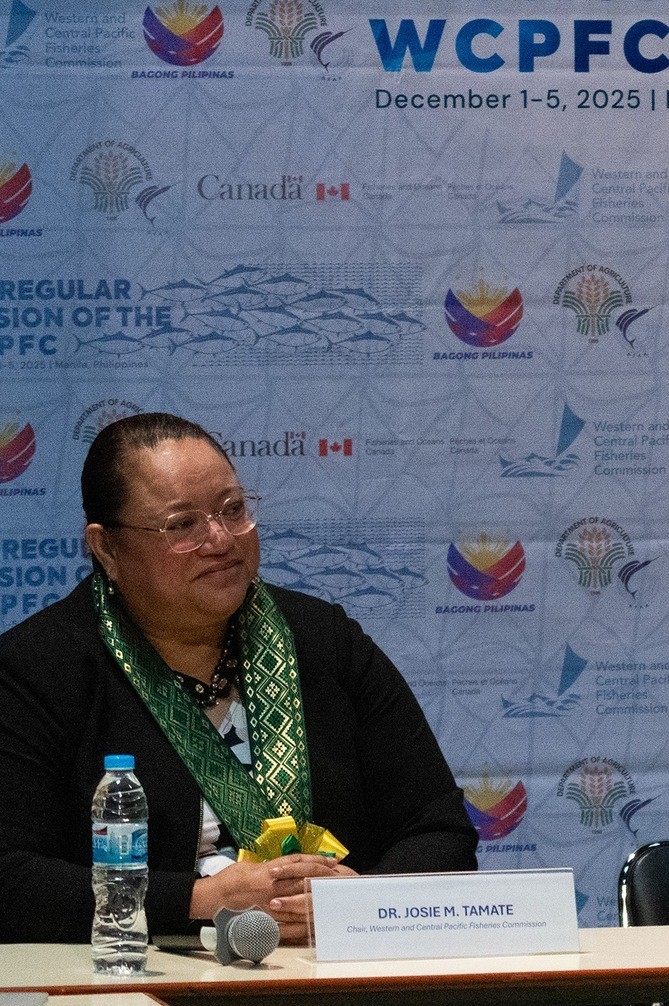
Western and Central Pacific Fisheries Commission (WCPFC) Chair Dr Josie Tamate says all major tuna stocks in the region remain healthy but warned that the Commission is now moving into a critical phase of setting firm catch limits and adopting management procedures to keep the world’s largest tuna fishery sustainable.
Speaking at a media conference in Manila, Tamate said the Commission’s responsibility covers four key tuna stocks — skipjack, yellowfin, bigeye and albacore as well as billfish and non-target species.
“There are four key tuna stocks that are under the responsibility of the WCPFC,” she said. “At the moment, all the stocks with respect to the tuna and bill are healthy.”
Dr Tamate said the region’s tuna stocks remain the strongest globally, and this year’s meeting will continue the shift into harvest strategies and long-term rules-based management.
“For this weeks number of conservation and management measures, we do have a tropical tuna management measure… This week, we’re looking at a harvest strategy, continuing the harvest strategy work,” she said.
She noted the Commission adopted a management procedure for skipjack tuna in 2022 and is now aiming to adopt the South Pacific albacore management procedure.
“This week, were looking to adopt the management procedure for South Pacific albacore, and this will be continued work.
The next species on the list for the commission to work on is the bigeye tuna,” she said.
Dr Tamate said discussions will begin on how the bigeye management procedure will be developed, signalling the next major step in the Commission’s harvest strategy roadmap.
WCPFC Executive Director Dr Rhea Moss-Christian said the management procedures being considered this week will introduce clear limits on how much fish can be taken.
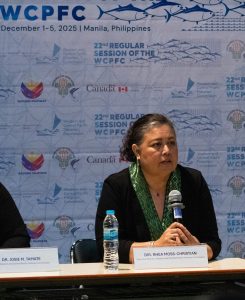 “The management procedure does limit the number of fish that can be taken in very simple terms,” she said.
She said the South Pacific albacore stock is biologically healthy, but economic performance has weakened — which is why the new rules will cap total catch and trigger allocation talks among members.
“Members will be looking at adopting a measure that will restrict the amount of catch that can be taken and then start to talk about how to allocate that catch,” she said.
“Once their decision is taken around how much catch of albacore can be taken, then the next step will be to distribute that amount among the interested members.”
Dr Moss-Christian confirmed similar work is beginning for bigeye tuna.
“There are other conservation and management measures under discussion for the big eye stock, in the same way, limiting catch, determining what is the maximum amount of catch that can be taken,” she said.
Yellowfin will be addressed next year.
“For yellowfin tuna, this is next years work,” she said.
“We will also be reviewing the management procedure for skipjack, which also restricts the amount of catch that can be taken by the purse seine fishery.”
When asked whether specific catch volumes were available, Moss-Christian said the details are still under negotiation.
“Exact numbers? Yes. There are many options on the table at the moment, and that will be the subject of negotiations this week,” she said.
WCPFC22 continues in Manila, with the albacore management procedure expected to be one of the defining decisions of the meeting.