

By Pita Ligaiula in Manila, Philippines
Tuvalu has delivered a clear message to WCPFC22, warning that key fisheries rules are falling behind and must be strengthened to protect the region’s tuna stocks and the economies that rely on them.
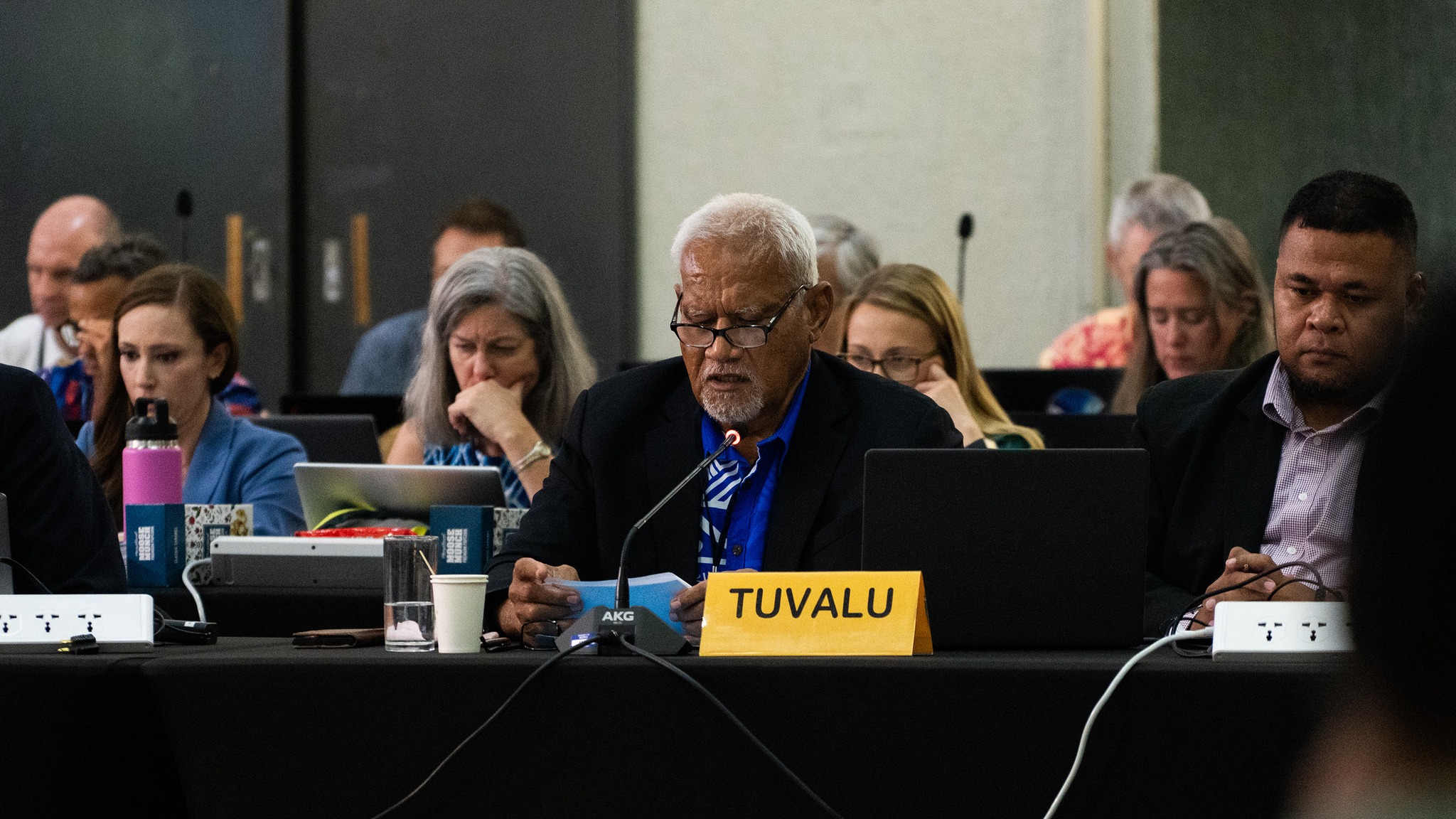
Speaking at the opening of the meeting Monday, Minister of Natural Resources Development Sa’aga Talu said Tuvalu expects real progress this year across four major issues.
Talu backed the long-delayed Management Procedure for South Pacific albacore, noting that while the species is not central to Tuvalu’s economy, regional solidarity and the Commission’s credibility are on the line.
“Frankly, for Tuvalu the fishery for albacore is not very important – but I have put this top of my list as a matter of solidarity with other FFA members, as well as to maintain the reputation of the Commission for responsible management of all our tuna resources,” he said.
“We are behind schedule with the adoption of the MP for Albacore, and I believe that the proposals put forward for the procedure and the implementing arrangement are fair, balanced and effective. Tuvalu urges all Commission members to accept these proposals.”
He then turned to the purse seine fishery, the backbone of Tuvalu’s national revenue, stressing the importance of effective management of Fish Aggregation Devices (FAD).
“The purse seine fishery in Tuvalu waters, on which my government relies for more than half its annual revenue, is highly dependent on the use of Fish Aggregation Devices,” he said.
Talu welcomed moves to make FAD-tracking and FAD logsheets a Commission-wide requirement, noting they were already used by Parties to Nauru Agreement (PNA).
He said Tuvalu supports biodegradable FADs in principle but backed industry concerns about their effectiveness.
Tuvalu has already launched a project to retrieve and reuse FAD buoys, “so that when bio-FADs are introduced this small non-degradable part of the system will also be dealt with.”
Talu’s strongest warning came on high seas’ transshipment, an issue that has stalled for years at the Commission.
“Tuvalu, like other coastal states in the WCPFC, has grave concerns over the extent of the transshipment of longline catches on the high seas,” he said.
“Something that was supposed to be allowed only in exceptional circumstances has become the norm, raising the risk of IUU activities and labour abuse.”
Previous efforts to tighten the rules have been blocked, but Talu said that must not continue.
“We firmly believe that the measure needs to be strengthened and improved.”
Talu backed delaying the review of the Tropical Tuna Conservation and Management Measure (TTCMM) by one year, arguing the extra time will allow the science provider to complete essential work.
“We strongly support the proposal to delay the revision… This will align the process with the Skipjack Management Procedure and give our hardworking science provider more time to do the necessary groundwork,” he said.