


By Pita Ligaiula in Manila, Philippines
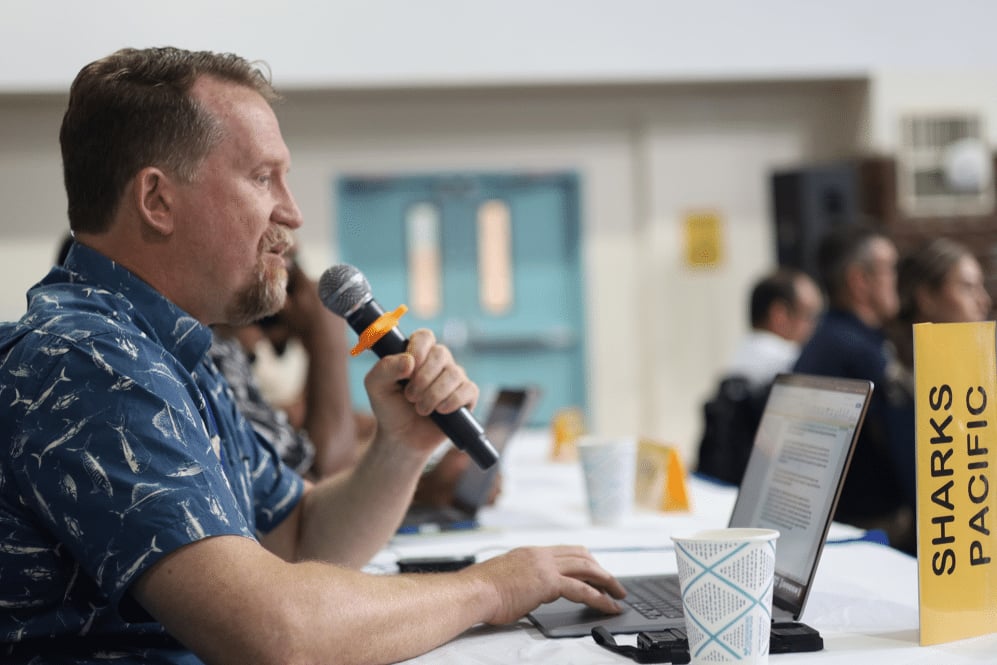
As negotiations open Monday in Manila for the 22nd Regular Session of the Western and Central Pacific Fisheries Commission (WCPFC22) one of the most consequential meetings in the Tuna Commission’s history, PACNEWS Senior Journalist Pita Ligaiula spoke with Sharks Pacific Policy Director Bubba Cook for an in-depth interview on the critical decisions facing Pacific tuna fisheries.
Cook, a long-time observer of the Tuna Commission and a vocal advocate for stronger accountability on the high seas, lays out what is at stake for South Pacific albacore, the mounting pressure from markets, the political deadlock around transshipment, and the credibility test facing the WCPFC this week.
Below is the full interview conducted in Manila.
PL:Bubba Cook What is your biggest expectation going into WCPFC22 in Manila, particularly on South Pacific albacore?
COOK: My biggest expectation with South Pacific Albacore is that there is enough incentive among the members, particularly among those that wish to maintain Marine Stewardship Council certification (MSC) certification, that they will adopt a management procedure. I think this issue will take up the majority of the time and energy expended by the WCPFC this year. However, as evidenced by statements from the Executive Director and Chair earlier this year, as well as the presence of the several papers on Non-Target and Associated or Dependent Species (NTADS; also “bycatch”) I believe we will see a shift of focus toward these issues, noting that the target tuna stocks remain “in the green” while many of the bycatch species are at best data deficient and at worst declining or heavily depleted.
PL: Do you believe the Commission is ready to adopt the FFA’s proposed management procedure, and what would it mean if they fail to do so?
COOK: South Pacific Albacore is a critical issue for the FFA member states. Four many FFA members, South Pacific Albacore (SP ALB) is a “bread and butter” species – it pays the bills through both fishing and processing revenue.
Thus, I think there is very strong incentives for them to secure a management procedure that maintains certification status into key markets and ensures better long-term sustainability. For these reasons, I think there is plenty of room for negotiation and compromise to determine allocations that meet the expectations and aspirations of all members.
Moreover, because of the importance of the issue, I believe that the FFA members are entering the discussion this year as prepared as they could possibly be with all of the analyses and justifications that would make it extremely difficult for any other member to claim a lack of understanding or information. If the WCPFC fails to adopt the management procedure, it could result in the loss of MSC certification for many fisheries and, commensurately, associated market access and premiums, so there could be a significant economic hit for those members’ fisheries.
More broadly, failure to agree to a management procedure means the process remains mired in the annual protracted and heavily political decision-making process that is only tangentially based in a foundation of science. Harvest strategy management, including through the use of established and, effectively, automated management procedures, ensures that management steps to adjust catch levels to ensure long term sustainability do not get hijacked by the economic and political considerations of any single member.
PL: How crucial is market alignment — including major retailers — in pushing WCPFC members toward a decision this year?
COOK: Markets, including the big buyers and major retailers, are playing an increasingly important role in driving some of these important sustainability decisions. We see organisations like the Global Tuna Alliance (GTA) bringing major markets together to call for stronger management measures across all the Regional Fisheries Management Organisations (RFMOs). Additionally, we see initiatives like the Pacific Islands Tuna initiative in the Republic of Marshall Islands (RMI), where large markets like Costco and Walmart have committed support under the expectation that strong and transparent management is implemented in their fisheries subject to strong supply chain traceability.
These issues, along with MSC certification pressures, are converging to drive management decisions toward greater transparency, traceability, and, ultimately, accountability. Money talks, so when these markets say they want something implemented, members are more likely to ensure that happens.
PL: Where do you see the strongest resistance coming from, and how should the Commission address it?
COOK: The strongest resistance will unquestionably come from those distant water fishing nations (DWFN) that rely most heavily on the high seas to conduct fishing operations. With more than a quarter of SP ALB harvested on the high seas (that we know of), those countries rely on the opacity and diffusion of the existing supply chain to obscure how much they are catching (and profiting from) and, therefore, oppose any measures that might reasonably improve the level of accountability of their actions on the high seas or, certainly, place any limits on their effort or catch whether it is within an EEZ or on the high seas. This position is no more evident than in the high seas transshipment issue, where the Asian DWFN have fought aggressively to avoid any accountability on the high seas that might expose just how much fish is being stolen from the Small Island Developing States. If the WCPFC genuinely wanted to address the issue of the theft of resources from the SIDS, the most simple and effective way would be to close the high seas to all transshipment, which would force any at-sea transhipment inside the EEZ, where it can be subject to greater scrutiny by the coastal state or, even better, into port, where the coastal state can not only more effectively monitor and account for the landings, but would secure greater rents and benefits from the resource. Until high seas transshipment is addressed, there will continue to be significant gaps in the ability of the WCPFC to manage all species, much less SP ALB.
PL: Electronic monitoring and observer coverage have been major sticking points. What concrete progress do you hope to see at this meeting?
COOK: I don’t see “concrete progress” occurring at this meeting with respect to electronic monitoring/observer coverage, but I do see some modest steps forward with the agreement of audit standards for Electronic Monitoring(EM) programmes and renewed leadership and momentum on the Electronic Reporting and Electronic Monitoring(EREM) Working Group. Those same countries and fleets that have traditionally opposed increased observer coverage will continue to oppose it, until technology and markets make it an unavoidable necessity to sell tuna anywhere in the world.
PL: Are you confident WCPFC members will strengthen high-seas transshipment rules, or do you expect another delayed outcome?
COOK: I am hopeful, but certainly not confident, that there will be any meaningful steps taken toward reforming high seas transshipment at this meeting. The proposal from Korea is effectively a “heads we win, tails you lose” proposal, where they effectively retain the status quo while shifting any burden for monitoring, control, and surveillance on to the SIDS. There is a pretty broad chasm between what the ADWFN want to maintain as the status quo ability to transship without meaningful controls or scrutiny and the level of oversight that is actually necessary to ensure that it is not facilitating IUU, illicit goods trafficking, or, particularly, violations of human and labour rights. We shall see what unfolds, but at this point I think that the Pacific Islands has hit their limit on willingness to negotiate as evidenced by RMI’s proposal to ban high seas transhipment outright (which is, incidentally, the same thing they called for back in 2008). Unfortunately, the consensus process of the WCPFC allows the ADWFN the ability to dig in their heels and simply oppose any meaningful improvements to transshipment monitoring and accountability without consequence, which suggests that the only way to break the deadlock might mean taking the issue to a vote, where at least the ADWFN would be held fully accountable for their opposition to reform through fundamentally basic improvements.
PL: How important is it for WCPFC to demonstrate leadership on bycatch and FAD management this year?
COOK: I would suggest letting Pew and ISSF answer this one as I am no longer specifically engaged on the issue.
PL: If Manila fails to deliver on harvest strategies, what are the broader implications for the Commission’s credibility and for global tuna markets?
COOK: The WCPFC is now faced with the prospect that it might be held to greater account for the decisions that it
makes, thanks to greater scrutiny in the media and markets taking notice of its actions. The members no longer have the luxury of failing to act year on year to implement basic provisions that ensure the conservation and management under their charge. Moreover, it is increasingly evident that there is one chamber of the WCPFC that relies on pure obstruction and recalcitrance to prevent meaningful measures from advancing. Of course, that will only change when they are publicly held to account for their bad faith and self-interest that only serves to make collective management actions less certain and leaves our global tuna fisheries more prone to potential declines and even collapse as a result of other external pressures such as climate change.