

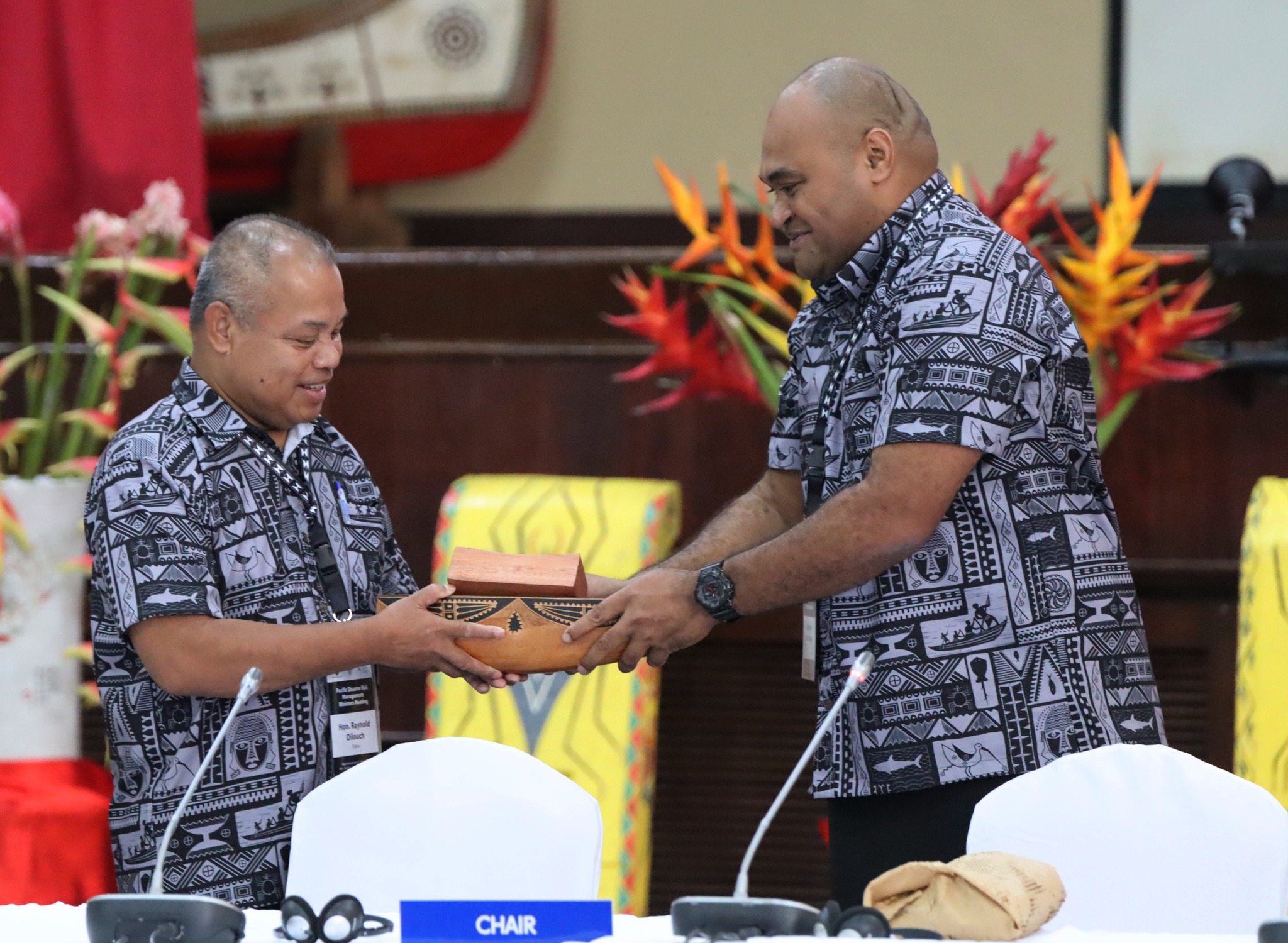
The Fiji Government officially handed over the Chairmanship of the Pacific Disaster Risk Management (DRM) Ministerial Meeting to the Government of Palau at the Second Ministerial Meeting in Koror, Palau Tuesday.
The transition of leadership was done by the Fiji National Disaster Risk Management Office (NDRMO) Director, Napolioni Boseiwaqa at the opening ceremony of the 2nd Pacific DRM Ministerial Meeting.
In his address, Boseiwaqa acknowledged the support and partnership of Pacific Island nations in enhancing disaster resilience across the region.
Reflecting on Fiji’s three-year tenure as Chair,Boseiwaqa emphasised the country’s commitment to strengthening disaster preparedness and resilience. He noted that Fiji’s vulnerability to natural disasters was underscored by its response to the impacts of tropical cyclones Harold, Yasa, and Ana in 2021, alongside the challenges posed by the COVID-19 pandemic.
These experiences, he said, reinforced the urgent need for proactive, risk-informed planning and a shift away from reactive responses.
“Fiji has been honoured to serve as Chair of the Pacific Disaster Risk Management Ministers Meeting. Our role has deepened our commitment to reform, readiness, and resilience, anchored in our lived experiences and a shared vision to leave no one behind,” Boseiwaqa said.
He highlighted Fiji’s progress in disaster risk management reforms, including the passing of the new National Disaster Risk Management Act in 2022. The Act, he said, introduced key measures such as a coordinated governance structure, formalised humanitarian clusters, a multi-hazard early warning system, and improved accountability for humanitarian actors and volunteers.
“Through programmes like Early Warning for All, and with the support of regional and international partners, we have strengthened disaster preparedness, helping Fijian communities better mitigate the impacts of natural hazards,” he said.
“We have also ensured that disaster risk management reflects a whole-of-society approach, integrating gender, disability, and youth perspectives.”
Boseiwaqa also acknowledged the collective regional efforts to advance disaster risk management, with leaders endorsing the establishment of a Pacific Ministerial Champion for DRM and the biennial regularisation of this crucial meeting.
“The challenge for change and improvement requires our collective effort,” he said.
Boseiwaqa also called for further collaboration between pacific leaders.
“Our collective strength lies in collaboration. Let us commit to concrete steps of policy reform, inclusive planning, and sustained investment to build a resilient Pacific.”
Fiji remains committed to working closely with Palau and other Pacific nations to continue the essential work of resilience building across the Pacific.
Meanwhile, the Pacific Disaster Risk Management Ministers Meeting serves as a vital platform for elevating Pacific perspectives and priorities to the global stage, including through the Global Platform for Disaster Risk Reduction.
It provides a mechanism for regular progress review, peer learning, and realignment of activities to meet emerging challenges.
The ministerial meeting brings together disaster risk management ministers, senior officials from National Disaster Management Offices, regional organisations, and development partners under the theme, “Strengthened Political Leadership for Disaster Risk Management in the Pacific.”
The 2025 meeting builds upon the foundation established at the Inaugural Pacific DRM Ministers Meeting in Nadi, Fiji (2022) and the 1st Intersessional Meeting in Manila, Philippines (2024).
The Nadi Declaration, endorsed by Pacific Island Forum Leaders, set clear commitments to strengthen resilience and enhance regional cooperation.
At this year’s meeting, Pacific DRM Ministers will address several critical priorities, including the:
i. Assessment of commitments made at previous ministerial meetings in 2022 and 2024.
ii. Consideration of endorsement of the draft Pacific Humanitarian Response Coordination Mechanism (PResCoM) Policy and Operating Guideline.
iii. Updates on implementation progress and implications for regional DRM agenda.
iv. Showcasing progress on the Pacific Humanitarian Warehousing Programme, Pacific Climate Mobility Framework, Water Security, and Early Warning for All; and
v. Ministers would also engage in closed dialogue to reimagine how the Pacific Ministerial Champion for DRM could be enhanced to effectively address regional policy imperatives.