


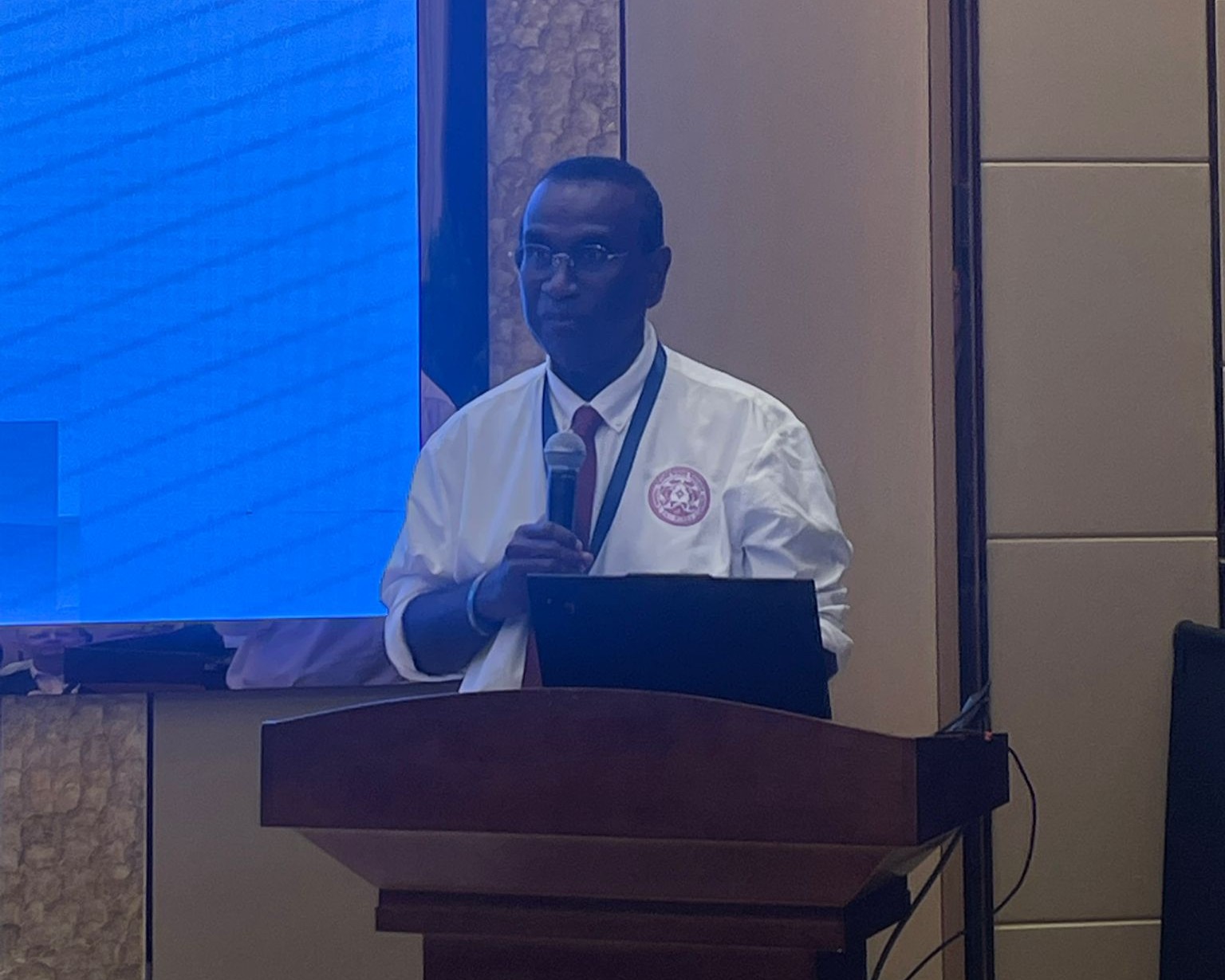
Solomon Islands National University (SINU) Vice-Chancellor Professor Transform Aqorau says Pacific Island States must continue to assert leadership in the global governance of tuna fisheries to protect their sovereignty, economy, and identity.
Speaking at the International Symposium on the Science of Pacific Tunas and Tuna Fisheries in Shanghai this week, Professor Aqorau said Pacific nations are “custodians of one of the planet’s largest and most biologically rich marine domains,” and that tuna governance lies at the core of their survival and sovereignty.
“The Pacific Island States are custodians of one of the planet’s largest and most biologically rich marine domains. Nowhere is this stewardship more consequential than the governance of tuna fisheries a sector that sustains livelihoods, food security, and national revenues across our region,” he said.
“For Pacific peoples, the ocean is not merely geography; it is identity, culture, and continuity our common heritage and our future.”
He said tuna is more than an economic asset — it is a symbol of Pacific identity and a test of global fairness in managing shared ocean resources.
“Yet beyond its economic value, tuna embodies a principle: that those who live closest to the resource are its rightful custodians. This ethos of stewardship and sovereignty defines how Pacific Island States engage with global ocean space,” Professor Aqorau said.
He highlighted how international frameworks including the WTO Agreement on Fisheries Subsidies, the UN’s 2030 Agenda for Sustainable Development, the High Seas Biodiversity (BBNJ) Treaty, and recent advisory opinions from ITLOS and the ICJ on climate change are shaping the way Pacific countries manage and defend their tuna resources.
“These frameworks offer opportunities for sustainability, equity, and recognition of Pacific stewardship, but they also present challenges if implementation fails to align with regional priorities and the sovereign rights of coastal states,” he warned.
Professor Aqorau said the WTO agreement could help Pacific nations by curbing harmful subsidies to large foreign fleets, while the BBNJ Treaty extends the Pacific’s stewardship beyond national waters to the high seas.
On climate change, he said the stakes are particularly high for Pacific nations, warning that shifts in tuna migration caused by warming oceans could cut government revenues by as much as 37 percent by 2050.
“The injustice is stark. Those who have contributed least to greenhouse gas emissions are poised to lose the most valuable resources sustaining their societies,” he said.
He added that the recent ITLOS and ICJ rulings linking climate change to marine pollution give Pacific countries “a powerful legal foundation to advocate for enhanced mitigation by major emitters and greater access to climate finance.”
Professor Aqorau credited Pacific unity and innovation for turning the tide in fisheries governance, citing the Parties to the Nauru Agreement (PNA) and its Vessel Day Scheme (VDS) as prime examples.
“The VDS has empowered Pacific states in intangible but important ways. It operationalizes the concept of Pacific islanders as rights-holders,” he said.
He said the PNA, the Forum Fisheries Agency (FFA), and the Western and Central Pacific Fisheries Commission (WCPFC) have demonstrated how Pacific cooperation can shift power away from foreign fleets toward regional control.
While global rules bring opportunities, Professor Aqorau warned they can also create burdens if not adapted to Pacific contexts.
“Global agreements often require capacity to implement that strains small administrations,” he said, noting the risks of “one-size-fits-all rules” and geopolitical pressure from larger powers.
He urged stronger advocacy, solidarity, and partnerships built on mutual respect, not dependency.
Professor Aqorau concluded that Pacific leadership in tuna governance shows how small island states can shape global ocean policy from a position of principle and unity.
“The governance of tuna fisheries in the Pacific Island States stands at a defining juncture – one where local values of stewardship and communal benefits meet the powerful tides of global regulation and climate change,” he said.
“The guiding principle remains clear: global policies must serve Pacific peoples first — from the fishers on a remote atoll to the youth who will inherit the ocean’s bounty.”
He said the Pacific’s message to the world is simple.
“We are not merely beneficiaries of the oceans, but its guardians — and the world’s collective future depends on walking beside us on this course,” Professor Aqorau.