


When islands sink, do nations disappear? The Court says no.
By Danielle Ireland-Piper
Reportedly, there were “gasps in the courtroom” when the International Court of Justice delivered its advisory opinion on climate change earlier this year, and its ramifications may yet extend beyond that courtroom into the realms of national security.
Climate change is widely recognised as a national security risk. Successive defence planning strategies have identified climate change as such. For example, the 2023 Defence Strategic Review observed that “climate change will increase the challenges for Australia and Defence” and that climate events have “negatively affected force preparedness, readiness and combat effectiveness.” And, further afield, as observed by Tom Middendrop in the Climate General:
“I realise just how much climate and security impact on each other and how water shortages cause local conflicts all over the place. They are a breeding ground for extremism. For the military, climate, weather and geographical conditions and the terrain are always a given that you have to take into account when preparing and executing missions and operations. Any operational analysis starts with an assessment of these aspects and, of course, of the enemy. But it is only when you zoom out and look at trends over the years that you see the strategic and existential significance of the changing climate.”
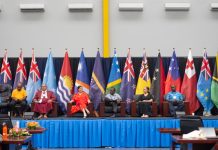
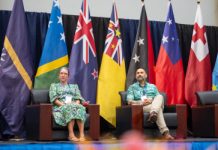
In July 2025, the International Court of Justice handed down its Advisory Opinion on the Obligation of States in Respect of Climate Change. The Court was formally prompted to give its opinion by General Assembly resolution 77/276. However, importantly for Australia’s relationships with Pacific Islands countries, the case had its genesis here in the Blue Pacific, beginning with a campaign led by 27 students from the University of the South Pacific. The Court received 91 written statements, a further 107 oral statements – delivered at The Hague in December 2024 – and 65 responses to follow-up questions by the judges.
There were two key questions before the Court (essentially relating, first, to obligations, and second, to consequences for breach of those obligations), and a number of legal issues were considered. Casting a national security lens over the ICJ’s opinion, however, brings at least two into sharp relief.
Maritime domains and territorial sovereignty
First, on the issue of a nation’s territorial sovereignty. Many participants in the case raised concerns about sea level rise and impacts on maritime zones. In short, it was argued by some participants that sea level rise should not have the effect of diminishing the maritime entitlements of States and that the “complete submergence of their territory should not deprive them of their maritime entitlements”.
Statehood – and its manifestation as sovereignty – can no longer be entirely understood purely by reference to physical geography.
In response, the Court’s view was that, “the provisions of [the UN Convention on the Law of the Sea] do not require States parties, in the context of physical changes resulting from climate-change related sea level rise, to update their charts or lists of geographical co-ordinates that show the baselines and outer limit lines of their maritime zones once they have been duly established in conformity with the Convention”. This would mean that states are under no obligation to update such charts or lists of geographical co-ordinates as a result of sea-level rise.
In turn, this line of reasoning led to the highly significant finding on the notion of statehood itself. Specifically,
“In the view of the Court, once a State is established, the disappearance of one of its constituent elements would not necessarily entail the loss of its statehood.”
In short, legal and political notions of statehood are challenged. Statehood – and its manifestation as sovereignty – can no longer be entirely understood purely by reference to physical geography. Given protection of statehood sits at the heart of national security, for low-lying nations (and their neighbours including Australia), this may mean a re-think of the conceptualisation and practice of maritime sovereignty, as well as notions of self-determination more generally.
Private actors
The issue of whether or not a state can be legally responsible for the actions of private actors also arose in the judgement. As a matter of international law, the mechanisms of attributing the conduct of private actors set a relatively high bar. However, the Court found a state’s due diligence obligations at customary international law (unlike treaties that only bind parties, custom binds all countries) means appropriately regulating private actors. In effect, this bypasses the issue of attribution. Specifically:
“In relation to private actors, the Court observes that the obligations it has identified under question (a) include the obligation of States to regulate the activities of private actors as a matter of due diligence. Therefore, attribution in this context involves attaching to a State its own actions or omissions that constitute a failure to exercise regulatory due diligence. In such circumstances, the question of attributing the conduct of private actors to a State does not arise.”
Traditionally, national security is preoccupied with public entities and state actors. However, as Isabelle Bond has argued in the context of climate security policy, “the question arises as to how the extraordinary powers of Australia’s security agencies could be effectively, but proportionately, utilised.” She suggests there are “strategic opportunities for Australia’s National Intelligence Community to enhance substantially the Commonwealth’s climate security response.”
If we are to meet the existential challenges posed by climate change, it may well be that the national security apparatus must reach further into the private sector.