
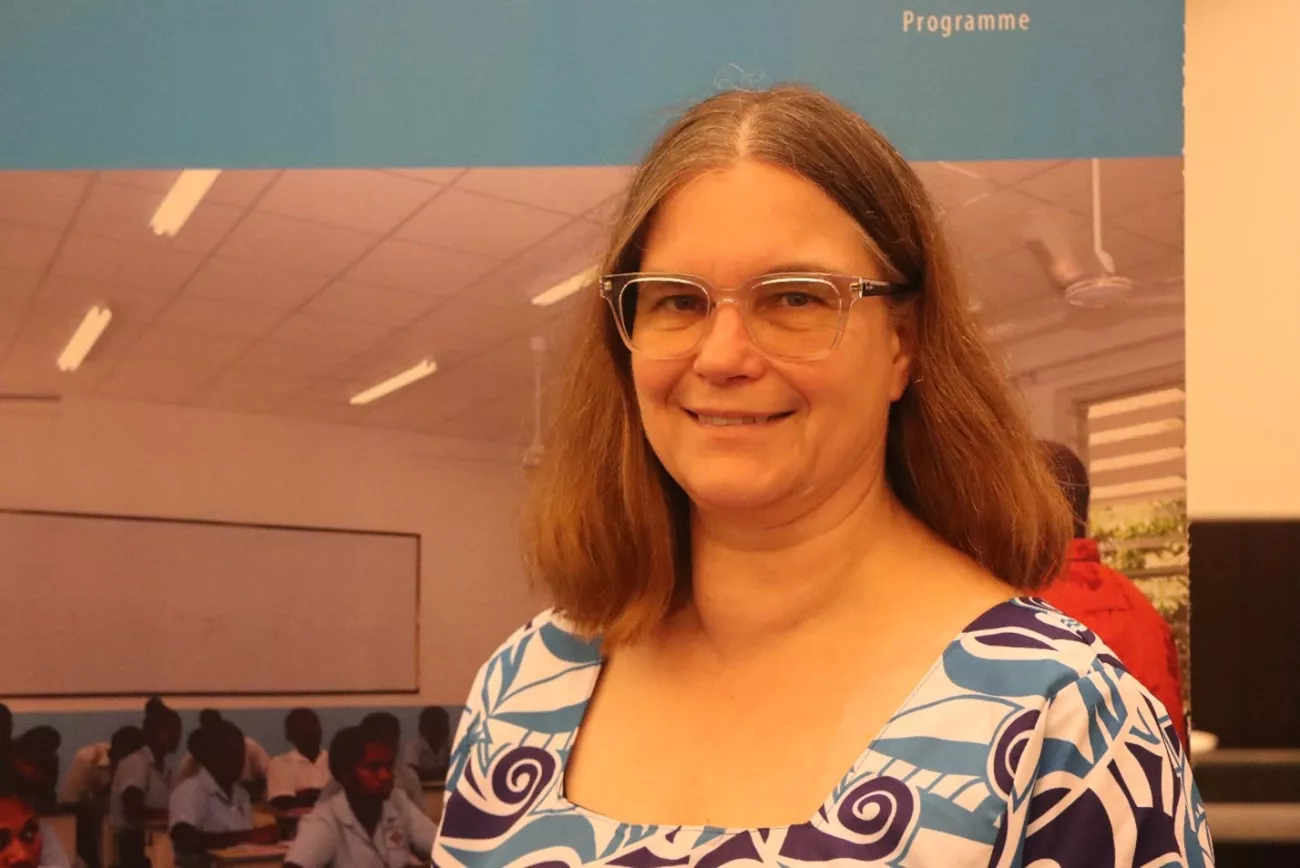
Pacific Island countries must urgently strengthen literacy education by combining traditional teaching with digital tools, but the key to success will always be empowering teachers, says Dr Michelle Belisle.
Speaking at the 2025 International Literacy Day celebrations, the Pacific Community’s Director of Educational Quality and Assessment Programme (EQAP) said literacy challenges across the region remain stark.
“Literacy skills — speaking, listening, reading and writing — are essential for the empowerment of citizens and for ensuring that everyone has the opportunity to participate fully in society,” Dr Belisle said.
“But literacy is more than just being able to read, write, speak and listen; literacy is about applying these skills alongside critical thinking, so that we understand the issues shaping our world and can play a meaningful role in determining our shared future.”
Dr Belisle highlighted the regional literacy data showing the scale of the problem.
“The 2021 Pacific Islands Literacy and Numeracy Assessment (PILNA) found that just over half of the Year 6 students in the Pacific region were meeting the minimum expected standard for reading for their year group, and fewer than half of the Year 4 students met the reading standard for that group,” she said.
She contrasted those numbers with Australia, where about 95 percent of Year 4 students meet reading benchmarks, underscoring the urgent need for change.
Despite these challenges, Dr Belisle highlighted strengths unique to the Pacific.
“In the Pacific, we have a long history of storytelling, which develops our speaking and listening skills. And children in the region generally have good listening and speaking skills when they start school because they have grown up listening to stories and singing songs. However, many primary school children live in households with little exposure to books or printed words, so they often begin school unaware that the symbols on the pages represent words that they already know.”
The 2025 theme, Weaving traditional literacy with digital tools in the Blue Pacific, shaped much of her address.
Dr Belisle outlined how digital resources can support learning in remote and resource-limited communities.
“Digital content is plentiful and diverse, and can help overcome distance-related issues,” she said.
“Interactive apps, e-books, videos with subtitles, and games that help students practice their reading and writing skills can make learning more motivating and fun for students.”
But she cautioned that digital tools are only as effective as the teachers who use them.
“Teachers are at the heart of education, so it is essential to empower teachers to integrate digital tools and digital resources into their approach to teaching literacy skills. At the same time, teachers also need support to ensure that they are aware of the potential pitfalls and dangers that go along with accessing and using digital tools.”
She stressed the need for locally developed content that reflects Pacific cultures and languages.
“Locally developed content is a valuable resource because it is appropriate in terms of the local languages and cultural contexts, and it is also more meaningful and engaging for learners. With digital tools, it is easier than ever to create local teaching and learning resources.”
Dr Belisle also reminded the audience that traditional methods remain crucial.
“Even though digital tools are useful, traditional teaching and learning tools, such as physical books, will always be valuable, as they do not require having access to devices, electricity or the internet. Traditional forms of literacy education, such as storytelling, also remain valuable in the digital age.”
She also urged Pacific nations to prioritise teacher training and local content creation as the foundation for real change.
“The most important investment we can make is in empowering teachers to harness digital tools and resources to improve pedagogical approaches and enhance the quality of education.
By supporting teacher empowerment, encouraging the creation of local content and embracing the benefits of digital tools, countries of the Blue Pacific will be able to unlock new opportunities and foster a future where every child gains the literacy skills they need to reach their potential and achieve their goals,” Dr Belisle said.