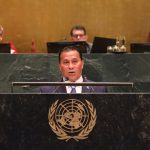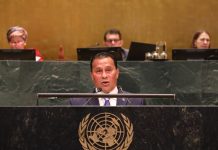

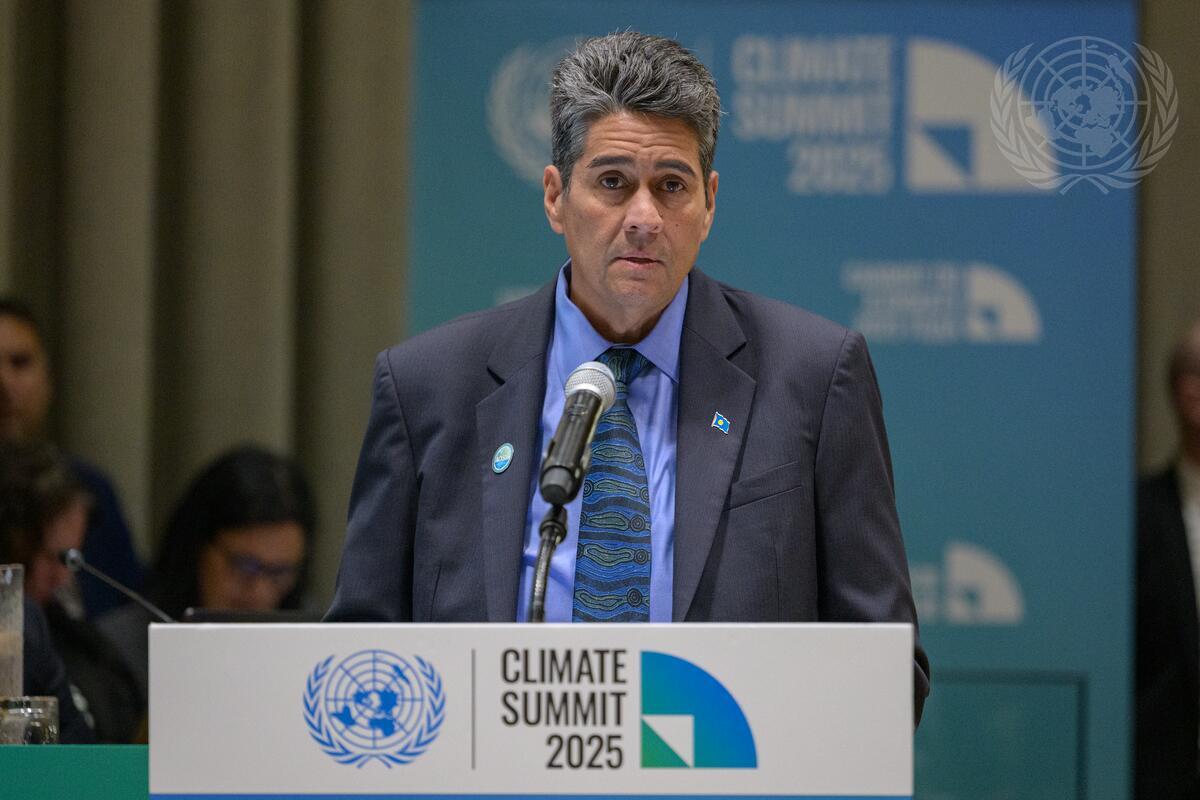
Palau President Surangel Whipps Jr has told the United Nations General Assembly(UNGA) that small island states are “at war” with climate change, warning that 1.5 degrees is now a binding global obligation and calling for urgent reforms to deliver justice, peace, and inclusion.
“The recent International Court of Justice Advisory Opinion affirms this truth, that our voice—though often overlooked—carries the weight of justice. We thank Vanuatu for their leadership, and recognise the Pacific youth who co-led this charge,” Whipps told world leaders gathered in New York last week.
The President warned that the 1.5 degrees Celsius limit is now a legal and moral imperative.
“The advisory opinion confirmed what we have always known: 1.5 degrees is not optional. It is now the benchmark for global action under international law. Let us defend this limit as the political, moral, and legal anchor of the Paris Agreement.”
Whipps painted a stark picture of the climate crisis hitting small island states.
“The world is at war. Defence spending is at an all-time high, approaching US$3 trillion annually! Small island states like Palau are also at war. Our shores are being invaded by seawater. Our homes are being blown away by storms. Our roads are being washed away by torrential rain. Our reefs are overheating. Our fish are disappearing. And our land is on fire. This is our daily battle.”
He called for immediate and ambitious climate commitments ahead of COP30 in Belem.
“We must see new Nationally Determined Contributions submitted particularly from major emitters, and they must be aligned with a 1.5 degree trajectory.”
Whipps praised Australia for its leadership on emissions reductions.
“We applaud Australia’s leadership in setting incredibly ambitious and achievable 2035 emissions reduction targets and developing clear strategies to reach its net-zero emissions pathway by 2050. Australia leads the way in supporting Pacific Island countries in accelerating the energy transition. This is a testament to the kind of leadership needed to defend and ensure a safe and prosperous future.”
He also stressed the need for climate finance.
“Ambition without implementation is an empty promise. For SIDS, the fight also depends on climate finance. Too often our countries are trapped in systems that are overly complex, slow and inaccessible. Finance must be predictable and adequate. It should not create new debt, freeing us to implement our NDCs, adapt to climate change impacts, and address loss and damage.”
Palau’s President highlighted the Pacific’s leadership on climate justice.
“Our region has served as the world’s moral compass on climate justice. We helped secure the 1.5°C goal in Paris. We pushed for the mechanism on loss and damage. If the world is serious about 1.5°C, we urge you to come to our region, to see with your own eyes what the Pacific is facing and be moved to act. That is why COP31 must be a Pacific COP: hosted by Australia – shaped in partnership with the Pacific islands.”
On ocean protection, Whipps urged caution on deep-sea mining.
“Deep-sea mining has been incorrectly promoted as a silver-bullet for the climate crisis. If we rush forward without understanding the consequences, we risk inflicting irreparable harm.
The loss of biodiversity, the release of carbon, damage to the water column, and the destruction of fisheries that sustain our people is unfathomable. At UNOC 3, 38 countries including Palau came together in support of a moratorium and our message is clear—we must let science guide us before we exploit the deep sea.”
He praised the historic BBNJ Agreement, which enters into force in January.
“While Palau is proud to be the first ratifier, we couldn’t have lit this fire alone. Like the Palauan proverb of the twigs — crossing the collective effort of over 60 countries demonstrates that we are better together. While we celebrate this achievement, we need even more nations to join this commitment to truly safeguard our ocean’s future.”
Whipps also emphasised the economic vulnerability of small island states and the need for inclusive multilateral financial systems.
“The stakes for SIDS could not be higher — our economies are small, our vulnerabilities acute, and our fiscal space painfully narrow. The Antigua and Barbuda Agenda for SIDS gives us a blueprint for resilient prosperity, but it cannot stand without tools. That is why the Sevilla Commitment matters: the world has finally recognised that the financial system cannot be fair if it measures only income and ignores vulnerability.”
On multilateral reform, he said, “Multilateralism is our only shield, yet too often SIDS are sidelined, blacklisted, cut off from finance, and boxed in by rules we did not write. We demand a seat not as bystanders, but as equal architects of our shared future. We call for the full and immediate integration of the Multidimensional Vulnerability Index (MVI) into the policies and frameworks of international financial institutions, multilateral development banks and international organisations. It is time we move the MVI from theory to practice.”
Whipps also urged for peace, inclusion, and shared responsibility.
“Palau knows too well the heavy cost of war, having endured the devastation of World War II on our islands. That history reminds us not only of the suffering left in the wake of conflict, but also of the sacred value of peace… As we face today’s greatest challenges — climate change, ocean decline, debt, inequality, wars and conflicts — no nation can solve these issues alone. But together, guided by the spirit of the UN’s founding and strengthened by 80 years of hard-learned lessons, we can turn the tide.
Let this Assembly be remembered not only for the words we speak, but for the actions we take — for the resilience we build, the justice we uphold, and the future we secure for generations yet to be born. We are better together,” he said.