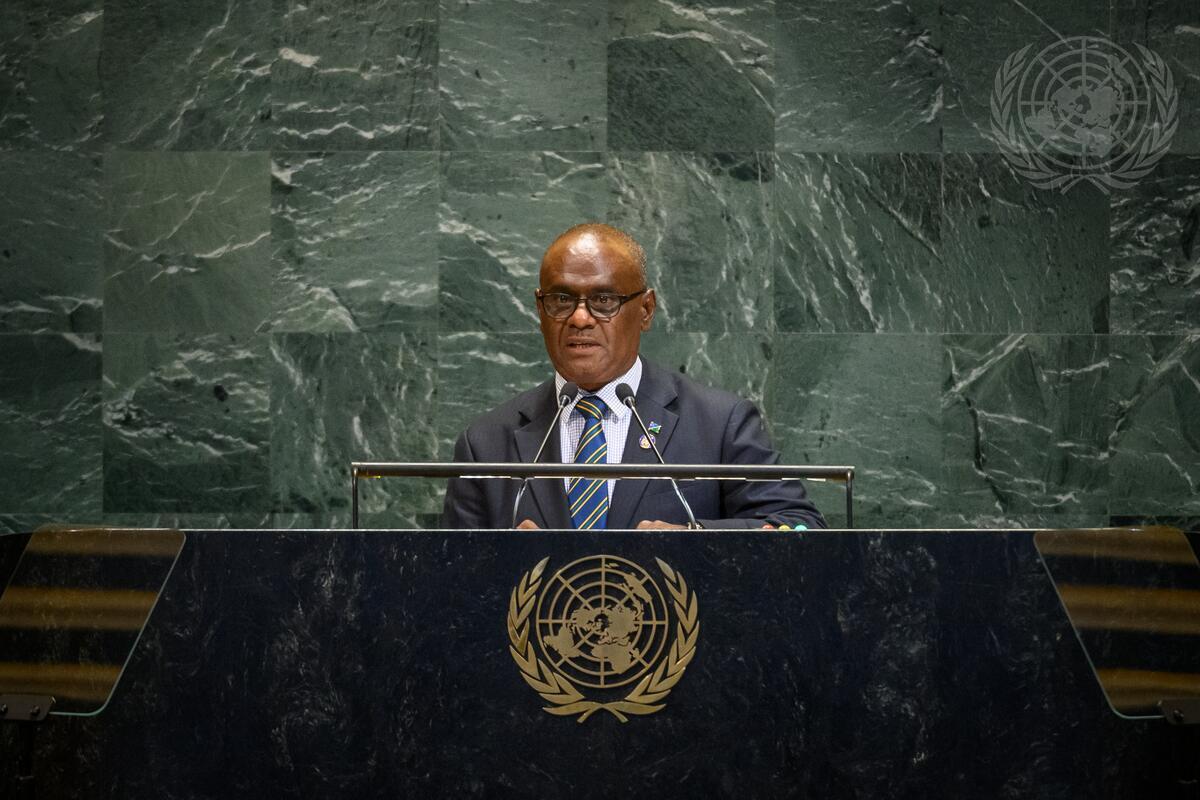
Solomon Islands Prime Minister and Forum Chair Jeremiah Manele has told world leaders at the 80th United Nations General Assembly(UNGA80) last week that the UN must be reformed to remain relevant, as he announced his country’s first-ever bid for a seat on the Security Council.
“Solomon Islands is seeking for the first time in 46 years a non-permanent seat in the UN Security Council for the period 2032-2033,” Manele said.
“We registered our interest eleven years ago, let me thank countries who have confirm support for our candidature over the years.”
Manele also called for urgent reform of the Council.
“We seek a more democratic, expanded Council that reflects today’s geopolitical realities. The use of the veto by the Council continues to undermine peace, international law and expose the vulnerable to harm. The veto must be eliminated as part of the reforms of the Council,” he said.
On peace and security, the Solomon Islands leader pledged his country’s support to UN missions.
“As a peace-loving country, Solomon Islands is keen contribute to UN peacekeeping missions this year,” he said.
Manele also pressed the UN to strengthen its presence in the Pacific and improve recruitment pathways.
“The time has come to review the UN regional architecture to ensure it remains connected to the members that need it most. Solomon Islands remains underrepresented within the UN staff establishment.
We call on the UN to consider convening in-country competitive recruitment exams in Solomon Islands,” he said.
Turning to nuclear issues, Manele drew attention to the Pacific’s long history of exposure to weapons testing and waste dumping.
“Solomon Islands reaffirms its strong commitment for the total elimination of nuclear weapons,” he said.
“This year the Pacific celebrates 40 years since the adoption of the South Pacific Nuclear Free Treaty. The Pacific has been used to test weapons, store nuclear waste and discharge treated nuclear water. We see the scars of nuclear impacts and will remain the world’s strongest advocates for a world free of nuclear weapons.”
He also highlighted the enduring threat of unexploded ordnance left from World War II.
“This is the cruel reality of a war we never chose, yet whose scars we continue to carry. Justice demands that those responsible accept their duty to help heal the wounds they left behind,” he said.
“It is only by standing better together in solidarity, with shared responsibility and compassion that we can finally close this painful chapter of history and build a safer, more just future for all peoples.”
On Gaza, Manele urged accountability and an immediate ceasefire.
“We must do more for peace, protect civilians—especially children and women—and hold those accountable for such action,” he said.
“Solomon Islands condemn Hamas attack on Israel and for all lives lost. We also call for the release of all remaining hostage and immediate cease fire in Gaza. This is critical for regional stability and global peace.”
Manele reaffirmed his country’s support for a two-state solution.
“We look forward to Palestine and Israel living side by side in peace along secured borders in accordance with international law, UN Resolutions and the UN Charter,” he said.
The Solomon Islands leader also highlighted the right to self-determination.
“Solomon Islands reaffirms the right to self-determination as enshrined in the UN Charter,” he said.
Manele warned that urgent reforms and collective action are vital for the UN’s survival.
“For small islands developing states like Solomon Islands, a strong multilateral system is not an ideal – but a necessity. It ensures that every nation has a voice. That power does not silence principle, and that cooperation, not coercion, guides our global affairs,” he said.
“As we commemorate 80 years of our United Nations, we must also recognise that this year 2025 marks the close of the first quarter and the dawn of the second quarter of this twenty first century. This is not only a milestone to celebrate, but also a moment to reflect on the path that we have collectively or individually taken, and looking into the future, the course we must now chart better together,” Manele said.
“What we do today, to secure peace, to drive sustainable development, and to uphold human rights, will set the path for the next twenty-five years. Come 2050, when future leaders gather in this Assembly, what will we present to them? Let it not be scars of missed opportunities, but a legacy of courage and cooperation,” he told the Assembly.