

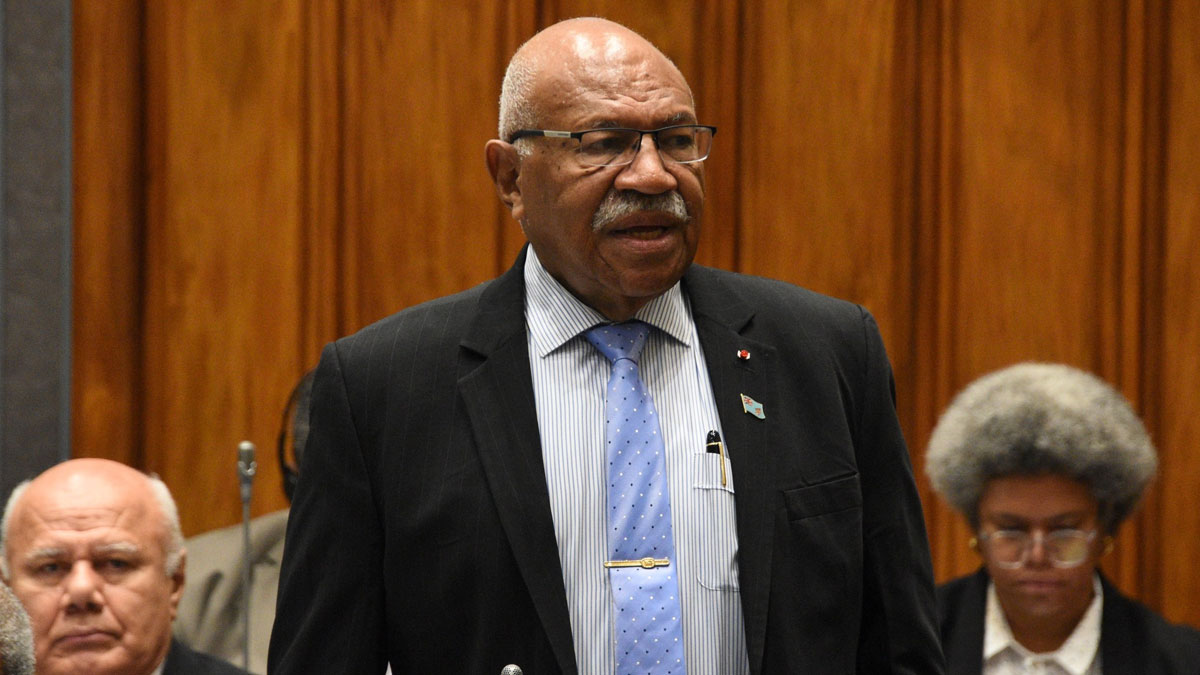
Fijian Prime Minister Sitiveni Rabuka Monday updated Parliament about the Memorandum of Understanding (MOU) on Development Cooperation between Fiji and Vanuatu, which was signed by him and the Prime Minister of Vanuatu, Jotham Napat, on 10 September 2025 during the Pacific Leaders’ Meeting in Honiara, Solomon Islands.
The MOU reaffirms the strong bonds of friendship and partnership between the two Melanesian nations.
The Prime Minister made these remarks in response to a question on the MOU that was raised by the Assistant Minister for Rural and Maritime Development Jovesa Vocea.
The MOU signifies a renewed commitment between the two nations, increasing the scope and depth of our bilateral cooperation in areas of mutual interest, thus reflecting our shared aspirations as Pacific Island countries and members of the Melanesian family.
Prime Minister Rabuka highlighted that the MOU increases cooperation in areas such as tourism, agriculture, customs, and public works disaster risk reduction, management, and humanitarian assistance, and labour mobility, volunteerism, sports, and infrastructure development.
“This MOU is not symbolic. It is a working document that sets the stage for practical, on-the-ground collaboration. The new MOU features the establishment of Senior Official-level Political Consultations to formulate a detailed implementation plan that would ensure better coordination, implementation, and monitoring of agreed initiatives.”
Prime Minister Rabuka further informed Parliament that the Agreement reinforces Fiji’s commitment to regional solidarity, which is consistent with the objectives of Fiji’s National Vision, the region’s Ocean of Peace Declaration and the 2050 Strategy for the Blue Pacific Continent.
“It is aligned with our foreign policy priorities of strengthening Pacific partnerships, promoting collective self-resilience and advancing sustainable development and efforts in climate change adaptation, economic development, and regional security,” he added.
In concluding, the Prime Minister highlighted that the MOU also reflects our response to current global challenges, including the ongoing climate crisis, economic volatility, and geopolitical shifts.
“It is through strengthened bilateral and regional cooperation that we can best navigate these complexities,” said PM Rabuka.