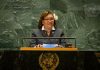
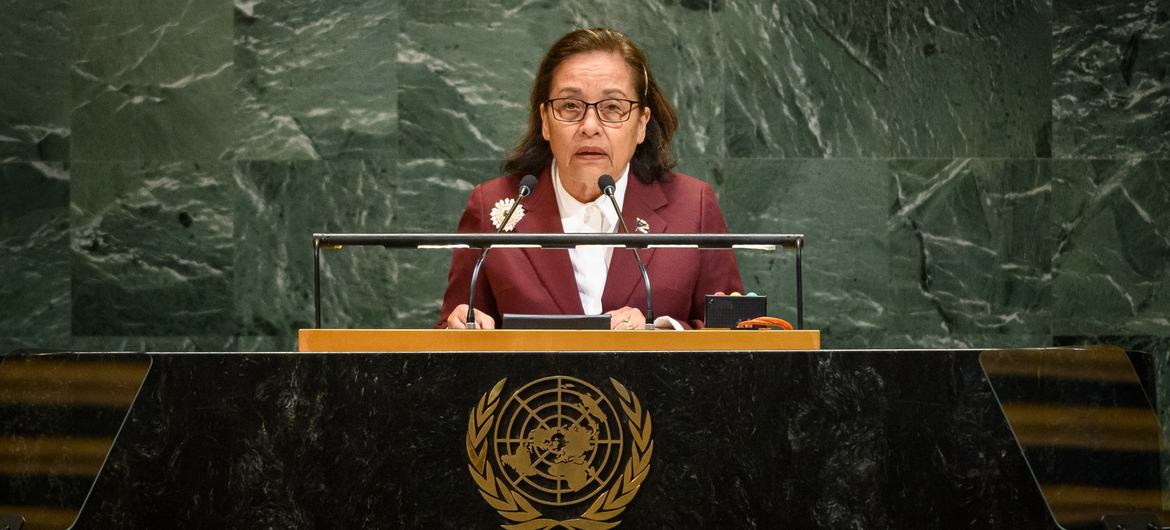
Marshall Islands President Dr Hilda Heine has told world leaders at the 80th UN General Assembly (UNGA80) that urgent global action is needed to confront climate change, rein in deep-sea mining, uphold ocean protections, and defend Taiwan’s rightful place in international forums.
“My low-lying atoll nation bears witness to the sharpest edge of climate change, which the Pacific Islands Forum Leaders have consistently defined as the region’s number one security threat,” President Heine said.
“The scale of impact – and the future of our youngest generations – depends on whether global powers are working together.
“If I could find a louder alarm for the Pacific Islands than my words today, I would sound it.
“There is still time for action, but only urgent action – at scale – can reduce vulnerability across all key sectors, and to strengthen the free and democratic nations which define our island region.
“We need the world to better understand that our security is linked to our fragility, cutting across key indicators. We worry our institutions will not easily withstand future threats – whether it if by rising seas or geopolitical competition,” President Heine told UNGA.
On climate action, she criticised the failure of major powers to meet their Paris Agreement obligations.
“The vast majority of countries are failing to meet their obligations. Promises don’t reclaim land in atoll nations like mine. They don’t develop mangrove defences, shore up our hospitals and schools against rising seas, or preserve cultures deeply tied to land that is slipping under waves. Those things require money.
“This year is the 10th Anniversary of the Paris Agreement, and the creation of the High Ambition Coalition, which helped deliver the Agreement’s 1.5°C warming limit. A decade on, we stand on the verge of that threshold,” she said.
She said the International Court of Justice (ICJ) has confirmed that international law demands action from all nations, whether signatories to the Paris Agreement or not.
“Its ruling was clear: there are binding obligations to prevent exactly the type of significant harm that we see today, and that will only worsen as temperatures rise. The vast majority of countries are failing to meet their obligations.
“The International Court of Justice has now stated that international law demands action and stringent due diligence from all – that there are binding obligations to prevent exactly the type of significant harm which we face. The ICJ also confirmed what the Pacific has always said: once established, our maritime zones are fixed, and that our statehood will persist, even as sea levels rise. Every country should have submitted its new climate target by February, so that by now we would have a clear picture of what we must do to keep 1.5°C alive.
“Only 15 countries, including the Marshall Islands, did so by February, and only 32 have done so now. These plans must set out how countries will end the reliance on fossil fuels that holds our future hostage, and replace them with the renewables that are better for our health, our economies, and our future,” she said.
Heine called for billions in new finance, particularly for adaptation and loss and damage.
“It is past time for the rich world to meet its obligations and get money to where it’s needed most,” she stressed.
“As we approach COP30, we need all nations to deliver on promises to respond to the climate catastrophe. We must close the trillion dollar climate finance gap, particularly for adaptation. We must deliver stronger plans which show how we’ll end fossil fuels and halve global emissions in this decade.
On oceans, she welcomed the upcoming entry into force of the Biodiversity Beyond National Jurisdiction (BBNJ) treaty but warned against the rush to exploit seabed resources.
“More political will is needed to break through a mentality of ‘drill first, ask later,’ before even assessing what is at stake, including the impacts on fisheries and marine food chains,” she said.
“The Marshall Islands welcomes this week’s achievement of entry into force of the Biodiversity Beyond National Jurisdiction agreement early next year, and looks forward building a robust early architecture”.
She reminded the UN that the Marshall Islands has already enacted a national ban on deep-sea mining permits.
“We have enacted our own national ban on deep seabed mining permits, and as we move to document and manage seamount biodiversity within our EEZ, to our immediate north, high seas mining exploration threatens to expand into exploitation. As important an opportunity as seabed mining may become, it cannot be at the irreversible expense of our Pacific waters and vast fisheries.
Heine also directly addressed the Taiwan issue, pushing back on Beijing’s use of UNGA Resolution 2758.
“UNGA Resolution 2758 has been repeatedly and falsely portrayed as consensus on a One China ‘UN law.’ Never has there been such gaslighting in this institution,” she said.
“These, and other politically influenced practices where Resolution 2758 is misrepresented, will never be justification under international law for military invasion or coercive acts against Taiwan.”
On nuclear legacies, Heine called on the UN to acknowledge its failure to protect the Marshallese people during 67 nuclear tests conducted between 1946 and 1958.
“The Marshall Islands has recently become a signatory to the Rarotonga South Pacific Nuclear Free Zone treaty, and we also look forward to completing timely ratification. It does not escape attention that the Trusteeship Council is due to meet this December.
“79 years after the first nuclear test was conducted in my country in 1946, the UN should now be capable of delivering a contemporary acknowledgment and apology for what took place in its name and under its flag, and for not hearing the voice of our people when we told this body to stop.
“Perhaps after 34 years since our admission as a member of this body in 1991, the appropriate UN organs can help to bring healing and closure over decisions which never should have been made.
“And while we acknowledge important actions by the former administering authority, the U.S, significant disagreement remains, including ultimate responsibility for what remains today. Our communities seek justice, a clean environment and safe return to their homes,” she said.
President Heine’s address made clear that for the Marshall Islands and the wider Pacific, survival depends on immediate global action.
“There is still time for action, but only urgent action — at scale — can reduce vulnerability across all key sectors, and to strengthen the free and democratic nations which define our island region,” said President Heine.