


By Pita Ligaiula in Honiara, Solomon Islands
Pacific Ocean Commissioner Dr Filimon Manoni has told leaders that securing maritime boundaries is essential for sovereignty, security, and the future of ocean management.
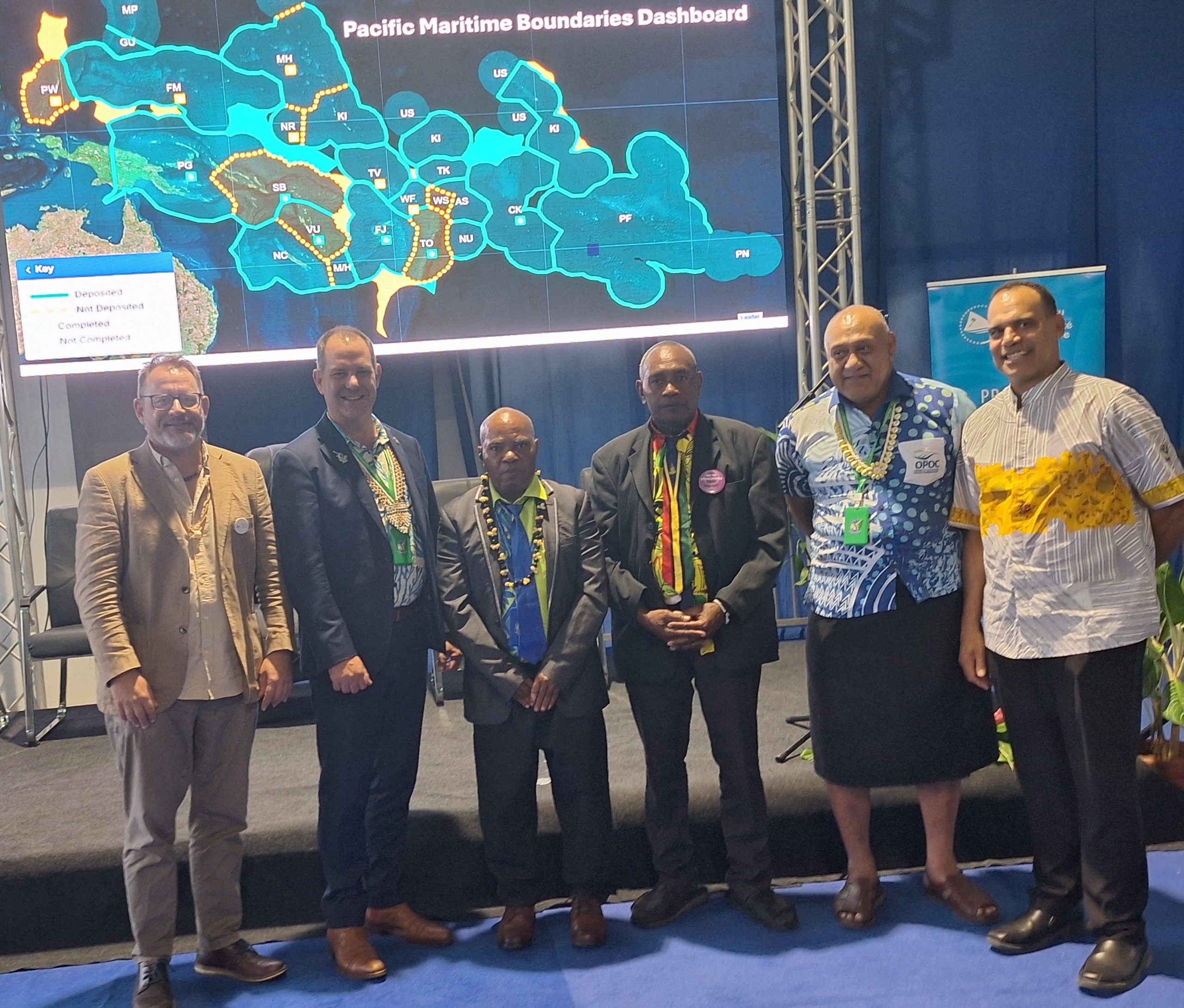
“I find it important to say a few words to the leaders on the importance of finally securing once and for all the limits of our Blue Pacific continent. Finalising boundaries anchors sovereignty. It provides certainty, security, and predictability in the enjoyment of our rights as coastal states under the Law of the Sea Convention,” Manoni said at a side event on finalising maritime boundaries and advancing 100 percent ocean management.
He stressed that the issue goes beyond legal or technical processes, with direct implications for fisheries, livelihoods, and regional stability.
“For fisheries, which are important to all of us, only with settled boundaries can we exercise our rights with certainty and predictability for enforcement and jurisdiction under the Law of the Sea,” he said.
Manoni welcomed the example set by the Temotu Province in Solomon Islands and Torba Province in Vanuatu, which have signed agreements to manage shared waters.
“Boundaries are not just lines on a chart. They are bridges and connections of leadership, linking communities through kinship and heritage. Culture and dialogue give life to treaties, and this is what we should strive for under the 2050 Strategy,” he said.
He noted progress across the region, with 75 percent of maritime boundaries already concluded, but warned that delays carry risks.
“Outstanding boundaries leave gaps that undermine security, erode resource management, and reduce resilience to climate change,” he said.
Manoni also linked boundary work to broader goals, including biodiversity protection, fisheries, and the new agreement on Biodiversity Beyond National Jurisdiction (BBNJ).
“Before you talk about biodiversity, you must first understand what you are protecting. If you have not marked out your boundaries, it is very difficult to manage your resources. That is why 100 percent ocean management is so critical,” he said.
On fisheries, Manoni praised Pacific leadership for ensuring all four major tuna stocks remain healthy.
He also pointed to the region’s early ratifications of the BBNJ Agreement as evidence of strong stewardship.
He cautioned against leaving the high seas unmanaged. “If we allow the high seas to remain the Wild West, all the good work we are doing in our EEZs will be undermined. There are no physical barriers in the ocean. What happens in one part affects the rest,” he said.
Turning to deep-sea mining, Manoni acknowledged its sensitivity but welcomed leaders’ decision to take charge of the debate.
“For the very first time in February this year, leaders convened a talanoa on deep-sea minerals. It is important that divergences here do not undermine the good work being done across the ocean sectors,” he said.
Looking ahead, Manoni urged leaders to close the remaining 25 percent of unsettled boundaries.
“When we gather in Palau next year, I look forward to seeing more boundary treaties signed and progress made in securing our Blue Pacific,” he said.