

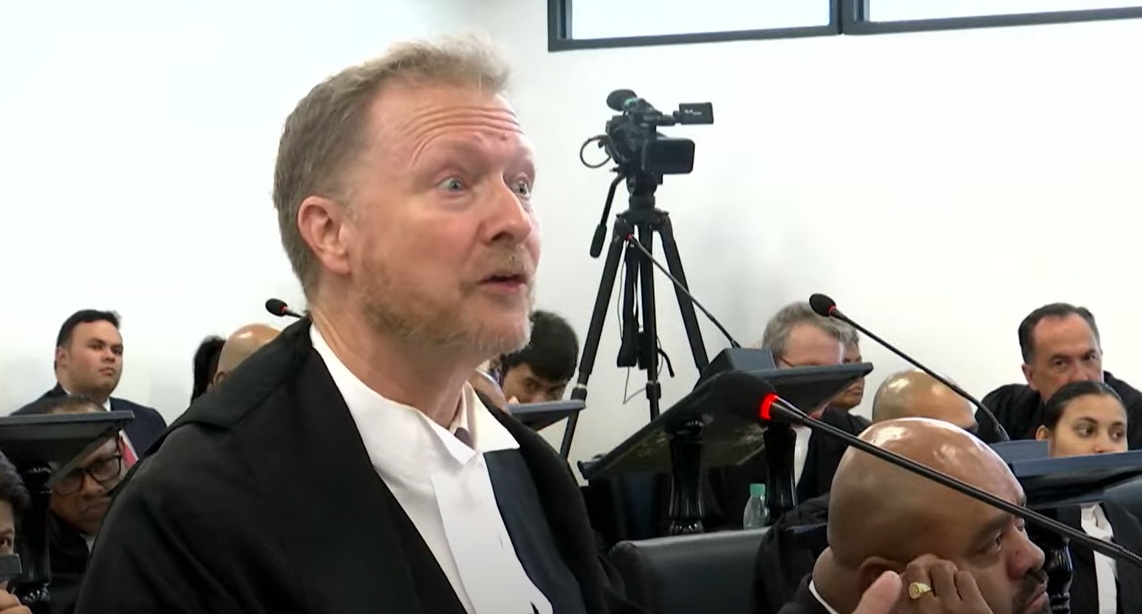
Constitutional expert and amicus curiae Andrew Butler has cautioned the Supreme Court Wednesday against adopting proposed interpretations of Fiji’s 2013 Constitution that would dilute the strength of its amendment provisions.
He warned that such approaches could undermine the legal and democratic integrity of the document.
Butler was responding to submissions by both State Counsel and the National Federation Party (NFP) during the constitutional reference hearing.
“Adopting the approach advocated by my friends seems contrary to the way in which a court should go about constitutional interpretation,” he said.
“The State is saying, interpret the Constitution to mean a simple majority of Parliament is sufficient to amend it. But don’t worry there are other steps we might take to protect the system, steps which no court can compel or enforce.”
Turning to the NFP’s alternative proposal that the current three-quarters majority plus referendum requirement be replaced with a two-thirds majority and no referendum, Butler said this would result in a weaker protection than Fiji’s previous constitutions.
“Earlier constitutions had bicameral two-thirds majorities and extra protections for specific constitutional features. What the NFP suggests is a regression.”
He also pointed out that the NFP’s position contradicts the findings of the Ghai Commission, which in 2012 recommended the establishment of a National People’s Assembly to involve citizens in the constitutional amendment process.
“The Ghai Commission made clear that not involving the people explicitly in constitutional amendment processes would not be desirable.”
He also challenged the NFP’s claim that referendums are neither part of Fiji’s constitutional tradition nor the Commonwealth norm, arguing that this position overstates the departure from regional and international democratic practices.
As the court weighs competing visions for constitutional reform and legitimacy, Butler’s submissions continue to stress the importance of preserving the rule of law, historical continuity, and genuine public involvement.
National Federation Party lawyer Jon Apted has urged the bench to consider what he termed the “blue pencil approach” in determining the validity of constitutional amendment provisions under the 2013 Constitution.
He submitted that while the Constitution as a whole may be recognised, the court has the authority to invalidate specific provisions that are inconsistent with fundamental democratic principles.
“Our principal submission is that the court can recognise the Constitution as a whole,” Apted said.
“But treat a provision as enacted as invalid, in light of the democratic principles guaranteed under Section 3.”
Apted submitted that if the court gives recognition to parts of the Constitution, it should apply principles derived from customary international law, especially democracy and self-determination.
“The court must balance rigidity with flexibility to meet the changing needs of the people.”
While Apted noted earlier reservations about the requirement of a referendum for constitutional change, he acknowledged that allowing a two-thirds parliamentary majority alone might be too weak a safeguard.
“We would accept, if the court so decides, a blue pencil rule that maintains the referendum, but with a simple majority, striking out the three-quarters requirement,” he concluded.
Meanwhile, Peoples Alliance Party lawyer Simione Valenitabua delivered a final submission before the Supreme Court today, again challenging the legitimacy of the 2013 Constitution and urging the court to restore the 1997 Constitution.
Speaking on behalf of his client, the governing People’s Alliance Party, Valenitabua said the Party leader is also the current Prime Minister.
Quoting a Fijian proverb, he asked the court, “will Your Lordships sit with your arms folded while the canoe sinks?”
“To choose an alternative remedy when the constitutional remedy under Section 91(5) was there to use, “would be to let the canoe of our state sink under the weight of an illegitimate constitution,” he said.
Valenitabua insisted that the appearance of cooperation with the 2013 Constitution was “for convenience,” and must not be misread as acceptance of its legitimacy.
“We come before you not to tinker with the rigging of a sinking ship, but to ask you to condemn the hull,” he argued.
“The hull itself needs to be condemned.”
He said Cabinet had followed the procedural path laid out in the 2013 Constitution, but argued that the entire document was void from inception.
He called on the court to perform its “deepest duty” and to restore the rule of law by reviving the 1997 Constitution, which he maintained had “never been lawfully abrogated.”
Valenitabua cited previous case law, including Fiji v Prasad and Fiji v Qarase, to support his position that the lawful supreme law remains the 1997 Constitution.
The constitutional reference hearing continues.