
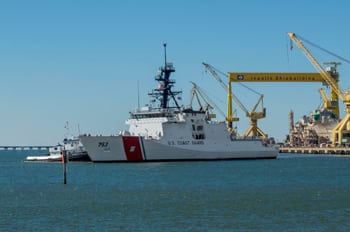
To help it meet President Trump’s directive for the U.S government to achieve operational control of the southern border, the acting Coast Guard Commandant said he changed plans for one of the service’s National Security Cutters (NSCs) to support operations in the Indo-Pacific in favour of border security duties.
The change in plans was done in consultation with U.S Indo-Pacific Commander Navy Admiral Samuel Paparo, Admiral Kevin Lunday told a House panel on Wednesday.
Lunday described the deployment as temporary and said “there’s been no change to our permanent presence in the Indo-Pacific.”
The Coast Guard operates a mix of cutters in the central and western Pacific regions, sometimes in support of U.S Indo-Pacific Command for freedom of navigation operations, but also working with island nations to help them with capacity building and maritime governance, and conducting its routine missions such as drug interdiction and fisheries patrols.
Lunday told the House Appropriations Homeland Security Subcommittee that he also redirected the NSC Calhoun from a schedule port visit in Iceland in support of the international Arctic Coast Guard Forum to the southern border operations. The planned Iceland visit “wasn’t an operational meeting,” he pointed out.
“Our highest priority is achieving full operational control of the border, and that includes our ports and waterways,” Lunday said in his opening remarks. “As the Coast Guard has done throughout our history, we adjusted our operational posture to focus on the top needs and priorities, while continuing to conduct our other missions with excellence.”
Overall, the Coast Guard tripled its forward deployed air and surface assets to the southern border and maritime approaches, he said. The service has also interdicted more cocaine at sea by mid-February than it had in all of fiscal year 2024.
The clampdown on illegal activity along the southern border is forcing drug and alien smugglers to use more sea routes and Lunday said there has been an increase in illegal activity accessing the San Diego area and even further north toward Los Angeles. All of this requires increase presence and capabilities, he said.
“And so, we do need increased and sustained top-line funding to be able to generate and sustain the assets, ships, cutters, boats and aircraft and sensors necessary to enable us to protect that maritime approach to the U.S border, off of California, off of Texas and the Gulf of America, and then off of Florida and U.S Virgin Islands and Puerto Rico,” Lunday said.
Lunday stressed that current Coast Guard operations are “not sustainable” given the service’s “severe readiness crisis that has been decades in the making.”
The Coast Guard stands to benefit from a Republican reconciliation bill that the House hopes to vote on soon that would give the service about US$22 billion over the next five years for recapitalisation and maintenance needs. The Trump administration still has to provide its fiscal year 2026 budget request to Congress, which is separate from the reconciliation bill.
Rep Mark Amodei (R-Nev.), chairman of the appropriations subcommittee, predicted that his panel would mark up the Department of Homeland Security’s FY ’26 budget request the second week of June. He also expects the bill to go to the House floor the same week.
It’s unclear when the administration will deliver the FY ’26 request to Congress. Rep. Lauren Underwood (D-Ill.), the ranking member on the subcommittee, said the budget is expected the first week of June.